 Wow! eBook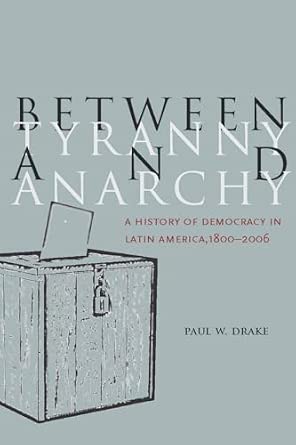
Between Tyranny and Anarchy: A History of Democracy in Latin America, 1800-2006
Author(s): Paul W. Drake (Author)
- Publisher: Stanford University Press
- Publication Date: 27 Feb. 2009
- Edition: New
- Language: English
- Print length: 344 pages
- ISBN-10: 0804760012
- ISBN-13: 9780804760010
Book Description
Editorial Reviews
Review
“[The book’s] careful consideration of the intricate, unexpected ways in which political, social, economic, ideological, and diplomatic factors play off each other in particular circumstances, enhancing or restricting the effects ‘institutional engineering’ offers valuable insights to those concerned with constructing substantive and meaningful versions of democracy in the region”–Erica Gbriela Pani Bano “
The America’s.““The book is well written and rich in detail, and is recommended especially for political scientists needing historical background on Latin America and/or interested in the political development of the region.”–A. Siaroff “
Choice. “About the Author
Excerpt. © Reprinted by permission. All rights reserved.
BETWEEN TYRANNY AND ANARCHY
A History of Democracy in Latin America, 1800-2006By PAUL W. DRAKE
STANFORD UNIVERSITY PRESS
Copyright © 2009 Board of Trustees of the Leland Stanford Junior University
All right reserved.
ISBN: 978-0-8047-6001-0
Contents
Preface………………………………………………………………………………………………….ixMap of Latin America………………………………………………………………………………………xiv1. The Theory and History of Latin American Democracy, 1800-2006……………………………………………….12. The Historical Evolution of Latin American Democratic Institutions, 1800-2006…………………………………233. The Bolivarian Legacy: Struggles Toward Democracy During the Wars for Independence, 1800s-1820s…………………524. The Archaeology of Democracy After Independence, 1820s-1870s………………………………………………..885. Oligarchic Republicanism, 1880s-1920s…………………………………………………………………….1266. Populist Democracy, 1930s-1970s………………………………………………………………………….1637. The Tsunami of Neoliberal Democracies, 1970s-2000s…………………………………………………………2018. Two Centuries of Building Democracy in Latin America, 1800-2006……………………………………………..244Notes……………………………………………………………………………………………………249Index……………………………………………………………………………………………………317
Chapter One
The Theory and History of Latin American Democracy, 1800-2006
The title of this book comes, appropriately, from Simon Bolvar. In the opening decades of the nineteenth century, the Liberator expressed his exasperation at forging a democratic republic that could withstand the opposing dangers of “tyranny and anarchy.” Ever since then, his descendants have grappled with the classic dilemma of crafting a democracy that provides order without dictatorship, and liberty without disintegration.
Juxtaposed to its venerable fame as a home for despotism, Latin America also boasts one of the planet’s longest, deepest, and richest histories of experiments with democracy. Along with the United States, the region hosts “the oldest continuous republics of the contemporary world.” Occupying a unique niche between the West and the developing world, Latin America offers an extraordinary laboratory for examining democratic movements, ideas, and institutions. “In no other part of the world have more persistent efforts been made to preserve freedom under such unfavorable circumstances.”
Amidst a history dominated by dictators, Latin America’s struggle for democracy-like its battles for economic development, social justice, and human rights-was a protracted, erratic, and painful process. From the beginning in the nineteenth century, they sowed seeds that took a long time to sprout, let alone flourish. In the long view, these flawed (and often futile) attempts to instill democratic values and rules bore fruit. Their early themes, concepts, practices, and institutions continue to shape the successes and failures of democracy in the region even into the present day.
In spite of all their shortcomings, the attempts at democracy that had their start in the nineteenth century should not be underestimated. Explicitly or implicitly, observers inside and outside the region have too often denigrated these episodes because of the plethora of authoritarian regimes. This study unearths a more positive picture without slighting the severe deficiencies. Contrary to conventional wisdom, the countries leading the region in making democratic advances did not lag very far behind the United States and Western Europe. Latin America’s continuing battles to establish and improve democracy have resembled similar problems confronted in both richer and poorer nations alike.
In comparison with the United States and Western Europe, Latin America’s democratic history has been distinctive because of its fundamental dilemma: how to reconcile political systems that are theoretically committed to legal equality with societies that are divided by extreme socioeconomic inequalities. Too often, the polarized distribution of social power undermined the efficacy of democratic institutions. For two centuries, the Latin American upper classes repeatedly resorted to tyranny out of dread that the lower classes would unleash anarchy-or worse, revolution. Between the alternatives of dictatorship or disorder, Latin Americans developed two special variants of democracy to cope with their exceptionally unequal societies-one through exclusion and the other through inclusion.
These competing models of protected versus popular democracy stressed the content and outcome of democracy more than the intrinsic value of the institutional procedures revered in Western Europe and the United States. In Latin America, many elites preferred protected democracies, with strict formal and informal limits on participation and programs for the unprivileged majority. By contrast, many reformers advocated popular democracies, with an emphasis on a massive role for the working classes in selecting governments and deriving benefits from them. This book traces the trajectory of these contested visions of democracy from the 1800s to the 2000s.
To assess that evolution, this book asks when, where, and why has democracy existed and lasted in Latin America? What have been the concepts, types, rules, regulations, institutions, and limits of those systems? And what have been their triumphs and tragedies?
Without a thorough examination of the historical causes, most existing general theories of democracy can not adequately explain its failures, successes, and forms in Latin America. Whether one assesses the international, economic, social, cultural, or institutional determinants of the existence and quality of democracy, the historical context conditioned their regional and national impact. Historical factors largely accounted for Latin America’s earliest struggles for democracy and cast a distinctive mold that has shaped its democracies ever since.
To provide historical background for the current issues in political science, this study pays special attention to the new institutionalism. This book agrees with that school of thought that democratic institutions made a difference-even in inhospitable settings, and even when governments turned them into a farce. Whether fully enforceable or not, ancient Latin American constitutions and laws established norms and practices, precedents and beliefs, hopes and expectations. Even when democratic institutions were woefully defective, they still operated in significant ways and laid the groundwork for the future.
From the 1810s to the 2000s, Latin American political institutions exhibited unstable and often unenforceable constitutions, extreme centralism, hyper-presidentialism, legislative Lilliputians, conservative and ineffective judiciaries, explosive elections, and ephemeral political parties. For all these features, varying institutional designs could facilitate the probability and performance of some democracies. However, since the basic institutions remained much the same for two centuries in nearly all the countries in Latin America, it is improbable that they accounted for big variations in democratic outcomes over time and place.
Despite their significance, institutions by themselves can not fully explain the arrival, survival, or depth of democracy in Latin America. The challenge for proponents of democracy consisted not only in writing the correct laws but also in exerting the power or persuasion to get the crucial social actors to obey them. The exceptionally unequal distribution of social power made it very difficult for those institutions to elicit compliance and function properly. Their success usually depended heavily on structural and historical conditions, as well as elite consensus in favor of some form of democracy.
Among these institutions, elections were the most important. They constituted the essential, if not sufficient, condition for creating democracy. In Latin America, democracy unfolded as a protracted history of making the government actually allow, reflect, and represent widespread citizen preferences as expressed in electoral outcomes. Even when corrupted and violated, the amazingly ubiquitous elections from the 1800s to the 2000s were fiercely contested, sometimes surprisingly open to mass participation, and crucial for legitimating governments. They proved vital to the gradual inculcation and institutionalization of democracy.
DEFINITIONS OF DEMOCRACY
In this study, the term democracy refers narrowly to the prevailing procedures of electoral political competition. This book basically uses a binary, minimalist definition of democratic versus authoritarian political systems. It is necessary to establish this dichotomy before analyzing the virtues and defects of any subtypes.
This classification scheme is relative in three senses. First, it employs the standards appropriate to and prevalent in particular eras, since democratic expectations escalated from the early nineteenth to the late twentieth centuries. Second, for any one time period, the governments labeled as democracies might not meet some absolute or maximalist criteria. However, they were generally more freely elected, representative, constitutional, and civilian-based than those dubbed dictatorial, which were more imposed, authoritarian, arbitrary, and military-dominated. Third, movement from one broad regime type to the other indicated that a government became relatively but significantly more democratic or despotic than its predecessor. Across time and space, there were many close calls and mixed breeds.
This book’s definition of democracy emphasizes institutions. To qualify as a democracy, a political system had to select its key leaders through regular elections that were reasonably participatory, free, and fair, by the standards of the era. It also had to respect enough civil liberties to carry out these procedures. One country could be more democratic-allowing broader suffrage, holding more honest elections, and protecting more civil liberties-than another, but they both could be classified as minimally democratic in contrast with blatantly dictatorial alternatives.
Some scholars also mention other requisites for democratic systems, such as the rule of law, government accountability, civilian control over the military, and even some minimal degree of social and economic equality. These indicators, however, were difficult to measure, established too high a barrier to entry, and, while important to the quality of democracy, were not necessary to distinguish broadly democratic from non-democratic political systems. Latin America should not be held to higher standards than other regimes in the same time period.
At least three types of regimes in Latin America met enough of the criteria for democracies to demarcate them from the authoritarian species. First, in the nineteenth and early twentieth centuries, constitutional or liberal oligarchies or republics held regular elections (but with very limited participation), excluded some key issues and agencies from public control, and limited civil liberties significantly.
Second, in the twentieth century, “restricted democracies” provided more open government on all dimensions than did aristocratic republics-but they did not deliver as much participation, liberty, or accountability as did “full democracies.” In contrast with authoritarianism or oligarchic republicanism, even restricted democracies tended to curb or eliminate property or tax qualifications for voting, enfranchise a majority of literate adult males (resulting in at least 5% of the population casting ballots), hold regular and direct popular elections for the executive and/or legislature, respect the electoral results, respond to elected officials, and defend basic civil liberties. They still were prone to ban certain parties and to succumb to frequent military interventions.
Third, in order to rise (increasingly in the twentieth century, particularly from the 1970s onward) to the level of “full democracies,” these governing systems had to also establish universal male suffrage (and eventually include females and younger people), ensure totally secret and free and fair elections, protect more civil liberties, and respond more fully to the wishes of voters. In many parts of the world, countries generally progressed from types one to two to three, though with many breakdowns and reversions along the way.
Table 1.1 shows the evolution in Latin America, listing countries according to their first experience of reasonably stable (though not necessarily uninterrupted) democracy that dominated an era. Minor and short-term regimes have been omitted. While there is room to quarrel with some of these precise dates, the placement of a regime in an era is widely accepted by most scholars. For different authors, the dates chosen for this table could refer to when a regime was constitutionalized, installed, or really took effect as a republic. For example, Argentina’s oligarchic republic could be dated from the constitution of 1853, the taking of power in 1862, or the national institutionalization in 1880. At the same time, Costa Rica could be entered with the passage of the constitution of 1871, or the electoral stabilization in 1889. Since the best choice is usually a combination of constitutionalism and effective rule, this table places Argentina in 1862, and Costa Rica in 1889. The most unreliable and debatable dates are for the beginning of the oligarchic republics in the nineteenth century, both because of a more turbulent history and a less extensive scholarship prior to the 1930s. Many disputes continue about the more recent full democracies, which are categorized here mainly by institutional criteria-not by the more idealized indicators of performance and quality.
CAUSES OF DEMOCRACY
International Factors Since democratic trends among countries outside and inside Latin America constituted international events, they must have had international causes (unless they were pure coincidences). The first modern wave of international democratization occurred from the 1820s to the 1920s, followed by a reverse flow from the 1920s to the 1940s. The second democratic surge swept through from the 1940s to the 1960s, succeeded by a rollback from the late 1950s to the mid-1970s. Then the third global overflow of democracy cascaded from the mid-1970s to the 2000s, without ebbing back so far. In very broad terms, Latin America participated increasingly in these inundations.
Prior to these flood tides, no Western nations qualified as democratic in 1750. Then the American and French revolutions unleashed the first democratic outpouring. The rough criteria for this period were that half the adult males were eligible to vote and that the chief executive was elected periodically. Following the wars of independence, a few Latin American countries met or came close to this standard from time to time. However, they were especially prone to illegal behavior and regime collapse.
After erasing property qualifications and instituting universal male suffrage, the United States came on board in 1828, although excluding slaves. By the 1920s, over thirty countries had reached the same stage, usually including voting by secret ballot. The most prominent were several European nations (most significantly Great Britain, France, Switzerland, Italy, and Ireland) and Argentina, although Costa Rica, Chile, and Uruguay also fit the criteria except for the size of the electorate.
After the tide went out during the 1920s and 1930s, the second forward wave washed ashore briefly from World War II to the 1960s. The beneficiaries included West Germany, Italy, Austria, Japan, South Korea, Turkey, and Greece, as well as several Latin American countries, at least temporarily: Guatemala, Brazil, Argentina, Costa Rica, Ecuador, Bolivia, Peru, Colombia, Venezuela, and the Dominican Republic. The Latin American cases were still subject to frequent deviations and breakdowns. Decolonization in Asia and Africa also produced a few shaky democracies.
Thereafter, the second global authoritarian riptide inundated Latin America. By the mid-1970s, one-third of the thirty-two democracies that had been alive in the world in 1958 had died. Whereas nine democracies had flourished in South America in 1960, only those in Colombia and Venezuela survived by the end of 1973.
In the third democratic flood beginning in the mid-1970s, over 30 democracies supplanted dictatorships in Europe, Asia, and Latin America. The tsunami even swept away communist regimes in Europe. Rising higher than ever before, that tidal wave lifted approximately sixty countries, or almost half the nations in the world, to democratic status. Only about half that number had been democratic at the previous peak in 1922, but they had also accounted for over 45 percent of the states in the world at that time.
In this long view of history, diffusion was a powerful instigator of democracy, both from outside Latin America and within Latin America. Huntington wrote, “New democracies are thus less the result of cumulative, necessary, predictable, and systematic developments than of historical busts and booms, global opinion climates, shifting opportunities, and contingent preferences.” As evidenced by regional reactions to these international currents, external forces provided crucial impetus for regime changes and democratization in Latin America. At times, currents from overseas furthered democratization in Latin America, which then spread from one country to another. Over two centuries, that contagion enveloped more and more countries. Those foreign factors included strategic, economic, and intellectual impulses, whether arriving as events, trends, influences, or policies. They exerted the most impact when they dovetailed with the preferences of domestic winning political groups.
(Continues…)
Excerpted from BETWEEN TYRANNY AND ANARCHYby PAUL W. DRAKE Copyright © 2009 by Board of Trustees of the Leland Stanford Junior University. Excerpted by permission.
All rights reserved. No part of this excerpt may be reproduced or reprinted without permission in writing from the publisher.
Excerpts are provided by Dial-A-Book Inc. solely for the personal use of visitors to this web site.


