 Wow! eBook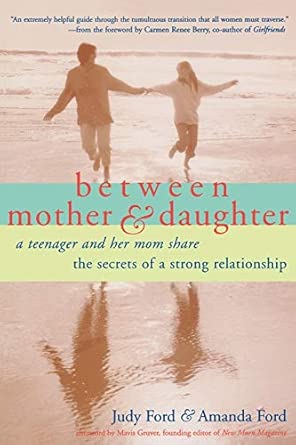
Between Mother and Daughter: A Teenager and Her Mom Share the Secrets of a Strong Relationship
Author(s): Judy Ford (Author), Amanda Ford (Author)
- Publisher: Conari Press
- Publication Date: 19 Aug. 1999
- Language: English
- Print length: 275 pages
- ISBN-10: 9781573241649
- ISBN-13: 1573241644
Book Description
Written by family therapist and bestselling author Judy Ford and her nineteen-year-old daughter Amanda, Between Mother & Daughter is geared toward both mothers and teenage girls who want to maintain or create healthy relationships during the tumultuous teen years. This book is proof of the benefit of positive parenting to empower mothers and daughters.
Editorial Reviews
About the Author
With over half a million copies of her books in print, Judy Ford, M.S.W. is the bestselling author of Conari’s Wonderful Ways books, which include Wonderful Ways to Love a Teen, Wonderful Ways to Love a Child, Wonderful Ways to Be a Family, Wonderful Ways to Love a Grandchild, and Wonderful Ways to Be a Stepparent. Coauthor with her daughter Amanda of Between Mother & Daughter, she lives in Washington state.
Excerpt. © Reprinted by permission. All rights reserved.
between mother & daughter
A teenager and her mom share the secrets of a strong relationship
By Judy Ford, Amanda Ford
Red Wheel/Weiser, LLC
Copyright © 1999 Judy Ford and Amanda Ford
All rights reserved.
ISBN: 978-1-57324-164-9
Contents
Foreword by Carmen Renee BerryTwo Voices—Two ViewpointsPART 1 Staying Connected1. Roots to Support Her and Wings to Fly2. Your Evolving Relationship3. Responsible Freedom and Positive Limits4. Talking about Difficult Subjects5. Healing Your Relationship6. Trust Is Where It’s At!7. Courage, Brains, and Heart8. Avoiding Guilt Trips9. Escaping HumdrumPART 2 Rolling with the Punches10. Quarreling11. Driving and Other Rites of Passage12. Clothes and Costumes13. Body Piercing, Tattoos, and Other Desires for Adventure14. I’ve Got Legs! Body Image and Eating Disorders15. Bring on the Boys16. Getting High17. Privacy, Solitude, and Space18. Mom Embarrassment: How Could She Do That!19. Role Reversal20. The Blues: Daughter’s Down DaysPART 3 Flying into the Future21. Finding Your Passion22. Legacy of Love23. A New Spin on an Old StruggleAfterword by Mavis GruverResource GuideAcknowledgments
CHAPTER 1
Roots to Support Her and Wings to Fly
But I’m Her Mother!
“Your daughter is in critical condition,” Dr. Stewart said. “She’ll betransported to Children’s Hospital as soon as the neo-natal emergency teamarrives.”
“Why? What’s wrong?” I asked, still whirling from the emergency C-section I’djust undergone.
“Meconium aspiration syndrome,” he said. “She needs to be on a respirator.”
“Can I see her?” I pleaded.
Covered from head to toe in sticky, greenish goo, weighing 5 pounds 14 ounces,Amanda was, I could see, the most beautiful and smartest baby. Although herbreathing was labored, her spunk and determination were strong. Tiny, tired, andsick, and only 19 inches long, she was magnificent. With a twinkle in her eyeand a sparkling personality, she had an enormous spirit. Instantly I wanted toget to know her, comfort her, kiss her, whisper in her ear, make it all better,but there wasn’t time. The special-equipped ambulance was waiting. There wasnothing for me to do, the nurse said, except to recover my strength.
“But I’m her mother,” I pleaded, as if that fact alone was enough to shield herfrom the uncertainty ahead. As they rolled her away in the life-savingincubator, I gasped. It didn’t seem fair that I was unable to protect my darlingbaby girl. No one could ease the agony of this premature separation. However,this episode taught me an enormous lesson about the relationship I would developwith my daughter—ultimately Amanda’s life was out of my hands. I shivered as itslowly dawned on me how many challenges she’d face in her life that I couldn’tcontrol.
Immediately after her birth, I was thrown into the seemingly contradictory taskof caring intensely while graciously letting go. In order for her to receive thebest medical attention, I signed the permission slip for her to be transportedacross town without me. Only one hour old, Amanda was already a separateindividual with a will and destiny of her own. Little did I know how many timesover the next nineteen years I’d encounter that fact.
Mothering is a mysterious task. First you create an intimate, all-consumingattachment with your daughter, then you spend the rest of your life learning tolet her go. Providing food, love, and shelter, you are your daughter’s life-source.Although she is a separate person from you, as a baby, your daughter isso thoroughly dependent on you that she is a part of you. As your daughter growsolder, this intense closeness lessens and takes on a more subtle dimension. Shestill depends on you, but not in the same way. Navigating this gradual releasewhile still remaining connected can be difficult, particularly as she reachesher teen years. That’s when conflict between you may be intense and when mothers(and daughters too) bemoan the lack of connection.
At first you take care of your daughter’s every need, but gradually this shiftsas she grows up. First you carry her in a backpack; soon she’s walking on herown. Abruptly, during the teen years, it seems as if she doesn’t need you at allany more. You’re no longer your daughter’s life source as she pushes for moreindependence. Painful as it is to go through, that’s the way it’s meant to be.It’s your sacred duty to give your daughter roots to support her and wings tofly.
Parents can only give good advice or put them on the right pathS, but fhe finalforming of a person’s character lies in their own hands.
—Anne Frank
This is much easier to do when she’s four years old and she only wants to climbthe ladder and go down the slide by herself while you “sit over there.” It’sharder when she wants to stay out past midnight or doesn’t think you need tomeet her date’s parents. It’s much easier to keep your relationship thrivingwhen at eight she writes you notes and says how much she loves you than whenshe’s thirteen, rolling her eyes and sighing at every comment you make. When shewas a little girl, she wanted you to read her bedtime stories; now she insistsyou knock before entering her room. Once she told you everything, now shedoesn’t say a word. Sometimes it seems that she doesn’t want you in her life atall, that she doesn’t need you any more.
When your daughter reaches adolescence, you may miss your sweet little girl withthe sunny disposition. It’s not because you don’t want your daughter to grow up,but because there are days, even months, when you wonder if you will ever have aharmonious connection again. All mothers desire to have a strong relationshipwith their daughters, but when our daughters begin to pull away and are talkingback or pouting, it is hard for us to tell if that is what they want as well.
There is nothing more thrilling in this world than to have a child that isyours, and yet is mysteriously a stranger.
—Agatha Christie
Be assured that your adolescent daughter needs you as much as she always has,but in a new way. She’s growing up and cannot tolerate being treated like achild. What worked at ten is antiquated only two years later. Unfortunately manymothers and daughters get stuck in a vicious circle, reacting in the same oldway to one another. Their minds are closed, they’re stuck in a rut. It doesn’thave to be that way—the teen years are full of glorious opportunities to get toknow each other better and have more heart-to-heart connection.
I wish every mother and daughter could look each other in the eye and honestlysay, “I like you.” Getting your daughter to love you is not a triumph, becauseevery girl loves her mother. You know that you have really succeeded when youradolescent daughter tells her friends that she really likes you. It is not oftenthat an adolescent girl chooses to spend time with her mother or openly sharesdetails of her day. These things come with the respect, openness, and trust thatare formed in friendship, not in a relationship where the mother is solely incharge.
As a mother who has a delightful relationship with her teenage daughter and as acounselor to thousands of other mothers, let me reassure you that you too canhave a fulfilling connection—as long as you’re willing to grow, learn, andexperiment.
The Little Cirl in the Photo Album
Several times during my teenage years, my mother would get nostalgic and drag meon a trip down memory lane with her. Sitting on the couch with dozens of oldpicture albums and scrapbooks, she would flip through pages filled with photos,drawings, and letters, hoping that I would soon join her in the joys ofreminiscing.
“Look at this one,” she would say, handing me a drawing of two people, bothwithout bodies and with arms coming out of their heads where their ears shouldbe. “It’s me and you playing ball,” she would say. “Don’t you remember? You drewit for me.”
“No, I don’t remember at all.”
She would continue by pulling out piles of old papers. “Let me read you these.”I never found the notes that read, “I love you, Mom” or “Mom, you are the best”particularly profound or moving, but as my mother read, her eyes would light upwith excitement and joy.
“Remember when you used to write me all these cute little notes?” she would ask.
“Mom, I was like five years old,” I would say, a bit irritated by her question.”Do you really expect me to remember?”
She always chose to ignore these statements and would continue. “Oh, look at youthere!” my mother would say, pointing out a little girl who was dressed up in aCookie Monster costume. “You were so adorable!”
The bright-eyed, blonde child in those pictures was a stranger to me. I didn’tknow her. I never quite understood why my mother would show me all of those oldphotos and letters. It was as if she hoped they would strike some chord withinme and bring me to remember something that I had obviously forgotten.
For my mother, there was sentimental value attached to every item in thosebooks, but it was different for me. Looking at pictures of me as a child broughtjoy to my mother’s heart; for me, it merely brought back a few blurry snapshotsof a life I used to live. It was real to her, yet so obscure to me. Treasuringthe days when I insisted on following her wherever she went and wrote her notesprofessing my desire to be just like her when I grew up, my mother remembersbeing the center of my world. However, I don’t remember what it felt like to bethat child in those pictures. I don’t remember worshipping her as she swears Ionce did.
My memories of relating to my mother go back only as far as the seventh grade;for me, that is when our relationship began. I can clearly remember theexcitement that filled me when she dropped me off at my first junior high danceand my irritation at her when she made me get off the phone at 9 P.M. on schoolnights. For me, my adolescent years, not my childhood, make up the foundation ofour relationship.
I know from my own experiences and from talking with dozens of other girls that,once they become teenagers, many girls get frustrated with their mothers.Complaining that their mothers don’t understand them, that they are too strict,that they don’t trust them, and that they are embarrassing, most teenage girlshave seemingly endless lists of things that bug them about their mothers. Weoften blame our mothers for all the difficulties in our relationship, saying,”If she would only do this differently, we would get along better.” Putting mostof the responsibility on our mothers’ shoulders, we expect them to change sothat the relationship moves in a positive direction. However, if you want tohave a good relationship with your mother, you must be willing to do your part.Believe it or not, you have the ability to make a positive change in yourrelationship with your mother.
Just because you and your mother have disagreements and don’t ever seem to getalong doesn’t mean that there is no hope for a good relationship. First, ithelps to realize that all girls have difficulties in their relationships withtheir mothers, particularly during the teen years. My mother and I are notperfect. We fight and argue, we disagree and have struggles just like everyother teenage girl and her mother. However, we have worked hard to learn how todeal with our problems and to create a relationship that is fulfilling for usboth.
Family life is a training ground. Learn to get along at home and you can getalong everywhere.
—Harriet Ruchlin
I wrote this book to give other teenage girls insight into my relationship withmy mother and a chance to learn from the things that I did right, as well as mymistakes. I don’t pretend to be the perfect daughter or claim know all the”secrets” to getting along with your mother. I can be a brat, and at times I’vebeen difficult. I’ve picked fights with Mom; I’ve gone behind her back and donethings that she specifically told me not to do; I’ve told her, “I had a greatday at school today,” when, really, I had skipped all my classes and spent theday with my friends at the mall.
So, you see, I am not perfect and I know what it’s like to be a teenage girlwho’s struggling to get along with her mother. I don’t have all the solutions toproblems that you may have, but I do have insight. I am nineteen now and incollege. Away from home, I can look back on our relationship in a new light. Ican understand what mistakes I made when relating to my mother, I know whatthings worked for us and what things didn’t work. I can look back and say,”Here’s what I could have done differently.”
After reading Between Mother and Daughter, I hope your feelings of desperationand hopelessness disappear. I hope you will have learned how to teach yourmother how to relate to you as the young woman you now are, not as the littlegirl in the photo album you once were.
CHAPTER 2
Your Evolving Relationship
Drive Me to the Mall, Please
“You can drop me off up there,” I said, pointing to the corner ahead of us.”But, honey, that’s two blocks away from the mall,” Mom replied, surprised thatI wanted to be let out of the car so far from my destination. “Don’t you want meto drop you off closer?”
“No, thanks. I’ll just walk.”
“It’s not a problem,” she replied. “Where are you meeting Jamie? I’ll just dropyou off there. You know, I really don’t like you walking all that way alone.”
“Mother, I’m thirteen. I think I can walk a few blocks by myself!” I crossed myfingers, hoping that she would let me out at the corner and wouldn’t insist ondriving me all the way to the mall. “I want to walk. You don’t need to take methe whole way.”
My mother looked at me and sighed. She was obviously frustrated, but she pulledover to the corner anyway.
“Can I have some money?” I asked. “After we’re finished at the mall, Jamie and Iare going to take the bus to see a movie.”
“I have an idea,” my mother said, her eyes lighting up. “I have some shopping Ican do at the mall. I’ll go and do mine while you girls do yours, then we canmeet up and I’ll take you both to the movie and out to dinner.”
“No thanks, Mom. We wanna take the bus.” I could tell she was disappointed, butdid she honestly believe I would want to go to the movies with her? I see herevery day; why doesn’t she understand that I just want to be with my friends?
Reaching for her purse, Mom took a deep breath. “You know,” she said, “when youwere little, you loved to hang out with your mother. You always wanted to bewith me. I couldn’t even go to the mailbox without you wanting to tag along.”
Rolling my eyes, I responded, “I’m not little anymore.”
She grabbed a twenty-dollar bill from her purse and handed it to me. Then shesaid, “At least we know you still need me for some things. How would you get tothe mall if you didn’t have your mother? And where would you get money?”
“I’d take the bus and I’d get a job,” I said matter-of-factly. Then jumping outof the car, I said, “Thanks, Mom. I’ll see you later.” I began my two-block walkto the mall.
She’s Growing Up
One of the first clues that your daughter has started individuation—pulling awayfrom her mother in order to find her own identity—is when she wants you to driveher places so that she can be with her friends.
It doesn’t stop there. You cheerfully drive your daughter where she wants to go,and instead of being thankful for what you’ve done, she is distant and cold. Youask her if she had fun skiing, if she handed in her homework assignment, or whatmovie she saw with her friends, and she gets irritated. Devoting more of herenergy to hanging out with her friends, she spends less time with you. Shedoesn’t tell you as much as you’d like her to. Some days she doesn’t want tohave anything to do with you at all. Suddenly you are no longer number one withher and are left on the outside looking in.
I have so much I can teach her. I would say you mjght encounter defeats but youmust never be defeated. I would teach her to love a lot. Lauqh a lot at thesilliest things and be very serious. I would teach her to love life, I could dothat.
—Maya Angelou, on the possibility of having a daughter
I vividly remember my response to Amanda’s insistence that I drop her off so shecould walk the two blocks to the mall by herself. I was proud of her spirit andindependence; in fact, many times I encouraged her try new things and ventureout on her own. I didn’t want her to be tied to my apron strings, so whenevershe wanted to have an adventure I’d say, “Sounds good, try it.” At thirteen, shewas taking the bus to the slopes for allday skiing and lessons. I wanted her togo after what she wanted, to know her own mind, and to be able to stick up forherself. I’d raised her to have good self-esteem; I boasted to friends about heraccomplishments and cheered her on when she demonstrated a new level ofcompetence.
Up until that moment, however, I’d never considered how her determination to beher own person would impact me. I hadn’t considered how her thrust towardindependence would shatter my security. Her determination to spend an afternoonwith her best friend left me feeling like I’d had been stripped of my life’spurpose. Walking two blocks to the mall was a victory of autonomy for her, butfor me it was a reminder of my vulnerability and a shaking of my “Mommy”identity. Until that moment I hadn’t realized how much I depended on Amanda—notonly because she added meaning and purpose to my life—but because she was goodcompany. She was fun to be with, and for twelve years she’d been my cheerfulcompanion and buddy. Her needing me gave me a reason to get up in the morning.Though I understood her need to be with her friends, that afternoon I didn’twant her to go to the mall and movie without me. I tried several times to coaxher into letting me tag along, but she sensed my clinging and jumped out the caras quickly as possible. She was diplomatic, but that didn’t stop me from tryingto manipulate her by asking, “What would you do without me?” I didn’t likemyself for using a guilt trip, but I couldn’t stop myself. I handed her twentydollars and didn’t even try to hide my disappointment. Ashamed, frustrated,angry, sad, abandoned, and lonely, I barely knew what to do with myself. For therest of the afternoon, I was agitated and couldn’t get my bearings. When shecame home, I probed for every little detail—”Did you like the movie?” “What didyou have for lunch?” “How was the bus ride?” She answered with one-syllablewords, went straight to her room, shut the door, and called her friends torelive the excitement of her day. My day seemed utterly flat and boring bycomparison; our relationship was approaching a new phase, and I didn’t like it.
(Continues…)Excerpted from between mother & daughter by Judy Ford, Amanda Ford. Copyright © 1999 Judy Ford and Amanda Ford. Excerpted by permission of Red Wheel/Weiser, LLC.
All rights reserved. No part of this excerpt may be reproduced or reprinted without permission in writing from the publisher.
Excerpts are provided by Dial-A-Book Inc. solely for the personal use of visitors to this web site.


