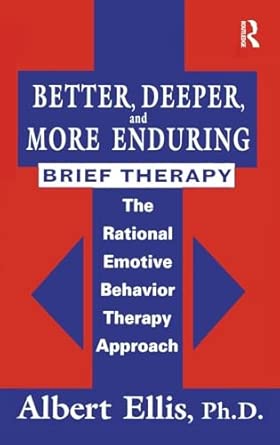
Better, Deeper And More Enduring Brief Therapy: The Rational Emotive Behavior Therapy Approach
Author(s): Albert Ellis (Author)
Publisher: Routledge
Publication Date: 1 Nov. 1995
Edition: 1st
Language: English
Print length: 316 pages
ISBN-10: 0876307926
ISBN-13: 9780876307922
Book Description
In Better, Deeper, and More Enduring Brief Therapy Albert Ellis, the founder of Rational Emotive Behavior Therapy, describes how REBT can help clients significantly improve in a short period of time and effect a profound philosophical-emotional-behavioral change-more often that can be achieved with other popular forms of therapy. In a comprehensive, accessible format, Dr. Ellis offers his theories, practices, verbatim sessions, and other materials that help describe how REBT can be a valuable asset in psychotherapeutic treatment.
Editorial Reviews
Review
“As the founder and leader in the development of brief therapy, Albert Ellis continues to make major contributions to the literature. Ellis’s clear, cogent, clinically sensible, and valuable model provides a template for quality clinical practice. From his early approach, RT (Rational Therapy), to his newly revised model of REBT (Rational Emotive Behavior Therapy), Ellis demonstrates that 40 years later, he is still in the forefront of brief psychotherapy. This volume offers the skilled psychotherapist a focused and straightfoward treatment model and the strategies and tools for effectively making brief therapy and enduring reality.” — Arthur Freeman, Philadelphia College of Osteopathic Medicine
From the Back Cover
In Better, Deeper, and More Enduring Brief Therapy, Albert Ellis, founder of Rational Emotive Behavior Therapy, describes how REBT can help clients to significantly improve in a short period of time (10 to 20 sessions) and effect a profound philosophical-emotional-behavioral change – more often than can be achieved with other popular forms of therapy. In a comprehensive, accessible format, Dr. Ellis offers his theories, practices, verbatim sessions, and other materials that help to describe how REBT can be a valuable asset in psychotherapeutic treatment. He clearly elaborates those REBT methods best suited to helping people reduce their neurotic symptoms and achieve more fulfilling individual and social lives. He also includes alternative approaches that often prove effective, as well as common pitfalls to avoid when employing them.
 Wow! eBook