Wow! eBook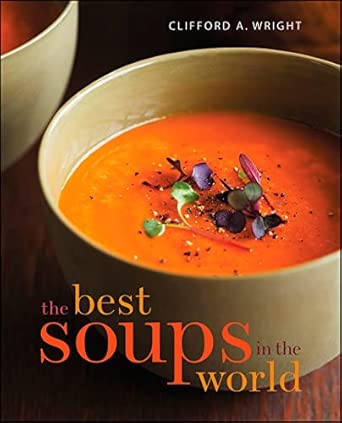
Best Soups in the World
Author(s): Clifford A. Wright (Author)
- Publisher: John Wiley & Sons Ltd
- Publication Date: 1 Dec. 2009
- Language: English
- Print length: 480 pages
- ISBN-10: 0470180528
- ISBN-13: 9780470180525
Book Description
Editorial Reviews
From the Back Cover
The Best Soups in the World
Clifford A. Wright
Cooking/Courses & Dishes/Soups & Stews
Travel the world, soupspoon in hand, with a James Beard Award?winning author as your guide
In restaurants and dining rooms on every continent, soup is on the menu. A Mexican chef simmers Roasted Poblano and Three Cheese Soup. A Sicilian nonna stirs Beans and Greens Soup, while her Thai counterpart cooks up Mushroom and Chile Soup. Wherever it’s eaten, a bowl of soup?whether elegant or hearty, creamy or clear, chilled or piping hot?delivers rich flavor and simple satisfaction. In this ultimate soup cookbook, acclaimed cookbook author Clifford A. Wright has collected the best classical, famous, and not-so-famous recipes to be found anywhere.
The Best Soups in the World includes 247 recipes for heartwarming and palate-pleasing soups: Imagine savoring delicate Italian Small Rice Balls in Broth, refreshing California Chilled Peach Soup, piquant Georgian Beef and Apricot Soup, or curry-scented Tanzanian Black-Eyed Pea and Coconut Soup. But this is no mere collection of recipes. Wright is a food scholar; he applies his expertise in lively explorations of the history and culture behind each soup, which makes this book as rewarding to read as it is to cook from.
Exciting, enticing, and easy-to-prepare, these recipes use ingredients both common and unusual?Wright provides Internet sources for every item?making them perfect for budget-conscious cooks whose taste know no boundaries. From Old-Fashioned Chicken Noodle to Chayote Soup from Nicaragua and from Tuscan White Bean to Vietnamese-American Pho, these soups will take you around the globe, all from the comfort of home.
About the Author
Excerpt. © Reprinted by permission. All rights reserved.
The Best Soups in the World
By Clifford A. Wright
John Wiley & Sons
Copyright © 2010 John Wiley & Sons, Ltd
All right reserved.
ISBN: 978-0-470-18052-5
Chapter One
introduction
In the dead of winter, rosy cheeks, cold hands, blown snow, and the icy chill are all forgotten the moment you stamp your boots in the mudroom and catch a whiff of a rich, thick, and hearty soup wafting in from the kitchen. Sometimes heaven is being hunched over a bowl of cabbage soup flavored with smoked bacon, kielbasa sausage, sour cream, and paprika, slurping with abandon. And in the summer, when the temperature hits the nineties, when green beans arrive in the market and tomatoes are bursting with ripeness, you make a simple yet delectable soup flavored with garlic, olive oil, celery, and fresh basil, or maybe a cold cucumber, yogurt, and walnut soup, or gazpacho.
Everyone remembers that “best” French onion soup they ate, with the slightly burnt cheese spilling over the edge of the bowl, or the spicy tang of the hot-and-sour shrimp soup at the neighborhood Thai restaurant. Oh, how you would love to make these soups at home! How hard could it be? Well, not so hard at all, and now you don’t even have to look for a recipe. They’re all here, all the classical, famous, and not-so-famous soups from around the globe. These are the best soups in the world (or should I say, those that could fit in this book). Whatever the season, a bowl of soup is a soul-satisfying experience.
One of my most poignant memories of real food is from a vacation I was on as a ten-year-old-a memory that inspired me to write this book. We were in Spain in the summer of 1961. I remember I had the most amazing soup. My parents took us to a wonderful restaurant. I had never been to such a place. It was elegant, or seemed elegant compared to the kind of restaurants we went to back home. The walls were a pale pastel gray, and the starched tablecloths were white. The tables were arranged in banquettes, which to this day I love to sit at. The waiter was better dressed than my dad.
My mother ordered vegetable soup for me. My heart sank because the only vegetable soup I knew was what I considered to be, even at age ten, the ghastly canned version, an unforgiving atrocity committed against what were once real vegetables. But what the waiter brought was something quite different. First of all, it was not red or clear or filled with perfectly diced overcooked vegetables. It was greenish and smooth-a velout, I later learned. It was served in a very wide white bowl with a broad brim. And it was delicious: the most delicious thing I had ever eaten. I ate it with a funny little spoon that was halfway between a cereal bowl spoon and a baby spoon. It was a soup spoon. I had never eaten soup with a soup spoon.
Nearly fifty years later I finally told my mom about this memory, and she said, as if it had happened yesterday, “Oh, that must have been in Zaragoza; it was about ten in the evening and we couldn’t find anywhere for you to eat until we finally found a restaurant that was open ‘early.'” (Anyone who has been to Spain knows how impossibly late Spaniards eat supper.) She couldn’t remember the name of the restaurant, but when my father died and I was cleaning out one of his closets I found a large brown envelope with all the hotel receipts from that trip in 1961. The restaurant was down the street from the Hotel Goya in Zaragoza, a hotel that still exists!
Soups are a basic food. They are enriching and satisfying. This book is a treasury of the favorite soups from world cuisines. Many of the recipes require no more than a trip to the supermarket and have great appeal because soups are comfort food. They’re easy to make, can be an appetizer or a meal in themselves, freeze well, fit into a variety of personal diets, are light or filling (depending), and have a lot of culinary bang for the buck-one gets a heck of a lot of flavor out of something so simple. This is one of the reasons that soups have always been the first food of hard times.
Some recipes require ingredients found in ethnic markets. Today there are ethnic markets everywhere, and you should have no problem finding the somewhat specialized ingredients needed for the true taste. But even if you can’t, on page 445 there is a complete listing of foods used in the book, and where on the Internet you can purchase them.
The central approach in my world of soups follows the comments of that great nineteenth-century French gastronome Grimod de la Reynire, who said, “Soup is to a dinner what the porch is to a building.” The French chef Auguste Escoffier seconded him by suggesting that soup “in the manner of an overture in a light opera, should divulge what is to be the dominant phrase of the melody throughout.”
Throughout this book, soups range from the ridiculously simple to the gastronomically sublime. To start, there is a vast repertoire of soup nomenclature, nearly all of which is rooted in the classical French cuisine of the famous chefs Marie-Antoine Carme (1784-1833) and Georges Auguste Escoffier (1846-1935). As useful as these classifications are, such as clear, pured, bisque, and so on, they turn out to be limiting in a book such as this one, which deals with soups from around the world, not just French soups. You will not need to know the difference between a bouillon and a consomm to use this book with the greatest of joy.
There are soups made in restaurants and soups made at home, and the two soups are very different. For the most part, restaurant soups are based on stocks that can take days of preparation and involve several cooks and kitchen workers. Home soups are a much simpler affair, although home cooks can make complicated stocks, too, if they enjoy the process, are not pressed for time, and have good storage facilities. This book is a book of homemade soups, with a handful of so-called restaurant soups that can be successfully made at home.
First, though, what separates soups from stews and pottage? Basically, it all comes down to liquid. Except for fish stews, which are very soupy, a stew (which incidentally is both a noun and a verb, whereas soup is only a noun) can be thought of as a soup so thick the liquid has nearly disappeared. A stew can be eaten with a fork, whereas a soup can only be eaten with a spoon. Porridge or pottage is in between a soup and a stew; it’s thick, but less thick than stew.
At its simplest, soup making does not require much-just a pot and water. But to make the full range of soups represented in this book, from bisques to velouts, every home kitchen should have the following equipment. (I am not listing some items that are obvious and you already have, such as stew pots, pans, and knives):
Small pot (4-quart)
Large pot (8-quart)
Stock pot (20- to 22-quart)
Mortar and pestle
Blender
Food processor
Cheesecloth
Wok
Fine mesh wire strainers
Skimmer
Food mill
soup basics
homemade broth The first decision soup cooks need to make is what they will use as their base when a recipe calls for broth. (I use the terms “broth” and “stock” interchangeably, as do many people, although technically there is a very small difference-not important to the home cook.) There are two options: make your own broth, or buy commercially available broth in the form of bouillon cubes, canned or cartoned broth or consomm, granules, or paste. I leave the choice to you, but can assure you that your own home-made broth will always taste better than a commercial broth, no matter what brand or kind. I know because I’ve tasted every commercial broth as research for this book. But, honestly, I use both; it depends on my time constraints, how spectacular I want my soup to taste, and whether I have, in fact, any homemade broth already made. Any recipe that relies on the broth itself as the centerpiece of the soup will clearly require homemade broth.
The foundation of all soups is water. Once you start flavoring or seasoning water you are making the foundation of all soups, not to mention gravies, sauces, and stews. In fact, a basic stock in French cuisine is called a fonds, or “foundation.” Some soups require nothing but putting things in water and bringing them to a boil. Others require a foundation of broth or stock. Stock, broth, consomm, and bouillon tend to be used interchangeably for the same thing. A stock is a liquid seasoned by long simmering with meat, fish, or vegetables that is the basis for sauces, gravies, and soups. A consomm is a clear soup made from stock, clarified with egg whites and eggshells. It derives from the Latin word consummare, “to consummate or make perfect.” Bouillon is a clear seasoned soup derived from the Old French word boillir, “to boil.” The notion that bouillon was invented in the late eleventh century by Godfrey of Bouuillon, one of the first Crusaders, is myth. A broth is a liquid in which meat, fish, vegetables, or cereal grains have been cooked. The word, derived from the Old English word breowan, “to brew,” dates to before the twelfth century and is akin to the Old High German word brod, meaning “broth.”
Some English-speaking writers make a distinction between broth and bouillon, but bouillon is simply the French word for broth. You’ve undoubtedly heard of broth, bouillon, stock, and consomm, and you will have read a variety of descriptions. Luckily, these are all the same thing as far as the mode of preparation-and this book-is concerned. The differences between them are minuscule, having to do with their purpose and flavor. Important mostly to restaurant chefs, these differences are not as important to the home cook. There is a distinction, if minor, between broth and stock. A broth is a clear liquid deriving its essence from a combination of meats, vegetables, and herbs that has simmered in water for a long time. Sometimes the meats themselves are combined, for example, beef and chicken. Stocks, called fonds de cuisine in French, meaning “foundations of cooking,” are made in the same way as broths but are principally used by chefs for braising, stewing, and making sauces.
These classifications are rooted in French culinary culture, and there is nothing wrong with that. But increasingly, and this is especially true in the United States, a cookery is developing that can be called “international eclectic,” and newer classifications need to be devised. Unfortunately, that’s not so easy, but this book’s chapter headings are my own attempt.
Traditionally, everything starts with stock, and chefs have devised general classifications for stocks, dividing them into two basic kinds: white stock and brown stock. White stock is made with white meats such as chicken and light-colored vegetables such as onions. Brown stock is made with dark meats like beef. The making of stock usually begins with scraps of meat on the bone that cannot be used for any other purpose (including cooked carcasses or fresh bones with a little meat on them), vegetable parings, and other bits of unspoiled food that are not attractive enough to serve on their own. Before I forget, let me say that you should never throw away the carcass of roast anything. The carcass makes for delicious soup making. French cooks often roast or saut the meats they are using for their stocks to make the final product richer in taste and color; Italian (or for that matter, Thai) cooks, do not.
Supermarkets sell meat for stocks and soup making, packaging them as soup bones or marrow bones. Beef shank, neck bones, and oxtails all are good to use for soup making. To extract the maximum amount of flavor and gelatin from these bones they should be cut or cracked, which they usually are, but you can always ask the supermarket butcher to crack them further. A general rule of thumb is to use 1 quart of water for every pound of bones. For stock making at home to be worth your while, you need to use a large stock pot. My largest stockpot is 22 quarts. Any larger than that is not practical in a home kitchen, because your burner is too small and the range hood is too low. Two meats rarely used for stock making are lamb (too strong) and pork (too sweet). The ideal meats for nonspecialized all-purpose stock making are beef, veal, and chicken. Many cooks like a vegetable stock as their all-purpose stock.
Once your stock is made-and hereafter I will call it broth, following the language you will encounter in the recipes-there are three basic kinds of soups you can make. These divisions, though, are again derived from classical French cuisine, so it’s difficult to apply them to all of the soups in this book, which are from around the world. The first kind of soup is clear soup, the second is thick soup, and the third is bulky soup. Miso soup or consomm is an example of the first, cream of mushroom is an example of the second, and minestrone is an example of the third. There are further divisions, such as pures, cream soups, and velouts, under thick soups, as well as bisques, chowders, and international soups.
Now a few words about consomm. Consomm is a clarified beef broth, and a double consomm is a clarified broth made with broth rather than water. A consomm is consummate, meaning it’s supposed to be perfect-and perfect means clear, without any fat globules or cloudiness from particles, and only slightly gelatinous. Making clear soup, or consomm, involves a process of clarifying the basic stock.
The first step is to make the stock, then refrigerate it in order to remove the fat that solidifies on top. Measure the stock, then pour it into a clean saucepan or stockpot with a mixture of one lightly beaten egg white, one eggshell broken into smaller pieces, and 2 teaspoons cold water per quart of stock. Place the stockpot on a burner and stir over medium-low heat until it comes to a boil. Boil for two minutes, then turn the heat off, cover, and let rest for twenty minutes. Strain into a large bowl, another pot, or storage container through a fine mesh strainer lined with a triple layer of cheesecloth.
But it is not always necessary to go through these steps to make a clear consomm. If you use care and patience, you can make a fine clear consomm by keeping the liquid just below a boil, the water only shimmering on top. Skim the foam that rises often and thoroughly, then strain slowly and carefully through multiple layers of cheesecloth. And don’t forget, as a home cook, you can make a less-than-perfect consomm and no one will fire you. The basic consomm recipe is on page 20, with one variation on page 21, but there are literally hundreds of different consomms, and once you make the basic recipe you can become as inventive as you want.
Clear soups, or consomms, can have things added to them, while thick soups are made by pureing vegetables, poultry, or fish in a blender or food processor or passing it through a food mill. Cream soups are pures that have had cream or milk added to them; if they are made with shellfish, they’re called bisques.
In soup making, it is important not to salt or pepper until the end of cooking. If you salt at the beginning of the process, before the inevitable reduction of the liquid through evaporation, the result will be a far too salty and even inedible broth. Pepper is never added at the beginning of the cooking process, because the pepper, after long cooking, becomes tasteless and acrid. Peppering at the end gives the soup a burst of fresh, spicy flavor that perfumes the dish perfectly. (I sometimes violate this rule and you should feel free to do so, too.)
commercial broths There is no denying that store-bought broths are a great convenience, no matter how much foodies pooh-pooh them. I use them whenever I don’t have homemade broth around. But I have to admit that one of the wonderful, unexpected benefits of writing a book about soups is that I always had plenty of my homemade broth in the refrigerator or freezer, and I just loved that.
(Continues…)
Excerpted from The Best Soups in the Worldby Clifford A. Wright Copyright © 2010 by John Wiley & Sons, Ltd. Excerpted by permission.
All rights reserved. No part of this excerpt may be reproduced or reprinted without permission in writing from the publisher.
Excerpts are provided by Dial-A-Book Inc. solely for the personal use of visitors to this web site.