 Wow! eBook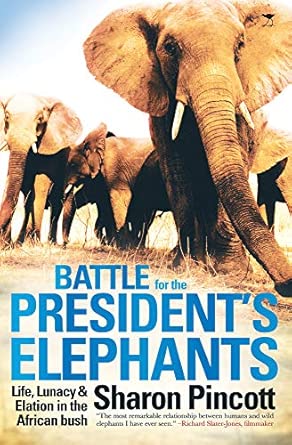
Battle for the President's Elephants: Life, Lunacy and Elation in the African Bush
Author(s): Sharon Pincott (Author)
- Publisher: Jacana Media
- Publication Date: 14 Mar. 2014
- Language: English
- Print length: 240 pages
- ISBN-10: 1431403598
- ISBN-13: 9781431403592
Book Description
Editorial Reviews
About the Author
Excerpt. © Reprinted by permission. All rights reserved.
Battle for the President’s Elephants
Life, Lunacy and Elation in the African Bush
By Sharon Pincott
Jacana Media (Pty) Ltd
Copyright © 2012 Sharon Pincott
All rights reserved.
ISBN: 978-1-4314-0359-2
Contents
Preface,
Saving precious lives,
Animal enchantment,
The gregarious Ws,
Vervets, leopards, bushbuck and baboons,
Lady and family,
A mix of wild and domestic,
The changing months of Hwange,
An alien way of life,
‘Wanted’ (dead or alive?),
Misty and Masakhe,
Pans and more of the preposterous,
Sharing the splendour,
The thrill of the unexpected,
Evicted,
The Bvumba’s treasures,
Big, and Little, Fives,
The demise of Grantham – and Nicki Mukuru,
Another new beginning,
Days of décor and averted disaster,
Back with the elephants,
Reaffirmation of the Presidential decree,
A week in another wilderness,
The film crew and more crazy carry-on,
Bend-down in Bulawayo,
Garden friends and foes,
Willa,
Christmastide,
A spirit messenger,
Over the railway line,
Afterword,
Acknowledgements,
CHAPTER 1
Saving precious lives
No day is ever the same in the African bush. Despite not knowing what joys and sorrows lie ahead, there’s always a multitude of both to be had. Although this day in May 2010 dawned like any other, it turned out to be an especially memorable one.
I’m forever on the lookout for snared animals as I go about my daily elephant monitoring on the Hwange Estate and as luck would have it I stumbled upon a badly injured female elephant. She was wandering on the estate without any members of her family and was struggling to walk. The snare wound on her back right leg was horrific and the deadly length of copper wire was clearly visible.
I’d resorted to buying a mobile phone only a few months earlier. Signal had finally become available on the estate, although, like many things in Zimbabwe, it was not yet reliable. I hated the possibility of the contact-me-anytime intrusion, but it proved to be a godsend when occasions like this arose.
I remained with the snared elephant and immediately phoned two nearby animal darters, who responded without delay. The elephant obligingly stayed in the open, away from thick bush and other elephants, which was an ideal opportunity for darting.
Although it felt like an eternity to me, the necessary equipment had been collected with haste and a dart promptly prepared. (The expensive M99 immobilisation drug is a vital prerequisite to an operation such as this, and is fortunately provided in ample quantities by kind donors.) I was able to drive the darter close enough for a shot, and the dart hit its target, but tragically the immobilisation drug didn’t inject. Frightened by the sting of the dart, the elephant hurried off into thick bush.
It took time to prepare and load another dart and, as it turned out, a second chance didn’t present itself. Not realising that we were trying to help her, the elephant had disappeared deep into dense bush where we could no longer reach her. It was one of those heartbreaking moments that I have so often experienced in the African wilds.
Although I had known immediately that she must be a Presidential Elephant – given her calm demeanour and close acceptance of my 4×4 – I hadn’t been able to positively identify her. The elephants that roam the Hwange Estate became known as The Presidential Elephants of Zimbabwe after President Robert Mugabe issued a ‘special protection decree’ in 1990, as a symbol of Zimbabwe’s commitment to responsible wildlife management. To make identification easier, I’d assigned a letter of the alphabet to each extended family group, and had given each elephant within the family group a name beginning with that letter. Based on this particular elephant’s looks and body shape, I suspected she was from the A family. Back in my rondavel that evening I flicked through identification photographs, comparing tusk and ear patterns to the photos I’d just taken, and discovered that it was Adwina who was so horribly injured and wandering alone out there in the darkness.
The following few days in the field were particularly distressing. I searched and searched and couldn’t find her anywhere. In the early hours of the morning, lying awake and reliving the misfortune of the failed darting attempt, I found myself wishing that I hadn’t established her name. It’s so much more personal when you know someone’s name.
Petrol was horribly expensive at US$1.40 a litre, and my 30-year-old 4×4 managed only 4 kilometres to the litre, but how can you put a price on an innocent animal’s life? So, I drove for more time and distance than I usually would each day, digging deep into my own savings.
Long weeks passed. There’d been no sign of Adwina. There were days when I thought she must be dead. Even so, I double-checked every female of her size that I came across, to ensure that it wasn’t her. The rains were over and elephant sightings were increasing, but her time was running out.
More than a month after the initial sighting, I left for my daily round of patrols and monitoring in the late morning. Just the day before I’d declared, ‘I’m going to find her this week’, not actually believing it myself. I’d been in the open area called Kanondo for almost an hour when I saw Adwina’s head in thick bush. At times like these I become a bit of a basket case. My heart pounds and my hands shake. I fumbled with my mobile phone …
Esther and her husband Hans, who were attached to the nearby Painted Dog Conservation Project, had successfully darted a horribly snared Presidential Elephant just a few months before, and were on standby. I’d actually had Esther on standby for weeks.
‘She’s finally here Esther, at Kanondo,’ I blurted into my mobile, pretending to be calmer than I was. This wasn’t the time to talk as they needed to pack their 4×4 and race the 15 kilometres to join me. There’s never any time to waste with these operations, since the chance of the animal disappearing into thick bush is always high.
Only a few minutes had passed, but I was back on my mobile again. ‘Esther, she’s already moving off,’ I warned. Thankfully, they were already on their way. By strategically positioning my vehicle in Adwina’s path, I tried to encourage her to stay put.
Momentarily, I’m back on my mobile again, ‘I’m not sure that I can hold her much longer. Please, we need a tracker …’ I circle around and keep herding Adwina back and forth, back and forth, trying to prevent her from crossing the road into thicker bush. In desperation I phone for another vehicle to help keep an eye on her.
The vehicle eventually arrives, but it’s just too late. Adwina runs across the road that I’m on. I can hear Esther’s vehicle pulling up and I drive madly towards her, needing to get to the next road to prevent Adwina from crossing that one as well. Hans is driving and Esther is as calm, cool and professional as always, which does nothing to soothe my own thumping heart. Thank goodness one of us is so composed. She’s about to start preparing the dart (the drug is potentially deadly if spilled on human skin, so I’m thankful that I’m not the one loading it) and has a tracker on-board. I leave them to get on with it and zoom off towards the next road.
By the time the dart and gun are ready Adwina is still somewhere between these two sandy roads. But the bush is horribly thick. We’re all looking in the wrong direction when she eventually crosses. I catch a glimpse of her, however, and manage to confirm that it’s Adwina. Mkhalalwa, our tracker, quickly leads Esther and Hans after her on foot.
It proves fruitless. There are sounds of elephants everywhere, and the risk of walking straight into one in the thick bush is high. Eventually, I see all three helpers retreating back towards the vehicles. My hands fleetingly cover my eyes in disappointment. ‘We just can’t miss her twice,‘ I whisper to myself. Yet it looks as if we have. It’s not practical for this darting team to wait around too much longer, since the chances of Adwina returning to the open area of Kanondo are low. If some of the elephants we can hear are her family there’s a chance that she will but, although we wait for a while longer, all we encounter are lone bulls.
Eventually, I return to Kanondo alone in the desperate hope that she reappears. A game-drive vehicle arrives with American tourists on-board, so I show the safari guide the gruesome photographs that I’ve just taken of Adwina and ask him to keep a close eye out for her.
Meanwhile, the Ws – one of my favourite families – have appeared in the open, sent perhaps to ease my despair. There’s also a bateleur in the sky, which some believe is a spirit messenger. I immediately think of my dear friend Andy who lost his life while he was a wildlife warden in Hwange National Park. It seemed impossible that he’d been dead for ten years. ‘Please help us find her,’ I whisper, looking skyward, hoping that he can hear me.
I drive with the tourists to the mineral licks, where well-known elephant ladies named Whole, Whosit, Willa, Whoever, Wishful and others enjoy the minerals and then surround our vehicles. I share information about their intimate family relationships and introduce the tourists to all of my favourites. I explain that the elephants are very familiar with me and my vehicle and know my voice well, but that as strangers they must sit in silence and never attempt to touch or feed them. The Americans are visibly moved by their close encounter, revelling in their astonishing proximity. ‘I could just cry,’ a middle-aged man whispers with sincerity.
This makes me smile. It’s the incredible effect that these trusting giants so often have on people. We talk some more about this remarkably friendly W family and also about Adwina and the darting attempt. Then, without warning, Adwina appears in the open just a few hundred metres away, about to splash soothing mud on her wound. ‘Thank you, thank you,’ I whisper instinctively, gazing once again towards the sky. If I thought my heart was pounding earlier it was now about to jump out of my chest. One phone call and Esther, Hans and Mkhalalwa are immediately on their way back.
Adwina does it to me again though. She starts to move off well before the darting team can get to me. I dash back to the same road that I was on earlier, having asked the safari guide and his guests to remain still and monitor her from there. Once again I herd Adwina back and forth, back and forth, trying to keep her from disappearing into the dense bush. But it feels like I’m going to lose her yet again.
I hear Esther’s vehicle roaring towards us and at the same time get a glimpse through the bush of the safari guests waving coloured cloth in the air, someone’s sweater perhaps, to help guide the way. Hans can now see where Adwina is, even though there are scores of elephants in the area by now, and he drives towards her. Esther knows that I’m struggling to hold Adwina at bay and, like me, fears that we’ll lose her again if she crosses the road. She has one chance to successfully get the dart in and it’s not a very good one since she’s awfully close to the limit of the dart gun’s 40-metre range and the thick bush is preventing her from getting any closer. Adwina isn’t staying still, but with calm skill Esther leans out the window of her 4×4 and fires. The dart hits, albeit a little precariously, on the side of Adwina’s leathery rump.
Through the leafy bush I can see the pink-feathered dart protruding from her backside and breathe a huge sigh of relief. My mobile rings and it’s Esther confirming that the dart’s in, and asking me to keep up with Adwina to see where she falls; assuming that enough of the drug has been injected to bring her down. Esther sounds cool and confident, as always. Adwina’s head and trunk eventually start to droop and I’m thinking, peering at my trembling hands, that I could do with a bit of immobilisation myself.
In a few minutes she’s down. We hurry in our two vehicles towards her fallen body and the operation is immediately in full swing. There are elephants all around us, but fortunately none are A family members and they’re considerately keeping their distance. The injury is more than horrific. The length of copper wire is embedded deeply, and the wound is a great deal worse than it was a month ago. There’s no skin left on the lower portion of her leg. Esther and Hans cut the wire and treat the wound. I tip water over Adwina’s ears to keep her temperature stable and Mkhalalwa holds her trunk, ensuring that her breathing is not obscured.
I invite the game-drive vehicle to come in quietly, to witness this life-saving procedure. They are moved, of course, and the emotion is palpable. The wound is soon treated and we all move off so that Esther can safely administer the reversal drug alone. My whole body is shaking; it’s impossible for me to relax until Adwina’s back on her feet.
And soon she is. It’s taken less than 30 minutes from the time the dart hit to seeing her standing once again. Five long weeks of searching, but just minutes of compassionate teamwork once I’d found her. Adwina wanders off, a little dazed, across the road that she’s now welcome to travel without interference from me. Her family’s still nowhere in sight, nor is her youngest calf, but I feel confident that she’ll be okay. The resilience of these animals is remarkable. So long as the deadly wire is removed, the chance of a full recovery is high no matter how dreadful the wound.
It’s a time for celebration and we all sit in our vehicles next to a pan, full of water from the generous wet season, surrounded by the W family who choose to stick around and seem to want to help us celebrate. Esther’s gift from me is the opportunity to meet the beloved Whole – one of my most favourite elephant ladies. It is Whole’s adult daughter, the cheeky Whosit, however, who insists on standing right beside Esther’s open window.
I stayed out longer than the others, alone under the almost-full moon, sipping a beer handed to me from the game-drive vehicle’s cooler box. I don’t particularly like beer but, with my heart still pounding, something alcoholic was definitely needed. It was a truly stunning, and gratifying, evening. Whosit’s firstborn, Wish, placed his trunk right inside my open window and proceeded to give my 4×4 a little shake. A tad naughty perhaps, but it made me laugh out loud just the same. This little Wish, who was only a few months old at the time, was an adorable mischief-maker. That evening I made my own wish – that we’d never have to do another snare removal. That wish, tragically, never comes true no matter how often I make it.
A few days later, while I was out with safari guests from Australia, we stumbled upon Adwina at Kanondo, splashing mud on her de-snared leg. She was still without her family, but she was looking much better than she had been. The back portion of her wound was horribly deep and raw, and a little blood still oozed from it, but she could now put her full weight on the leg.
It was another three weeks before I saw Adwina again, and by then she’d reunited with her four-year-old son. This was a really positive development since her youngest no longer needed to be looked after by family members. Having lost so much skin on the lower portion of her leg, there was nothing to protect the flesh and her wound was taking a worryingly long time to show signs of real healing. She mud-bathed and dust-bathed continually, helping Mother Nature along.
The next time I saw Adwina she was still limping – the merciless acts that humans are capable of very evident – but she was surrounded by all the members of her family.
* * *
Tragically, we don’t always manage to save snared elephants.
A Hwange National Park elephant family that was frequenting Kanondo had a young member – about four years old – with a tight wire wrapped around his little head; his ear awfully damaged and the cruel wire cutting into his throat. Try as we might, a darting opportunity kept eluding us. They were a family of seven not known to me and, unlike the Presidential Elephants, they were particularly skittish around vehicles.
My short time observing them from a distance teaches me many things. Five different Presidential families, all of whom I know well, come and go around them. Still they stay motionless in the shade of a tree. ‘They’re waiting for somebody,’ I mutter to the darter who’s seated beside me in my 4×4.
Just a few minutes later a second National Park family materialises from the bush; it’s one that I do sight now and again during the course of each dry season. Sure enough there’s a greeting ceremony. The intensity of it tells me that they’re not immediate family, but probably ‘bond group’ members who don’t always roam together. There’s no twirling of trunks or rubbing of faces, although they’re clearly related to some degree and certainly excited to see each other. They back into one another, and open-mouthed deep rumbles fill the air.
The darter mistakes this commotion for hostility, which is easy enough to do. Unless you know and understand the interactions and associated sounds, aggression and greetings can be easily confused. What we had just witnessed was friendly fraternising. The small family of 7 had, all of a sudden, become a group of over 30, which complicated the darting procedure further.
‘How closely were all of these elephants related?’ I wondered. Would everyone in this extended group become concerned and protective if the snared calf was immobilised now? Without a documented history of past encounters, it was impossible to know. Even the mother of the snared youngster isn’t easy to determine absolutely, with such limited observation time. He suckles from nobody, the snare perhaps making the suckling position painful. He belongs to one of two females, but which one? I make an educated guess, but what if I’m wrong? For security reasons, should the one who I think is the mother also be darted? With a four-year-old son, she is almost certainly heavily pregnant. With no records of oestrous periods or matings for this unknown family though, this is also just another educated guess. What negative effect might the drug have on a baby about to make its appearance into this world?
Darting youngsters in strange, unhabituated family groups is always a concern. Many things can go wrong and there are so many unknowns. My head spins with all that needs to be weighed up, and the darter is understandably hesitant. All of a sudden the elephants make the decision for us: they dash unexpectedly into impenetrable bush, and the darting opportunity is lost for the day.
I never saw this elephant family on the estate again. Unless a miracle happened and the snare somehow broke off without intervention, this family would have mourned the tragic death of one of their own.
Fortunately, other sightings have happier endings.
(Continues…)Excerpted from Battle for the President’s Elephants by Sharon Pincott. Copyright © 2012 Sharon Pincott. Excerpted by permission of Jacana Media (Pty) Ltd.
All rights reserved. No part of this excerpt may be reproduced or reprinted without permission in writing from the publisher.
Excerpts are provided by Dial-A-Book Inc. solely for the personal use of visitors to this web site.


