 Wow! eBook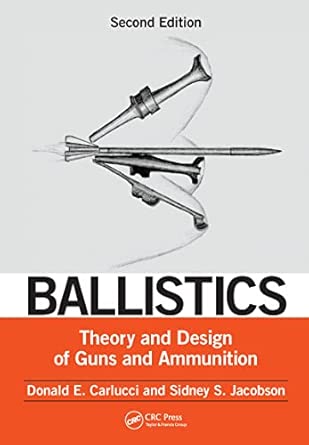
Ballistics: Theory and Design of Guns and Ammunition 2nd Edition
Author(s): Donald E. Carlucci (Author), Sidney S. Jacobson (Author)
- Publisher: CRC Press
- Publication Date: 26 Aug. 2013
- Edition: 2nd
- Language: English
- Print length: 612 pages
- ISBN-10: 1466564377
- ISBN-13: 9781466564374
Book Description
Providing new chapters, homework problems, case studies, figures, and examples, Ballistics: Theory and Design of Guns and Ammunition, Second Edition encourages superior design and innovative applications in the field of ballistics. It examines the analytical and computational tools used to predict a weapon’s behavior in terms of pressure, stress, and velocity, demonstrating their applications in ammunition and weapons design.
What’s New in the Second Edition:
- Includes computer examples in Mathcad (available on the CRC website)
- Adds a section of color plates, to better help readers visualize the physical concepts of ballistics
- Contains sections on modern explosives equations of state for detonation physics modeling and on probability of hit
- Provides a solutions manual for those teaching college and training courses
This book covers exterior ballistics, exploring the physics behind trajectories, including linear and nonlinear aeroballistics, and focuses on the effects of projective impact, including details on shock physics, shaped charges, penetration, fragmentation, and wound ballistics.
- Reviews and integrates the fundamental science and engineering concepts involved in guns and ammunition
- Uses straightforward, easy-to-read style, and careful development of complex topics
- Shares insights rooted in the experience of renowned experts, many associated with the National Defense Industrial Association (NDIA) and International Ballistics Society
The field of ballistics comprises three main areas of specialization: interior, exterior, and terminal ballistics. This book explains all three areas, offering a seamless presentation of the complex phenomena that occur during the launch, flight, and impact of a projectile.
Editorial Reviews
Review
“This book represents a complete self-contained reference for ballistics experts and gun designers. The material is written to allow the reader instant access to the fundamentals in the field, and shows practical examples across the entire spectrum of ballistics and guns. This is the only book that brings decades of research and engineering into one source that is readily accessible to both laymen and experts alike.”
––Kirk Vanden, Air Force Research Laboratory
“This expanded second edition of Ballistics: Theory and Design of Guns and Ammunition 2nd Edition fills a critical need in the conventional weapons design arena by providing a balanced, technically detailed treatment of the field of ballistics. This text clearly presents the development of the physical theories and their application to the solution of real problems. The authors have created a valuable introduction to the technical world of ballistics.”
––Dr. Thomas A. Mason, Weapons Physics Directorate, Los Alamos National Laboratory
“”This book is a good reference as well as an outstanding book for teaching. There are a significant number of problems at the end of the chapters and this is always very helpful for teaching purposes.”
––Dr. Carl T. Dyka, Naval Surface Warfare Center, Dahlgren,Virginia, USA
“The book can be used as a study text for ballistic courses, as it was written in a reader-friendly style and format. The authors explain the fundamental physics, theory and design techniques for each area of ballistics.”
―Advances in Military Technology, June 2016
“This book represents a complete self-contained reference for ballistics experts and gun designers. The material is written to allow the reader instant access to the fundamentals in the field, and shows practical examples across the entire spectrum of ballistics and guns. This is the only book that brings decades of research and engineering into one source that is readily accessible to both laymen and experts alike.”
––Kirk Vanden, Air Force Research Laboratory
“This expanded second edition of Ballistics: Theory and Design of Guns and Ammunition 2nd Edition fills a critical need in the conventional weapons design arena by providing a balanced, technically detailed treatment of the field of ballistics. This text clearly presents the development of the physical theories and their application to the solution of real problems. The authors have created a valuable introduction to the technical world of ballistics.”
––Dr. Thomas A. Mason, Weapons Physics Directorate, Los Alamos National Laboratory
“This is a very good book on a complex technical subject that provides enough detail to understate the real fundamentals that are involved. It is well presented and organized. This book is a good reference as well as an outstanding book for teaching. There are a significant number of problems at the end of the chapters and this is always very helpful for teaching purposes.”
––Dr. Carl T. Dyka, Naval Surface Warfare Center, Dahlgren,Virginia, USA
“The book can be used as a study text for ballistic courses, as it was written in a reader-friendly style and format. The authors explain the fundamental physics, theory and design techniques for each area of ballistics.”
―Advances in Military Technology, June 2016
About the Author
Donald E. Carlucci has been an engineer at the U.S. Army Armament, Research, Development and Engineering Center, Picatinny Arsenal, since May 1989. He is currently the U.S. Army senior scientist for computational structural modeling based at Picatinny. He holds a doctor of philosophy in mechanical engineering (2002) and a master of engineering (mechanical) (1995) degree from the Stevens Institute of Technology, Hoboken, New Jersey. In 1987, he received his bachelor of science degree in mechanical engineering from the New Jersey Institute of Technology, Newark, New Jersey. Dr. Carlucci is an adjunct professor of mechanical engineering at the Stevens Institute of Technology.
Sidney S. Jacobson
was a researcher, designer, and developer of ammunition and weapons at the U.S. Army’s Picatinny Arsenal in New Jersey for 35 years. He rose from junior engineer to associate director for R&D at the arsenal. In 1972, he was awarded an Arsenal Educational Fellowship to study continuum mechanics at Princeton University where he received his second MS degree (1974). He earned a master of science in applied mechanics from Stevens Institute of Technology (1958) and a bachelor of arts in mathematics from Brooklyn College (1951). He retired in 1986 but maintains his interest in the field through teaching, consulting, and lecturing.