 Wow! eBook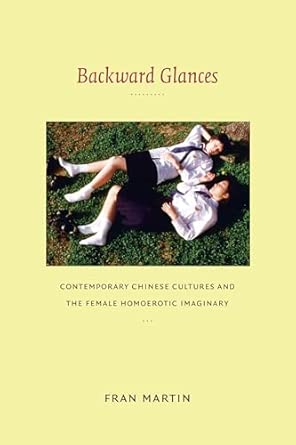
Backward Glances: Contemporary Chinese Cultures and the Female Homoerotic Imaginary
Author(s): Fran Martin (Author)
- Publisher: Duke University Press
- Publication Date: 19 April 2010
- Language: English
- Print length: 304 pages
- ISBN-10: 0822346680
- ISBN-13: 9780822346685
Book Description
As Martin explains, memorial schoolgirl love stories are popular throughout contemporary Chinese cultures. The same-sex attracted young woman appears in both openly homophobic and proudly queer-affirmative narratives, as well as in stories whose ideological valence is less immediately clear. Martin demonstrates that the stories, television programs, and films she analyzes are not idiosyncratic depictions of marginal figures, but manifestations of a broader, mainstream cultural preoccupation. Her investigation of representations of same-sex love between women sheds new light on contemporary Chinese understandings of sex, love, gender, marriage, and the cultural ordering of human life.
Editorial Reviews
Review
“Though academic in style,
Backward Glances is quite approachable. Written as a scholarly text, it can also be of interest to and easily enjoyed by anyone interested in the topics of queer representation, media, and Chinese culture. The book covers a wide range of material, but never feels overwhelming or dense. . . . Backward Glances is a well-written, critical exploration of a newly emerging field of study.”–Carrie Polansky “Feminist Review”“
Backward Glances is a substantial contribution to the emerging scholarship on female same-sex desire in contemporary Chinese contexts. Through close readings of literary and visual texts, Fran Martin develops a convincing, sophisticated theory of ‘memorial discourse’ to explain the prevailing conceptualizations and representations of female same-sex relations in the cultural imaginaries of Taiwan, Hong Kong, and mainland China. She is very thoughtful in negotiating the cultural differences as well as the links among the regions, and in dealing with Western theory in relation to Chinese contexts.”–Siu Leung Li, author of Cross-Dressing in Chinese Opera“
Backward Glances is an astute, exhilarating work about transnational Chinese media representations of the (im)possibility of female homoerotic love. This tightly argued, deeply thoughtful book provides a genealogy of literary and cinematic love between women that frames these relationships as contested terrain in the temporal, melancholic, forced march toward heterosexual marriage. Fran Martin’s perceptive interwoven analyses of the overlapping geopolitical dialogues, both scholarly and popular, between Western and Chinese cultural critiques make Backward Glances a must read no matter where people locate their concerns about marginalized sexualities.”–Lisa Rofel, author of Desiring China: Experiments in Neoliberalism, Sexuality, and Public Culture“This fascinating book skillfully delineates the unique characteristics of Chinese same-sex narratives in stories, television, and film. Fran Martin argues convincingly for the centrality of the ‘memorial mode of female homoerotic representation’ in which women are repeatedly haunted by an idealized lost love. She offers an important corrective to those who consider homosexuality to be a Western invention. In this very readable study, Martin engages current theories of lesbian sexuality, while insisting on the unique characteristics and importance of Chinese traditions of same-sex love. This impressive work should be read by anyone interested in the history of sexuality.”–
Martha Vicinus, University of MichiganFrom the Back Cover
About the Author
Fran Martin is a Senior Lecturer in Cultural Studies at the University of Melbourne. She is the author of Situating Sexualities: Queer Representation in Taiwanese Fiction, Film, and Public Culture and a co-editor of AsiaPacifiQueer: Rethinking Genders and Sexualities; Embodied Modernities: Corporeality, Representation, and Chinese Cultures; and Mobile Cultures: New Media in Queer Asia, also published by Duke University Press.
Excerpt. © Reprinted by permission. All rights reserved.
Backward Glances
Contemporary Chinese Cultures and the Female Homoerotic ImaginaryBy Fran Martin
Duke University Press
Copyright © 2010 Duke University Press
All right reserved.
ISBN: 978-0-8223-4668-5
Contents
Acknowledgments……………………………………………………………………..ixNote on Translations and Transliterations………………………………………………xiIntroduction: Love and Remembrance…………………………………………………….11 Tragic Romance: The Chinese Going-In Story……………………………………………292 Voluble Ellipsis: Second-Wave Schoolgirl Romance in Taiwan and Hong Kong…………………493 Postsocialist Melancholia: “Blue Sky Green Sea”……………………………………….754 No Future: Tomboy Melodrama…………………………………………………………935 Television as Public Mourning: Taiwan’s Sad Young Women………………………………..1186 Critical Presentism: New Chinese Lesbian Cinema……………………………………….147Epilogue……………………………………………………………………………180Appendix: Interview with Shi Tou………………………………………………………187List of Chinese Characters……………………………………………………………199Notes………………………………………………………………………………205Filmography…………………………………………………………………………255Selected Bibliography………………………………………………………………..259Index………………………………………………………………………………281
Chapter One
Tragic Romance The Chinese Going-In Story
Over ten years ago, Bret Hinsch concluded his argument on the decline of premodern Chinese conceptualizations of same-sex sexual behavior with the gloomy assertion that “The fluid conceptions of sexuality of old, which assumed that an individual was capable of enjoying a range of sexual acts, have been replaced by the ironclad Western dichotomy of homosexual/heterosexual. Instead of … terms taken from [Chinese] history and literature, Chinese now speak of “homosexuality” (tongxinglian or tongxingai), a direct translation of the Western medical term that defines a small group of pathological individuals according to a concrete sexual essence.” Despite some scholarly disagreement with Hinsch’s historical oversimplification, the view that modern Chinese cultures conceptualize sexuality primarily in terms of a rigid and indicatively Western dichotomy between the terms “homosexuality” and “heterosexuality” remains influential. In the pages that follow, however, I want to propose a different framework for approaching Chinese sexual epistemologies in the context of twentieth-century modernization.
In relation to post-Foucaldian scholarship on the history of sexuality, Eve Sedgwick cautions that “the historical search for a Great Paradigm Shift may obscure the present conditions of sexual identity.” This warning is certainly apposite to the study of the history of sexuality in twentieth-century China: as Sang’s work implies, an analysis like the one made by Hinsch is open to precisely this kind of critique in its simplistic construction of Westernization as effecting just such a radical, total, and irreversible break with “Chinese sexual tradition.” Further, pursuing the implications of Sedgwick’s warning even more explicitly into the territory of cross-cultural sexuality studies, I would propose that the geocultural search for a great paradigm divergence between the West and its “others”-a search that implicitly propels many cross-cultural and sexuality studies-may obscure the conditions of sexual cultures in both places. Reducing the question to be asked of disparate sexual cultures to “How does the understanding of sexuality there differ from our understanding of sexuality in the modern West?” entails some specific risks.
First, such a formulation implies that sexuality in the modern West is a self-evident object of knowledge, whereas, as Sedgwick forcefully demonstrates, this is very far from the case; modern, Euro-American sexual epistemology is nothing if not multiple, discontinuous, and riven with internal contradictions. The attribution of an ironclad dichotomy between heterosexual and homosexual to modern Western culture ignores the fundamental incoherence of the hetero/homo distinction in this context. To take an example from material close at hand: the chronic strain that Sedgwick observes between minoritizing and universalizing accounts of homosexuality is illustrated clearly in Havelock Ellis’s anxious distinction between temporary and congenital female homosexualities, which, as this chapter will demonstrate, had a significant impact on Republican Chinese accounts of same-sex love. That strange category, “temporary homosexuality,” has a peculiarly solvent effect on that supposedly unassailable fortress of modern Western sexual epistemology, the homo/hetero division. For surely the “temporarily homosexual” schoolgirl is, in effect, a kind of homosexual heterosexual or heterosexual homosexual. Through her, the supposedly hermetically sealed category of heterosexuality is infiltrated by the possibility of homosexual desires and behaviors; likewise, the outward appearance of homosexuality is belied by the potential of latent heterosexuality. The deconstructive critique of the homo/ hetero divide that has been advanced by queer analysis reveals the extent to which modern Western sexual culture is genuinely anxious, genuinely unable to rule, once and for all, where the homosexual leaves off and the heterosexual begins. What characterizes modern Western sexual culture, this work has shown, is not so much an ironclad distinction between homosexuality and heterosexuality as the repeated, panicked attempt to impose such a distinction on a body of knowledge and experience that is in reality defined by an uncontrollable indeterminacy. Given this, in approaching the transculturation of Western sexual knowledges into Chinese contexts in the early twentieth century, our first question should not be about how originally complex understandings of selves and bodies are reduced to something simple and ironclad. Rather, we should ask how the already complexly incoherent and anxious discourses of European sexology get transfigured into a related yet distinct set of incoherencies and anxieties in Chinese contexts.
The issue of cross-cultural conversations on sexuality relates to the second problem with the search for a great paradigm divergence between Euro-American sexual understandings and their “others”: it implies that “other” sexualities will necessarily be meaningful primarily in terms of their self-evident differences from modern, Western ones. Yet given that in the modern period non-Western sexual knowledges are never entirely isolable from Western ones, it makes little sense to assume in advance that the most meaningful relation between modern Chinese and Western sexualities will be one of contrast; more often, the relation between them turns out to be one of proximity-neither identity nor otherness, but a complex relation of adjacency and interconnection. Instead of asking how Chinese sexual paradigms decisively diverge from Western ones, then, it may prove more fruitful to ask which particular strands within modern Western discourses of sexuality are taken up and continued elsewhere. How are discourses that already begin life as multiple and internally contradictory translated and transcultured to produce the distinctive formations of Chinese sexual modernities? These are some of the questions addressed in this chapter.
Looking with a careful eye over the field of modern Chinese cultural production, in addition to a minoritizing understanding of female homosexuals as a distinct and finite group of sexually variant individuals, we also find alternative sexual epistemologies, ways of knowing feminine sexuality that resist articulation in the language of homosexual/heterosexual opposition. The coming-out narrative, which retrospectively both describes and constructs the moment of the lesbian or gay individual’s discovery of her or his “true” sexual identity, is a central one for modern Euro-American sexual cultures. In fact, in its installation of a concrete and essential homosexual identity within its protagonist the coming-out story exemplifies the very sexual epistemology whose supposed supersession over older nonidentitarian Chinese understandings Hinsch bemoans. And with the late-twentieth-century emergence of lesbian and gay movements in mainland China, Hong Kong, and Taiwan, the coming-out story has indeed become a common narrative in these contexts. Yet alongside the coming-out story and its attendant minoritizing epistemology there also persists here another kind of sexual story. Over the three chapters that follow, I examine the influential modern Chinese narrative of temporary same-sex love between adolescent girls remembered after the fact; I call this the memorial schoolgirl romance or, in contrast to the coming-out story, the “going-in story” (as it narrates a going into rather than a coming out of heterosexual relations, or, alternatively, a going out of rather than a coming into homosexual ones). Although, like the rhetoric of minoritarian homosexual identity, the history of this narrative can be traced in part back to the Chinese translation of European sexology in the early twentieth century, this narrative produces female homosexuality on a universalizing model that notably distinguishes it from the homo/hetero opposition’s instantiation of homosexuality as a minority identity.
I begin by sketching out the historical context of the going-in story’s emergence in early-twentieth-century China before analyzing two literary examples of the narrative: Lu Yin’s “Lishi de riji” (Lishi’s Diary, 1923) and Ling Shuhua’s “Shuo you zheme yihui shi” (“Once upon a Time,” 1928). As these readings demonstrate, taking the going-in story seriously, as befits its remarkable cultural pervasiveness, throws into relief the multiplicity and complexity of modern Chinese sexual epistemologies. While such epistemic incoherence structurally parallels the condition of modern Euro-American sexual knowledges, nevertheless, as I will show, the distinctive emphases and generic preoccupations of modern Chinese sexual narratives make them irreducible to-if also intractably entangled with-their Euro-American counterparts. Through a discussion of Yu Dafu’s novella “Ta shi yige ruo nzi” (She Was a Weak Woman, 1932), the second part of the chapter traces some of the literary and cultural roots of what would in the late twentieth century become a minoritizing discourse on the tomboy as an embodiment of sexual and gender deviance. Yet as I will show, translated European sexological understandings were not straightforwardly or uncritically reproduced in Yu’s novella any more than they were in Lu’s and Ling’s stories, for Yu’s masculine, same-sex-desiring schoolgirl, Li Wenqing, cannot be interpreted as simply a Chinese version of the Euro-American mannish lesbian but represents a far more complex transcultural amalgam.
Transcultured Sexology: Sexual Modernity via Japan
Despite the common assumption that the Chinese invention of “homosexuality” as tongxinglian or tongxing’ai is a direct translation from European sources and hence best understood as a straightforward instance of cultural Westernization, in fact, as Sang has shown, the category tongxing’ai first entered modern Chinese in the 1920s not directly from European sexology, but rather refracted through the Japanese translation, doseiai. This double transculturation from English and German through Japanese to Chinese raises the possibility that early Chinese constructions of homosexuality may have been colored, in part, by Japanese selections and interpretations of the material. In light of this Japanese connection, it is interesting to note that the coinage of the modern Japanese term doseiai in the opening decades of the twentieth century was strongly linked with contemporaneous attempts specifically to describe romantic friendships between female students in modern educational institutions. Sociologist Furukawa Makoto writes as follows: “Homosexuality among female students [in the first decades of the twentieth-century in Japan] encouraged the introduction of the term doseiai (homosexuality) to express an erotic relationship between two partners of the same sex, since the existing terms, nanshoku and keikan, applied only to men. A number of terms developed, through the translation from foreign literature…. These terms gradually converged on doseiai, with the nature of female homosexuality playing an important role in this process.”
The term doseiai had become standard usage by Meiji sexologists by the 1920s. It thus entered circulation just after the popularization of the modern term shojo (girl), a novel category designating feminine adolescence as a distinct experiential period within a woman’s life between childhood and adulthood. Shojo was also inherently a sexualized category, as it implied the concept of virginity, not previously a defining characteristic of young female personhood. As Tomoko Aoyama and others have pointed out, from the outset the concept of shojo was associated with the consolidation of a distinct shojo bunka (girls’ culture), linked to the establishment of women’s education, the translation of American girls’ fiction and the publication of (frequently homoerotic) girls’ stories by popular woman author Yoshiya Nobuko, the rise of a lively shojo magazine culture, and the targeting of shojo as consumers of a range of other commercial products. The conceptual possibility of female homosexuality, in doseiai, thus emerges in the same cultural moment as the idea and cultural practices of feminine adolescence in shojo. And as both Furukawa and Gregory Pflugfelder illustrate, early-twentieth-century Japanese discussions of doseiai were indeed marked by a selective emphasis on discussions of romantic love between shojo. Over the course of the opening decades of the twentieth century, doseiai became associated more and more with adolescent girls, ultimately producing an understanding in prewar Japan, Furukawa proposes, “of [doseiai] as lesbianism.”
Pflugfelder emphasizes that early-twentieth-century Japanese sexologists, journalists, and feminists reached no consensus on the significance of intimate relations between girls, producing instead a “discursive fray” that, “through its very clamorousness, helped keep the schoolgirl at the forefront of early twentieth-century debate on gender and sexuality.” Pflugfelder’s study reveals an intricate snarl of competing constructions of doseiai between schoolgirls in early-twentieth-century Japanese public discourse, including not just those who, taking a cue from Richard von Krafft-Ebing, saw it in a pathologizing and minoritizing light as a congenital sexual defect, but also those who, taking up one strand of Ellis’s thinking, normalized and universalized it as a situational behavior characteristic of feminine adolescence, in addition to commentators who reflected Freud’s influence in constructing youthful doseiai as a necessary stage in young women’s psychosexual development toward heterosexual adulthood. Constructions of the schoolgirl same-sex lover produced her, at different times, on the model of both gender transitivity and gender separatism, and feminist commentators and sexologists alike were divided on the possible benefits and dangers of same-sex love among schoolgirls. Yet despite this cacophony of competing constructions, which in part reflected the incoherencies intrinsic to the European sexological discourse itself, Pflugfelder observes a marked tendency among early Japanese commentators on schoolgirl doseiai to presume as foundational the contemporaneous gender ideology, derived both from European sexology and popular Japanese gender typologies, that women were emotionally more sensitive yet sexually less desiring than men. Hence, doseiai among schoolgirls tended to be constructed in a comparatively idealizing mode as more sentimental or spiritual (seishinteki) and less carnal or sexual (nikutaiteki) than doseiai among schoolboys.
The connection that was forged in the Japanese discourse between the two novel concepts of shojo and doseiai clearly appears to have been translated into the Republican Chinese context soon after its emergence in Japan, with Chinese discussions of tongxing’ai heavily indebted to the earlier Japanese debates, especially in their sharp focus on tongxing’ai among adolescent girls (shaon) in modern-style educational institutions. Direct Chinese translations of European sexological texts were made in the 1920s and 1930s, but this period also saw an intensive transculturation of the emergent modern Japanese sex discourse. The Japanese influence took effect through actual Chinese translations of Japanese articles about doseiai between schoolgirls; through Chinese authors’ discussions of the Japanese “fashion” for such relationships; and, more broadly, through the high level of general familiarity that the Chinese authors showed with contemporary Japanese sexology. Sang’s research shows that like the Japanese discussions of schoolgirl doseiai, the Chinese debates over tongxing’ai in girls’ schools demonstrated a wide range of competing constructions of the phenomenon, including not just minoritizing accounts but also universalizing ones. Directly evidencing the Japanese influence, in 1925 the intellectual women’s magazine Fun zazhi published a Chinese translation of the well-known Japanese feminist educator Furuya Toyoko’s influential 1922 article praising the pedagogical value of same-sex love in girls’ schools, “The New Meaning of Same-Sex Love in Women’s Education.” Pflugfelder observes that in the Japanese context, “Furuya’s essay captures a historical moment when the concept of ‘same-sex love’ could still convey a remarkably positive meaning in the realm of public discourse,” and he proposes that the essay implies an alternative-ultimately unrealized-vision of Japanese sexual modernity in which same-sex love among women would have an integral and valued role. The translation of this article marks one concrete instance of the importation into China of the universalizing and idealizing Japanese discourse on love between schoolgirls. And given the remarkable longevity of the elegiac narrative of love between adolescent girls in modern Chinese literary and popular cultures, it is worth considering whether the alternative vision of sexual modernity that Pflugfelder discerns in Furuya’s idealization of universalized same-sex love between schoolgirls may perhaps survive as one component of Chinese sexual epistemologies today. It is this possibility that the following chapters set out to explore.
(Continues…)
Excerpted from Backward Glancesby Fran Martin Copyright © 2010 by Duke University Press. Excerpted by permission.
All rights reserved. No part of this excerpt may be reproduced or reprinted without permission in writing from the publisher.
Excerpts are provided by Dial-A-Book Inc. solely for the personal use of visitors to this web site.


