Wow! eBook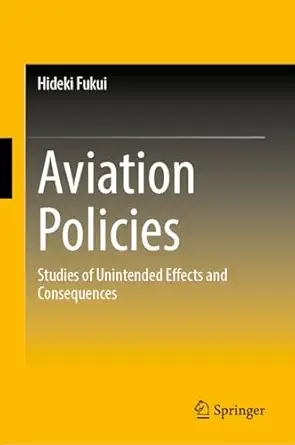
Aviation Policies: Studies of Unintended Effects and Consequences
Author(s): Hideki Fukui (Author)
- Publisher: Springer
- Publication Date: August 20, 2025
- Language: English
- Print length: 528 pages
- ISBN-10: 981967302X
- ISBN-13: 9789819673025
Book Description
This book sheds new light on aviation policies’ unintended effects and consequences, especially regarding infrastructure, environment, and consumer protection. The book provides the reader with the first systematic quantitative analyses of the impacts of airlines’ strategic reactions to the introduction of airport slot markets, aviation fuel tax, and consumer protection rules. Through extensive empirical investigations, the author reveals that aviation policies based on the regulations and tax can produce both intended and unintended effects and consequences. Although the introduction of airport slot markets was expected to enhance airline competition, airlines’ manipulative behaviors have impeded the slot markets’ effective functioning. Also, the aviation fuel tax can reduce emissions in the air transport market effectively, but the amount of the reduction of fuel consumption and CO2 emissions would be smaller in the longer term due to the rebound effect. Finally, the consumer protection rules, e.g., the tarmac delay rule of the US Department of Transportation (DOT) significantly reduced tarmac delays; however, the DOT’s investigations of tarmac delay incidents triggered the investigated airlines’ risk-averse behavior, which increased flight cancelations and gate departure delays to avoid violating the rule. The analyses suggest that the most effective way of regulation depends on conditions unique to each policy area; the government should design interventions that circumvent strategic behaviors of subjects or groups that the interventions affect. This book is highly relevant to academics and practitioners interested in understanding the interactive effects between policy interventions and firms’ strategic reactions.
Editorial Reviews
From the Back Cover
This book sheds new light on aviation policies’ unintended effects and consequences, especially regarding infrastructure, environment, and consumer protection. The book provides the reader with the first systematic quantitative analyses of the impacts of airlines’ strategic reactions to the introduction of airport slot markets, aviation fuel tax, and consumer protection rules. Through extensive empirical investigations, the author reveals that aviation policies based on the regulations and tax can produce both intended and unintended effects and consequences. Although the introduction of airport slot markets was expected to enhance airline competition, airlines’ manipulative behaviors have impeded the slot markets’ effective functioning. Also, the aviation fuel tax can reduce emissions in the air transport market effectively, but the amount of the reduction of fuel consumption and CO2 emissions would be smaller in the longer term due to the rebound effect. Finally, the consumer protection rules, e.g., the tarmac delay rule of the US Department of Transportation (DOT) significantly reduced tarmac delays; however, the DOT’s investigations of tarmac delay incidents triggered the investigated airlines’ risk-averse behavior, which increased flight cancelations and gate departure delays to avoid violating the rule. The analyses suggest that the most effective way of regulation depends on conditions unique to each policy area; the government should design interventions that circumvent strategic behaviors of subjects or groups that the interventions affect. This book is highly relevant to academics and practitioners interested in understanding the interactive effects between policy interventions and firms’ strategic reactions.
About the Author
Hideki Fukui is a professor of Public Policy in the Faculty of Law and Letters at Ehime University. He served as the first director of the Japan Civil Aviation Bureau’s Policy Research Office and a division of the Ministry of Land, Infrastructure, Transport, and Tourism (MLIT), for two years (from April 2015 to March 2017). As his career suggests, his research focuses on aviation policy, with a particular emphasis on airline competition, allocation of scarce airport resources, consumer protection, and environmental protection. He has published papers in international peer-reviewed journals such as Transportation Research Part A, Transportation Research Part B, and Economics of Transportation.