 Wow! eBook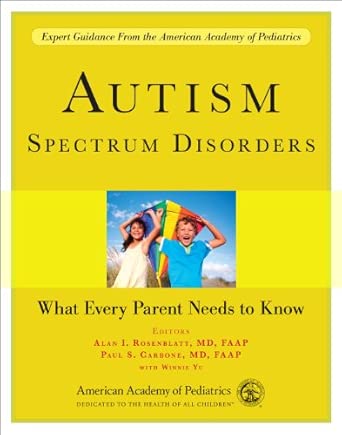
Autism Spectrum Disorders: What Every Parent Needs to Know
Author(s): Alan I. Rosenblatt (Editor), Paul S. Carbone
- Publisher: American Academy of Pediatrics
- Publication Date: 26 Sept. 2012
- Language: English
- Print length: 320 pages
- ISBN-10: 1581106513
- ISBN-13: 9781581106510
Book Description
Editorial Reviews
Review
“Outstanding book and a tremendous resource for parents of autistic children. It is also a must-read for anyone else working to help children with autism reach their full potential.” –Richard Besser, MD, FAAP, chief health and medical editor for ABC News
“Parents looking for a resource after an autism diagnosis will pull Autism Spectrum Disorders, What Every Parent Needs to Know off the shelf with great frequency. The AAP and Drs, Carbone and Rosenblatt cover complex issues in an accessible manner.” –Patricia Wright, PhD, MPH, executive director of autism services for Easter Seals
“Instead of reading like a book, going through the pages of ASD: What Every Parent Needs to Know is more like having a casual conversation in your living room with an ASD wisdom person (or guru?).” –Chris Plauche, MD, FAAP, medical director of the Community Autism Network
“An essential guide for parents of children diagnosed with Autism Spectrum Disorder (ASD). As a Mom of a teenager with ASD, I wish a resource like this was available when my son was diagnosed in 2000.” –Sandy Tiahart, HRSA grant representative for the Autism Program of Illinois
About the Author
Excerpt. © Reprinted by permission. All rights reserved.
Autism Spectrum Disorders
What Every Parent Needs to Know
By Alan I. Rosenblatt, Paul S. Carbone, Winnie Yu
American Academy of Pediatrics
Copyright © 2013 American Academy of Pediatrics
All rights reserved.
ISBN: 978-1-58110-651-0
Contents
Please Note,
Foreword,
Chapter 1: What Are Autism Spectrum Disorders?,
Chapter 2: What Causes Autism Spectrum Disorders?,
Chapter 3: How Do I Know if My Child Has an Autism Spectrum Disorder?,
Chapter 4: Behavioral and Developmental Treatment,
Chapter 5: Tapping Educational Services,
Chapter 6: When Other Therapies Aren’t Enough: The Role of Medication,
Chapter 7: The Role of Complementary and Alternative Medicine,
Chapter 8: Partnering With Your Pediatrician,
Chapter 9: Services in Your Community,
Chapter 10: Accessing Care,
Chapter 11: Adolescence and Beyond,
Chapter 12: Putting It All Together: Everyday Strategies for Helping Your Child,
Chapter 13: Autism Spectrum Disorders and Our Family,
Chapter 14: The Future of Autism Spectrum Disorders,
Chapter 15: Advocating for Children With Autism Spectrum Disorders,
Afterword: Shana’s Special Wish,
Appendixes,
A: Resources,
B: Early Intervention Program Referral Form,
C: Emergency Information Form for Children With Autism Spectrum Disorders,
D: Medication Flow Sheet,
Index,
CHAPTER 1
What Are Autism Spectrum Disorders?
As a pediatrician whose son has an autism spectrum disorder (ASD), I (Dr Carbone) know all too well about the difficult emotions that often surround a diagnosis of an ASD. My son was diagnosed with an ASD in 2004 at the age of 2. Before the diagnosis, we were concerned about his development, beginning in infancy. At times he seemed uncomfortable with symptoms of acid reflux, and at other times he was extremely quiet and hard to engage. While he has always made forward progress, he reached his developmental milestones later than other children. For example, as a young toddler, he had difficulty using gestures, like pointing, to tell us what he wanted, and didn’t begin to talk until he was 24 months old.
While getting the diagnosis was painful, it ultimately helped me to better understand him. It also began the process of knowing how to help him reach his potential.
Although his mother and I are pediatricians, we went through a grieving process just like any parents. At first I thought about the things I did with my father that my son and I might not be able to do, like playing sports. I later realized that although there are some things that are challenging for him, there are many things we do together that bring us both much joy. I have learned during this journey that parenting a child with an ASD is not “better” or “worse” than parenting any other child. It is simply different. My son has helped me appreciate and enjoy those differences.
We have always focused on what our son can do and not on what he can’t. Along the way, we have tried to obtain the best therapies possible that allow him to reach even higher. As scientists, we knew that the best evidence-based therapy available for children with ASDs was behavioral therapy, so we began his behavioral therapy program while he was very young. In addition to intensive behavioral therapy, we were open to trying complementary and alternative therapies as long as they were safe. After doing some research, we tried a few different nutritional supplements and the gluten-free/casein-free (GFCF) diet, understanding that there was limited evidence that these treatments would help reduce the symptoms of autism. After some time we came to the conclusion that his progress with behavioral therapy was no better with these interventions than without them, and so we discontinued them. We have continued to support him with ongoing behavioral therapy and have been delighted with his progress.
Now our son is an active participant in his community. With the support of family, friends, educators, therapists, and doctors he enjoys many of the same activities of his peers: swimming, basketball, bowling, summer camp, reading, and discovering. All who take the time to get to know him are drawn in by his gentle demeanor, curious nature, and wonderful sense of humor.
* * *
Ellen had always taken pride in her son’s intelligence, his expansive vocabulary, and his knowledge of dinosaurs. But at 11, Brian was struggling socially. Classmates found his all-consuming obsession with dinosaurs annoying, and Brian grew impatient with them if they didn’t know as much as he did about the prehistoric creatures. He had trouble understanding sarcasm from his peers. He couldn’t tell when they were being mean but got overly sensitive when they weren’t. He thought nothing of making rude, sarcastic comments during class while the teacher was talking.
Brian also behaved in unusual ways. He was always touching people when he was stuck waiting in lines, falling down at unexpected times, and making loud, inappropriate comments about people within earshot. What concerned Ellen the most was that Brian never seemed to look her in the eye while she was talking to him.
Over time, Ellen grew suspicious that something else was going on with her son, especially when she went back to college to get a degree in psychology and started doing more reading. Though he had already been diagnosed with attention-deficit/hyperactivity disorder (ADHD) at age 7, she began to wonder if he also had an ASD, a diagnosis that a teacher had once suggested but that Ellen had always dismissed. “He didn’t fit the profile of what I thought was autism,” she says. “I always thought children with autism were unattached, unresponsive, and in their own world.”
Ellen had Brian evaluated by a psychologist. A screening test suggested that he had high-functioning autism, a form of ASD marked by an obsession with 1 or 2 topics, challenges with the social aspects of language, and difficulties navigating social relationships. The more she learned about high-functioning autism, the more Ellen was convinced that Brian had it. So far, Ellen has been hesitant about getting a formal diagnosis. She fears that the label will create a lifelong stigma for her son. “And I’m afraid some people will look at me and think I’m a bad parent,” she says. (Ellen, Price, UT)
* * *
Chances are, you’re familiar with some of the concerns that Ellen is facing or the difficult emotions that Dr Carbone has experienced while raising a child with an ASD. Like Ellen, you may be wondering whether you should have your child diagnosed or what a diagnosis will mean for your child’s life. Like Dr Carbone, you may be looking for information about where to find help for your child’s language delays, social challenges, and behavioral problems. Or maybe you suspect your child has an ASD but haven’t addressed your concern with your pediatrician yet.
We hope that reading this book will help provide you with the information you are seeking to make the best decisions for your child. In this book, you will learn how ASDs are defined and diagnosed, and the types of behavioral and developmental therapies available for treating them. You will learn when medications may be required, and whether complementary and integrative medicine may be helpful. We will also help you create a treatment team that includes your pediatrician, and provide information to help you care for your child and get a handle on the types of services and assistance available to him. In addition, we will help you understand the effect of ASDs on you and the rest of your family. Stories from other parents will help you understand that you are not alone on this journey. You will acquire an understanding of how ASDs will affect your child as he grows older and the types of advocacy you can do as the most important part of the treatment team: the parent of a child with an ASD.
* * *
Autism spectrum disorders are a group of biologically based neurodevelopmental disorders that affect a child’s behavior and social and communication skills. They belong to a group of disorders known as pervasive developmental disorders (PDDs), a distinction that includes ASDs, Asperger syndrome, and pervasive developmental disorder–not otherwise specified (PDD-NOS). These subcategories were used in the fourth edition of the Diagnostic and Statistical Manual of Mental Disorders (DSM-IV), a manual published by the American Psychiatric Association to provide diagnostic criteria for behavioral conditions. They will be eliminated in the new DSM-5, which will be published in 2013. You will read more about the differences later in this chapter.
For most children, these conditions are chronic and require lifelong management. Some children — approximately 3% to 25%, according to studies — improve over time to a point where they no longer meet diagnostic criteria for ASDs. In general, these children are the ones who have typical learning abilities and have received behavioral therapy (see Chapter 4). However, most children who improve still have other developmental and behavioral symptoms.
No doubt, we certainly hear a great deal about ASDs these days. A study by the Centers for Disease Control and Prevention (CDC) estimated that ASDs affect 1 in 88 children, about 1% of all children. Boys are 5 times as likely to be affected as girls, and white children are more often diagnosed than African American and Hispanic children.
A major reason for the dramatic increase in the diagnosis of ASDs has to do with changes in the way the conditions are diagnosed. In 1994, the diagnosis was changed to include children with milder symptoms, including those whose language is closer to normal cognitive milestones. In addition, a growing body of research showing the importance of early, intensive behavioral treatment in helping children with ASDs prompted the federal government to emphasize early detection, so that more children could receive services at a younger age. The emphasis on importance of early diagnosis and intervention inspired several major public education campaigns to teach parents about ASDs and the importance of early diagnosis.
In spite of all the public interest in and attention on autism, figuring out whether your child has an ASD is not easy. These conditions are remarkably complex and difficult to diagnose. No 2 children exhibit the same symptoms, and severity varies widely. Some cases may be subtle, while others may be more straightforward. In most cases, the process of determining whether a child has an ASD usually begins with parents who are concerned about their child’s development. But in some cases, the early sign of an ASD first comes to the attention of a pediatrician or child care provider who observes something different in the way the child plays, learns, speaks, or acts.
We’ll discuss more about diagnosis in Chapter 3. First, we’ll go back in time to see how autism emerged as a major health concern.
A Brief History of Autism
Autism was first described in 1943 by Dr Leo Kanner, a child psychiatrist at Johns Hopkins University School of Medicine. It was Dr Kanner who first coined the term autism, borrowed from the Swiss psychiatrist Eugen Bleuler, who used the word to describe the idiosyncratic, self-centered thinking he saw in schizophrenia. Kanner used autism to describe 11 children in his practice who seemed to prefer isolation to social engagement. The children all displayed extreme aloofness and total indifference to other people. They made little eye contact and did not engage in imaginary play. Some displayed an amazing ability for rote memory. Others were obsessed with routines, spinning toys, and mechanical objects. Dr Kanner believed that autism was an inborn disorder and that children with this condition entered the world without biological underpinnings for social interaction. These were children who lived in their own world. Even today, Dr Kanner’s descriptions of autism are highly regarded and considered some of the best ever written.
In the 1950s, Freudian psychoanalysts put a new spin on autism, contending that the condition resulted from the emotional withdrawal of a baby born to a cold and emotionally distant parent. In particular, they focused on mothers and called these parents “refrigerator mothers.” Bruno Bettelheim, then the director of the Orthogenic School in Chicago, became fascinated with children who had autism and advanced this theory. (Bettelheim had a PhD in philosophy but was widely cited as a child psychologist. He lectured on psychology at the University of Chicago, despite the lack of any formal training.) Bettelheim’s most famous patient was a boy named Joey, whom he described in 1959 as a “mechanical boy” in the popular magazine Scientific American. At 18 months, Joey was unable to speak and was described by his grandparents as “remote and inaccessible.” Joey became fascinated with mechanical objects and learned to take apart and reassemble an electric fan. By the age of 4, Joey was spending a great deal of his time rocking back and forth and becoming completely consumed with mechanical objects.
Like many of his colleagues at the time, Bettelheim blamed Joey’s unusual behaviors on his parents. Bettelheim claimed that their aloof parenting style forced Joey to withdraw into his own world and marked the beginning of his descent into schizophrenia. In fact, autism was classified as a form of childhood schizophrenia in the first 2 editions of DSM.
Bettelheim’s views persisted for years until experts began to consider autism from more biological perspectives. In 1964, a research psychologist named Bernard Rimland described infantile autism as a neurologic disorder with a strong genetic component. Rimland and his wife were personally acquainted with autism — they were the parents of a child with autism, whom they had diagnosed themselves.
Studies in the early 1970s showed that despite similar symptoms, autism was a disorder distinct from childhood schizophrenia. In 1977, the first study of twins and autism was published in the Journal of Child Psychology and Psychiatry. The study found a strong genetic influence in identical twins who had autism. If one twin had autism, the other twin was much more likely to have other cognitive differences too. Finding a genetic connection to autism meant that autism needed to be described more precisely so that it could be properly studied and better understood. That became possible in 1980, when infantile autism finally received its own separate category in the third edition of DSM.
Defining Autism Spectrum Disorders Today
Even now, as we go to press, the definition of ASDs is evolving. To understand how it will change, we need to look at DSM-IV, which was published in 1994, and the soon-to-be published DSM-5, which is in the process of being written. In short, the disorder remains unchanged, but how it is classified and described will be different.
In DSM-IV, ASDs are listed as 1 of 5 PDDs. The other PDDs are Asperger syndrome, PDD-NOS, childhood disintegrative disorder, and Rett syndrome. Here is how these conditions are defined.
Autistic Spectrum Disorder
Autistic spectrum disorder is what most people know as autism. Children who have ASDs have problems relating to others socially. They may have trouble making eye contact, building friendships, and sharing things they enjoy with other people. As infants, they often display limited or no joint attention, a behavior that involves enjoying an object or event with another person by looking back and forth between the two.
Many children with ASDs have delayed language skills or use language in ways that are out of the ordinary. Rather than use language to connect with others, they may use words to meet basic needs, or they may just use their vocabulary for labeling but not to indicate their needs. For instance, a child may have a vocabulary of 20 or more words for labeling objects yet not be able to use those words to ask for an item at an appropriate time. In some cases, children may not develop the ability to use verbal communication.
While social difficulties may appear in the first year, communication problems may not become obvious until the second year. A 2-year-old may lack words to communicate or may not be able to use the words he does have for meaningful interaction, and by age 3, may have no phrases or sentences. Over time, these communication challenges become even more noticeable. Some children may have trouble knowing how to start a conversation. Others may have echolalia, in which they repeat what people say to them. Still others may constantly recite scripts from favorite videos or TV shows.
When children with ASDs play, they rarely use their imagination. They may not act out scenarios or pretend that an object is something else (using a pencil for a laser sword or a banana for a telephone, for instance). When they do play, they may prefer to arrange their toys or play with parts of a toy — opening doors on a car door instead of driving it, for example. Some children form attachments to hard objects such as a ballpoint pen or flashlight instead of stuffed animals.
Children with ASDs may become rigidly fixated on topics that most other people would consider unusual and have trouble letting go of these topics. For instance, they may be interested in movie credits, license plates, or addresses.
Some may become consumed with following rigid routines that may not have any useful purpose or have a strong insistence on sameness. For example, children with ASDs may prefer that certain activities be done in a precise order and may become highly anxious if a routine or ritual is broken. Likewise, they may have difficulty with transitions if they have not been prepared ahead of time.
(Continues…)Excerpted from Autism Spectrum Disorders by Alan I. Rosenblatt, Paul S. Carbone, Winnie Yu. Copyright © 2013 American Academy of Pediatrics. Excerpted by permission of American Academy of Pediatrics.
All rights reserved. No part of this excerpt may be reproduced or reprinted without permission in writing from the publisher.
Excerpts are provided by Dial-A-Book Inc. solely for the personal use of visitors to this web site.


