Wow! eBook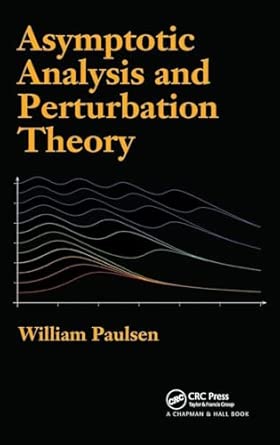
Asymptotic Analysis and Perturbation Theory
Author(s): William Paulsen (Author)
- Publisher: Chapman and Hall/CRC
- Publication Date: 18 July 2013
- Edition: 1st
- Language: English
- Print length: 550 pages
- ISBN-10: 1466515112
- ISBN-13: 9781466515116
Book Description
Beneficial to both beginning students and researchers, Asymptotic Analysis and Perturbation Theory immediately introduces asymptotic notation and then applies this tool to familiar problems, including limits, inverse functions, and integrals. Suitable for those who have completed the standard calculus sequence, the book assumes no prior knowledge of differential equations. It explains the exact solution of only the simplest differential equations, such as first-order linear and separable equations.
With varying levels of problems in each section, this self-contained text makes the difficult subject of asymptotics easy to comprehend. Along the way, it explores the properties of some important functions in applied mathematics. Although the book emphasizes problem solving, some proofs are scattered throughout to give readers a justification for the methods used.
Editorial Reviews
Review
About the Author
William Paulsen is a professor of mathematics at Arkansas State University, where he teaches asymptotics to undergraduate and graduate students. He is the author of Abstract Algebra: An Interactive Approach (CRC Press, 2009) and has published over 15 papers in applied mathematics, one of which proves that Penrose tiles can be three-colored, thus resolving a 30-year-old open problem posed by John H. Conway. Dr. Paulsen has also programmed several new games and puzzles in Javascript and C++, including Duelling Dimensions, which was syndicated through Knight Features. He received a Ph.D. in mathematics from Washington University in St. Louis.