 Wow! eBook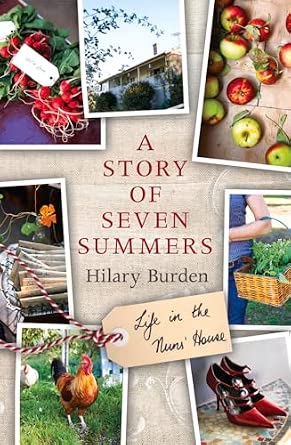
A Story of Seven Summers: Life in the Nuns' House
Author(s): Hilary Burden (Author)
- Publisher: Allen & Unwin
- Publication Date: 1 Sept. 2012
- Language: English
- Print length: 280 pages
- ISBN-10: 1742376843
- ISBN-13: 9781742376844
Book Description
‘Looking back over seven summers, I know that who I am is where I am. It might not be the secret to life, but it is the secret to this life … I’ll tell you how that came to be and that will be the story of the Nuns’ House.’
From the outside, Hilary Burden was living a glamorous life – she was a busy, high-flying, globetrotting magazine journalist based in London, who thought nothing of flying to New York for a weekend, interviewing movie stars in luxury hotels or jetting off to Italy on assignment to hunt truffles with Curtis Stone. But inside, something was missing in her life and she didn’t know quite what it was.
Deciding that she wanted to make her own life, Hilary returned to Tasmania. She bought a ramshackle cottage – the Nuns’ House – with a sprawling, neglected garden, and gave herself the time and space to begin again. There was no particular kind of plan, but things just somehow worked. Now, seven summers later, she has a home, a garden, two alpacas (named Jack and Kerouac), two chooks (called Marilyn and Monroe), a purpose and a passion.
A beautiful, intimate and inspiring story of having the courage to step into the unknown.
Editorial Reviews
Review
About the Author
Excerpt. © Reprinted by permission. All rights reserved.
A Story of Seven Summers
Life in the Nuns’ House
By Hilary Burden
Allen & Unwin
Copyright © 2012 Hilary Burden
All rights reserved.
ISBN: 978-1-74237-684-4
CHAPTER 1
London, 2004
I used to live in a one-bedroom, third-floor Edwardian mansion flat overlooking a bridge on the River Thames. In winter, I could see as far up the river as Craven Cottage, Fulham Football Club’s ground, and as far downriver as the spire of St Nicholas Parish Church, Chiswick. In summer, my view was of the leafy London plane trees whose roots lay somewhere under the concrete footpath. Sometimes you could hear the wood pigeons cooing, but mostly the sounds were of an endless drum of traffic from the road below. I don’t remember ever seeing the stars in four years, but I loved to sit on the bench on Hammersmith Bridge at sunset or moonrise with a bottle of sparkling wine. It was a simple wooden bench made for any bottom that cared to sit there: a bench with no name.
I was born in Britain, brought up in Tasmania, and worked overseas for most of my life, while still calling Tasmania ‘home’. I lived away — in Sydney, Tokyo and London — for over twenty years. ‘Have you ever worked abroad?’ was the question I wanted to answer with the YES of experience. So work became a home that was on the move and going places, a job with a salary and a wardrobe full of jackets. And my childhood left behind. Tasmania was where I learned how to shoot, go four-wheel-driving, scuba dive, line-fish for flathead, cook abalone and crayfish, steer a motorboat, sail a yacht, and hang-glide — mostly before I was old enough to vote. I used few of these skills in England. Maybe that’s why I always thought something was missing. While dating the exciting kind of men you meet in big cities (bankers, lawyers, writers and politicos), I fantasised about a partner who could also throw a dog on the back of a ute.
Instead, the glossy magazine world in which I was absorbed took me to exciting places: a café opening in Venice, the launch of a new Chanel nail polish in Paris. I went from jet-boat racing at the Cannes Film Festival to canoeing down the Zambezi, and interviewed everyone from Kylie Minogue (recording her first single for Stock Aitken Waterman in a Bermondsey studio) to Kevin Kline on a plump sofa at the Mayfair Hotel and Elle Macpherson in a chic pied-à-terre in Paris. I was like a Pollyanna living a lily-pad existence.
For many years I thrived on these skin-deep moments, but eventually my spirit wore thin and I could not throw off the feeling that my life was false. I started searching for something I could not define, some version of the road less travelled, and found my sense of direction took me into churches. For a while, All Souls Church, Langham Place, next to the BBC’s headquarters in Broadcasting House, was convenient to Great Portland Street where I worked. In my lunch hour I’d pop in to breathe a different air that comes with high ceilings and wide rooms. When Princess Diana died I recall an air of sadness so poignant I stood outside the nearest church to contemplate the space from a distance. Winchester Cathedral was also a favourite haunt, but that was more about architecture than religion. If ever there was a time for me to be ‘saved’ by religion, I suspect this was it. I guess I’ve never been the kind of person who puts their fate in someone else’s hands.
Instead, every year I would escape to New York on my own for a long weekend, shopping for labels, sitting in hip hotel bars, walking the streets, exploring museums and galleries for inspiration and ideas from the city that never sleeps. I think it was Carrie’s line in Sex and the City: ‘In New York they say the only thing you’re looking for is a job, a boyfriend or an apartment.’ Maybe I was, but none found me. So I went to the other extreme and learned to ride a motorbike so I could ride solo across the Nullarbor from Perth to Melbourne. From the middle of everywhere to the middle of nowhere I looked for meaning and direction, finding neither. Road signs along the route explained, helpfully, YOU ARE HERE. Yes, I pondered, it’s good to know where you are, but what does that mean?
Although for much of the journey the earth was blood-red and the sky true-blue, I took black-and-white photographs inspired by the solemnity of Ansel Adams’ landscapes. At London’s Hayward Gallery I’d recently seen his exhibition of stunning black-and-white images, taken over a professional lifetime, of Yosemite National Park, California. Of a moon over a winding road through textured wheat fields — a seemingly snapped moment, but, as the caption explained, one that Adams had waited days to capture. I know now that a life lived well is lived deeply beneath the gloss. But back then, I found myself sitting on a bench in the middle of the gallery unable to hold back tears, sobs of emptiness and morbid self-pity that drove me to misery, and finally therapy, because I could not stop the tears. ‘Perhaps you were crying because you missed Australia and the images of the mountains and wide open spaces reminded you of home?’ said the psychologist in one session. It sounded too simplistic and banal for me at the time. After all, I thrived on northern hemisphere thinking, craved a culture of intellect, revelled in sharp minds and articulate thinkers, and liked to swim in the zeitgeist. How could laid-back Australia compete? But the effect of things said is sometimes only realised much later.
‘There are only seventy-two summers in one lifetime,’ I remember a London ad man telling me when he left the safety zone of a big job to start up his own business with a friend. He said they’d named their agency ‘Karmarama’ and, while I wondered what exactly he’d be selling, the line he used stayed with me. If I only had thirty summers left — less if I was unlucky — then what was keeping me?
On the day of a solar eclipse, I went down to the river to watch the sun blacken, along with hundreds of others who lined the park by the Thames in the middle of the afternoon. I watched the moon pass in front of the sun and the randomly assembled crowd oohed and ahhed and whispered in unison, moved by something greater than themselves. After the sun had reappeared it took all the effort in the world for me to walk the short way home, as if I had to will and push my own blood through my body to keep living. What do I do now? What do I do?
The essence of my loneliness was that I wanted to be fully expressed and fully understood — and it wasn’t happening. It wasn’t happening in my work, or in my love life. And every step I took to meet the world seemed like a step that set me back. Every opportunity that sold itself was transient. Other people met men, got married, had children, bought homes together. My tendency was to meet people who offered the world and delivered the opposite. Marcelle was one friend who seemed to understand. As a former editor of British Cosmopolitan she had long been an advocate of the single girl’s life, especially over a coffee éclair in our favourite haunt, Patisserie Valerie. ‘Hil,’ she asked, when we were dissecting why the man to whom I was engaged to be married had started an affair, ‘do you think you’ll ever be able to fall in love again?’
As a single woman in London, weekends were often spent shopping, walking or soaking up old movies on BBC2, either alone or with friends. I recall one Saturday afternoon watching three in a row, all by the 1950s director Douglas Sirk. My notes remind me now. They were Magnificent Obsession, Imitation of Life and All that Heaven Allows. And they all revolved around the single theme of finding your true and real path in life; once you find that, they promised, you will be lit from the inside. There were many times in my life when I thought I’d found that point, only to be disappointed and to return to the gnawing frustration that this is what life is and always would be: that some people lived lives that other people dreamed about and that I was to be one of the dreamers with a life unlived. As it happened, All that Heaven Allows starred Rock Hudson and Jane Wyman and featured a book I’d never heard of, Walden by Henry David T horeau. I ordered a copy and when it arrived devoured it.
It is not worth the while to go
round the world to count the
cats in Zanzibar.
The fanciful line stood out and it was as if all the cats in all the cities I’d ever visited were haunting me now. I could see the skinny cats in Bali, the slinky Siamese in Marrakech, pampered cats in Parisian laps and cats on Roman holidays. I started thinking about moving out of the city, of fresh air, open spaces, and nature that was raw and wild.
* * *
After leaving Tasmania in a hurry in my early twenties to work first in Sydney, and then London, I never imagined that I would return to live there. People would joke that there were more sheep than people on the island and that the state’s half a million inhabitants were all inbred. Over two decades, many a holiday was spent travelling the 17,000 kilometres back to Tasmania to visit family for Christmases or birthdays, or to introduce them to the important boyfriends, though never a husband. Wilf, my father, once remarked knowingly, ‘Mark my words, you’ll be a spinster aunt,’ as if there was something rare or wrong in that. He could hardly know that in my world, the spinster aunt was the norm. Many of my friends were bright, independent women, flawed and funny doyennes of single life. In Tasmania, being a spinster aunt was nowhere near sassy, but I saw its other advantages. When you got off the plane, fresh air hit you in the face like a wet towel and you breathed differently there.
Gradually, over the years, an objective appreciation for things Tasmanian grew and I would return to my northern hemisphere life with pebbles and shells stolen from southern hemisphere beaches, and treasured photographs taken in front of wild oceans, in rainforests, on gravel roads. Following one particular trip, in the mid-nineties, I returned to London with a shopping bag of Tasmanian goodies I’d picked up on my travels: leatherwood honey in an old-fashioned tin, fresh rainwater in a plastic bottle, homemade relishes in jars, and small pouches of native pepperberry spices. I took the bag to the heart of foodie London: Conran’s Bluebird Epicerie on the King’s Road, Chelsea. The friendly food buyer was inspired by what I’d shown her from the other side of the world. ‘Cloud Juice,’ she said, referring to bottled rainwater from King Island. ‘I could easily see that on our restaurant tables upstairs …’ I don’t know what I was hoping to achieve from the visit other than wanting to share what I thought was unique about the place I grew up in, a place that often got left off the map. My love of something as pure as rain captured from a tin roof and bottled was clear to me, but I had no desire to become a food exporter.
Instead, I continued working as a writer and editor specialising in launching new magazines. I liked the challenge of starting from scratch with a blank page. One of them, a new food title for the BBC’s magazine division, was code-named ‘Project Olive’. Breaking all the rules to do with codes, Olive fitted so well it actually became the name of the magazine. That was also how I got to taste truffles for the first time. Close your eyes and try to imagine the smell. It’s like trying to describe the perfume your mother wore when you were three years old. More than a smell — it’s a memory, like attraction itself. I tasted my first truffles in Umbria with a group of chefs and food journalists invited to the Urbani family’s truffle estate in Scheggino. I took notes for a story as we went.
There are ten species of truffle gathered in Italy: the most prized are the white truffle from Alba, Piedmont, and the black truffle from Norcia and Spoleto. White truffle ripens from October to December, favoured by summer rains, and the black from November to mid-March. The white is more subtle and generally preferred raw while the black is usually cooked. It would take a poet to evoke their taste without using another taste to describe them …
One of the chefs was Curtis Stone. Even the men at the Olive magazine office had swooned when Curtis came in to discuss the trip, and now here we were squashed up next to one another on a minibus in Umbria. Curtis spoke Italian because he’d once lived in Calabria. Italians, he said, have the best attitude to food in the world because they live for their lunch. So, what is the best way to eat the world’s best truffles, I quizzed. ‘Shaved raw on to food,’ was his answer. ‘There’s nothing better than the smell and flavour of thin slices of fresh white truffle just as they hit hot food. The white is amazing uncooked — so delicate — you should let it speak for itself.’
I liked the idea of letting things speak for themselves; that we had come to experience the pointy end of haute cuisine, in the place where it belonged, only to learn that shaved raw was better than any trick played by a chef. That evening we strolled the streets of Spoleto to find a camping stove, borrowed plates and cooking utensils from the hotel we were staying at, and packed a rucksack ready for what we decided would be a food shoot in the countryside. The next day, in search of truffles, Geoff, the photographer, Curtis and I travelled by bus into the Umbrian hills with Gianni Piermarini and his truffle-hunting dogs. We set up camp on the side of a hill and Curtis made a lunch of scrambled eggs where our truffles were found. This may have been my first introduction to a word I had yet to learn the meaning of: provenance. The truffle was a gift from this place.
For me, an appreciation of food was not about being a cook, a chef or a foodie. It was more about having an appreciation for where things come from and for knowing what makes something truly itself. I couldn’t do this for myself without knowing where my home was. And when I asked myself honestly if it was London, it wasn’t. Although I was born in Bristol, and Wilf and my mother, Audrey, were both Londoners, England was in my head, not my heart.
I had hit a rut in the city but didn’t want to blame it. What I was looking for was the exact opposite of a packaged meal for one from the ready-made meals in Tesco Metro. I wanted to walk up the road to a real greengrocer, buy fresh fish from the fishmonger, have a yarn with the local publican, and wend my way home with fresh bread. I looked for this sense of home wherever I went, and seriously in Aldeburgh and Salcombe, but with no success. On one of these trips, I found in a second-hand bookshop a copy of William Hazlitt’s The Spirit of the Age, contemporary portraits first published in 1825 of Jeremy Bentham, William Godwin, Samuel Taylor Coleridge, Sir Walter Scott, Lord Byron, William Wordsworth, Thomas Malthus, William Wilberforce … names that resonated with romance and vision. ‘Mr Bentham is not the first writer who has assumed the principle of UTILITY as the foundation of just laws, and of all moral and political reasoning …’ wrote Hazlitt, though adding, ‘he has not allowed for the wind.‘ Wherever my independent life would take me next, I wanted to be both useful, and to allow for the wind.
* * *
I decided to take a holiday in Tasmania. I hadn’t been back for a couple of years and organised to join a group on a four-day walk along the white sandy beaches of the Bay of Fires. By day, our group of strangers shared footprints in the sand and conversations were lost on the sea air. By night, around a campfire and under stars, we talked about youth and beauty. I became friends with Gillian, one of the walkers from Sydney, and she mentioned a documentary called Wildness, about two Tasmanians, the great wilderness photographers Olegas Truchanas and Peter Dombrovskis. Later, Audrey tracked down the video and posted it to me in London.
The philosophy of these two photographers was simple — if people could see the beauty of Australia’s wild places they might be moved not only to protect them but to understand the true value of the world around them. It struck me that this message should be applied not just to the Tasmanian wilderness but to everywhere we live; that if we could see the beauty in anything we would then understand the value within.
(Continues…)Excerpted from A Story of Seven Summers by Hilary Burden. Copyright © 2012 Hilary Burden. Excerpted by permission of Allen & Unwin.
All rights reserved. No part of this excerpt may be reproduced or reprinted without permission in writing from the publisher.
Excerpts are provided by Dial-A-Book Inc. solely for the personal use of visitors to this web site.


