 Wow! eBook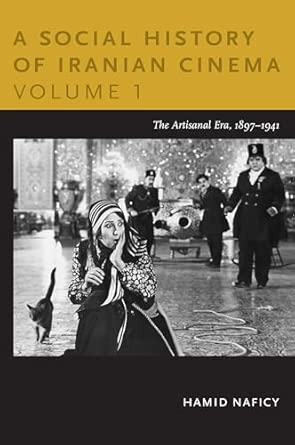
A Social History of Iranian Cinema, Volume 1: The Artisanal Era, 1897–1941 (Social History of Iranian Cinema (Paperback))
Author(s): Hamid Naficy (Author)
- Publisher: Duke University Press
- Publication Date: 16 Sept. 2011
- Language: English
- Print length: 456 pages
- ISBN-10: 082234775X
- ISBN-13: 9780822347750
Book Description
Volume 1 depicts and analyzes the early years of Iranian cinema. Film was introduced in Iran in 1900, three years after the country’s first commercial film exhibitor saw the new medium in Great Britain. An artisanal cinema industry sponsored by the ruling shahs and other elites soon emerged. The presence of women, both on the screen and in movie houses, proved controversial until 1925, when Reza Shah Pahlavi dissolved the Qajar dynasty. Ruling until 1941, Reza Shah implemented a Westernization program intended to unite, modernize, and secularize his multicultural, multilingual, and multiethnic country. Cinematic representations of a fast-modernizing Iran were encouraged, the veil was outlawed, and dandies flourished. At the same time, photography, movie production, and movie houses were tightly controlled. Film production ultimately proved marginal to state formation. Only four silent feature films were produced in Iran; of the five Persian-language sound features shown in the country before 1941, four were made by an Iranian expatriate in India.
A Social History of Iranian Cinema
Volume 1: The Artisanal Era, 1897–1941
Volume 2: The Industrializing Years, 1941–1978
Volume 3: The Islamicate Period, 1978–1984
Volume 4: The Globalizing Era, 1984–2010
Editorial Reviews
Review
– Michelle Langford, Senses of Cinema
“These volumes reveal the unspoken side of Iranian culture, society and history within the context of film and cinema. This marvellously detailed account of Iranian cinema is a must-read for anyone who is interested in understanding Iran in the past and present, a true story of a long-term, ongoing revolution in Iranian culture, society and film.” – Arezou Zalipour,
Media International Australia“
A Social History of Iranian Cinema is an extraordinary achievement, a scholarly, detailed work in which a massive amount of material is handled with the lightest touch. Yet it is Hamid Naficy’s personal experience and investment that give this project a particular distinction. Only a skilled historian, one who is on the inside of his story, could convey so vividly the symbolic significance of cinema for twentieth-century Iran and its deep intertwining with national culture and politics.”—Laura Mulvey, author of Death 24× a Second: Stillness and the Moving Image“Hamid Naficy is already established as the doyen of historians, as well as critics, of Iranian cinema. Based on his deep understanding of modern Iranian political and social history, this detailed critical study of cinema in Iran since its debut more than a century ago is his crowning achievement. To say that it is a must-read for virtually all concerned with modern Iranian history, and not just cinema and the arts, is to state the obvious.”—
Homa Katouzian, author of The Persians: Ancient, Mediaeval and Modern Iran“Hamid Naficy seamlessly brings together a century of Iran’s cinematic history, marking its technological advancements and varying genres and storytelling techniques, and perceptively addressing its sociopolitical impact on the formation of Iran’s national identity.
A Social History of Iranian Cinema is essential reading not only for the cinephile interested in Iran’s unique and rich cinematic history but also for anyone wanting a deeper understanding of the cataclysmic events and metamorphoses that have shaped Iran, from the pivotal Constitutional Revolution that ushered in the twentieth century, through the Islamic Revolution, and into the twenty-first century.”—Shirin Neshat, visual artist, filmmaker, and director of the film Women Without Men“This magisterial four-volume study of Iranian cinema will be the defining work on the topic for a long time to come. Situating film within its sociopolitical context, Hamid Naficy covers the period leading up to the Constitutional Revolution and continues after the Islamic Revolution, examining questions about modernity, globalization, Islam, and feminism along the way.
A Social History of Iranian Cinema is a guide for our thinking about cinema and society and the ways that the creative expression of film should be examined as part of a wider engagement with social issues.”—Annabelle Sreberny, coauthor of Blogistan: The Internet and Politics in Iran“These volumes reveal the unspoken side of Iranian culture, society and history within the context of film and cinema. This marvellously detailed account of Iranian cinema is a must-read for anyone who is interested in understanding Iran in the past and present, a true story of a long-term, ongoing revolution in Iranian culture, society and film.” — Arezou Zalipour ―
Media International Australia“While the first two volumes that I have had the pleasure to review here are indeed comprehensive, covering great depth and breadth, I find Naficy to be a very open, collegial scholar whose work certainly does not close down the field. Rather, at times, Naficy openly signals that more research is still to be conducted into certain areas ensuring that the field of Iranian cinema studies may live on with vital and vibrant energy. Graduate students in particular should take heed of these openings in the text, for therein lie great possibilities for future, compelling and original scholarship in the field…. I can only conclude my review by emphasizing what I said in my opening comment: this is rich, compelling, and complex scholarship at its very finest. Thanks Hamid!”
— Michelle Langford ―
“The four volumes of
A Social History of Iranian Cinema constitute a landmark achievement. . . . For students of Iranian cinema, I can think of no better place to begin than these four volumes. The sheer expansiveness of Naficy’s project is a testimony to the untold narratives, theoretical paradigms, and concepts waiting to be found in the ongoing history of Iranian cinema.” — Sara Saljoughi ― International Journal of Middle East StudiesFrom the Author
Hamid Naficy is Professor of Radio-Television-Film and the Hamad Bin Khalifa Al-Thani Professor in Communication at Northwestern University. He is the author of An Accented Cinema: Exilic and Diasporic Filmmaking, The Making of Exile Cultures: Iranian Television in Los Angeles, and (in Persian) Film-e Mostanad, a two-volume history of nonfiction cinema around the world. Naficy helped to launch ongoing annual Iranian film festivals in Los Angeles and Houston.
About the Author
Hamid Naficy is Professor of Radio-Television-Film and the Hamad Bin Khalifa Al-Thani Professor in Communication at Northwestern University. He is the author of An Accented Cinema: Exilic and Diasporic Filmmaking, The Making of Exile Cultures: Iranian Television in Los Angeles, and (in Persian) Film-e Mostanad, a two-volume history of nonfiction cinema around the world. Naficy helped to launch ongoing annual Iranian film festivals in Los Angeles and Houston.
Excerpt. © Reprinted by permission. All rights reserved.
A SOCIAL HISTORY OF IRANIAN CINEMA
Volume 1 The Artisanal Era, 1897–1941By Hamid Naficy
Duke University Press
Copyright © 2011 Duke University Press
All right reserved.
ISBN: 978-0-8223-4775-0
Contents
List of Illustrations…………………………………………………………………………………….ixAcknowledgments………………………………………………………………………………………….xiiiOrganization of the Volumes……………………………………………………………………………….xxiA Word about Illustrations………………………………………………………………………………..xxviiPreface: How It All Began…………………………………………………………………………………xxixIntroduction: National Cinema, Modernity, and Iranian National Identity………………………………………..11 Artisanal Silent Cinema in the Qajar Period……………………………………………………………….272 Ideological and Spectatorial Formations…………………………………………………………………..713 State Formation and Nonfiction Cinema: Syncretic Westernization during the First Pahlavi Period…………………1414 A Transitional Cinema: The Feature Film Industry and Sound Cinema……………………………………………1975 Modernity’s Ambivalent Subjectivity: Dandies and the Dandy Movie Genre……………………………………….277Notes…………………………………………………………………………………………………..309Bibliography…………………………………………………………………………………………….343Index…………………………………………………………………………………………………..371
Chapter One
ARTISANAL SILENT CINEMA IN THE QAJAR PERIOD
The first known actuality film by an Iranian was filmed in 1900, not in Iran but in Belgium, by the Qajar court photographer Ebrahim Khan Akkasbashi Sani al-Saltaneh, who had accompanied Mozaffar al-Din Shah on his European trip. The French Catholic mission opened the first public cinema, Soleil Cinema, the same year in the city of Tabriz; it was later operated by an Armenian Iranian, Alek Saguinian. The first commercial movie house, Cheraq Gaz Street Cinema, operated by the ardent constitutionalist Ebrahim Khan Sahhafbashi Tehrani, opened its doors to the public in late 1904, showing comedies, trick films, and newsreels of the Transvaal war in South Africa. Yet this cinema was apparently banned by the leading Muslim cleric Shaikh Fazlollah Nuri and shut down by the Shah within a month. These brief tales of origin already evidence the microphysics of maneuvers and relations between Iran and the West and among Iranians themselves that helped bring cinema and modernity to Iran.
The Constitutional Revolution of 1905–11, the first democratic revolution in the Middle East, replaced despotic monarchy with parliamentary monarchy: the Qajar dynasty ended, while modernity and Westernization movements emerged reenergized. The new constitution, the division of government into separate legislative, judicial, and executive bodies, and many laws were adapted from Europe, particularly from Belgium. Likewise, from the mid-nineteenth century onward, the education, postal, and banking systems; the technologies of telegraphy, telephony, and electric lighting; the mass media of printing, journalism, photography, and sound recording; and new literary, theatrical, and musical forms were all imported or adapted, ad hoc, from European, Russian, or American models. Cinema was only the latest in this long list of elements of Westernization in Iran. Travel abroad for business, education, military training, pilgrimage, and pleasure or for political exile further widened people’s horizons and drove Iranians’ critical self-awareness as individuals and as national subjects, creating important preconditions of modernity.
Although not colonized, Iran was integrated into the neocolonial and capitalist Western economies. This integration was aided by the bitter rivalry between the great powers of Czarist Russia and imperial Britain who vied with each other to either force or fascinate Iran into their own “sphere of influence.” 1 It was also facilitated by the actions of various Qajar shahs and political leaders who incurred huge national loans or mortgaged Iran’s resources (e.g., minerals, oil, tobacco, and customs duties) to foreign powers to finance expensive and sometimes dubious national and personal projects. These multiple contacts made Iranians painfully aware both of the achievements and dynamism of the great powers and of their own shortcomings and low international standing, putting them ill at ease. In fact, many Iranians thought they were suffering from a dis-ease—socioeconomic backwardness, self-doubt, and apathy—whose cure was thought to be the adoption of modernization, individualism, and nationalism, in short, modernity. Modernization and its disruptions brought about urbanism, a modern intelligentsia, and a middle class, from which the pioneers of cinema and film’s spectators emerged. A new modern national identity grew, to which cinema and other mass media contributed, and a widespread social discontent spread, which cinema would reflect and shape.
The Constitutional Revolution mobilized middle-class bazaar merchants, reformist Shiite clerics, and secular intellectuals to work together for modernization and sociopolitical reform (Keddie 1981). Given this neocolonial background and Iranian psychology and mythology, it seems little wonder that from the beginning Iranian nationalism was driven more by a search for justice than for rights. As a result, most twentieth-century oppositional movements and intellectual criticism, including cinematic critiques, also tended to revolve around issues of social justice rather than of human rights. Like other major recent reform movements in Iran, the Constitutional Revolution was chiefly urban and aided by the media. If the earlier anti-British and anti Shah tobacco protest movement (1890–91) was facilitated by the telegraph, and the later Islamic Revolution (1978–79) by the conjoining of the telephone and audiocassette recordings, the Constitutional Revolution’s cause was energized by newspaper reporting—fed by telegraphic dispatches from reporters —and by photography. Having studied the West, constitutionalists became convinced that the solution to Iranian backwardness was “to break the three chains of royal despotism, clerical dogmatism, and foreign imperialism. They abhorred the first as the inevitable enemy of liberty, equality, and fraternity; the second as the natural opponent of rational and scientific thought; and the third as the insatiable exploiter of small countries such as Iran” (Abrahamian 1982:62). It was during the constitutional upheavals that the phrase nation of Iran was for the first time uttered in the streets of Tehran (82). It was also the first time that this entity was imagined as a secular one (mellat), one consisting of people with diverse languages and religions equal before human laws. These human-centered conceptions of individual subjectivity and national identity were opposed to traditional ideas of religious community (ummat), in which believers were equal before divine law and its unelected interpreters and enforcers.
Many of the imported institutions, technologies, media, and literary forms proved instrumental to the emerging revolution. Qajar-era newspapers, photographs, and telegraphs linked Iranians domestically across many cities and internationally across national boundaries, consolidating not only an Iranian national imaginary but also an Iranian form of nationalism and a social reform movement. Newspapers bound the multicommunal, multilingual, multi ethnic, and multireligious Iranian populations together both inside the country and in the diaspora—in Turkey, Egypt, Iraq, India, and Europe. They disseminated new ideas about democracy, justice, the rule of law, individual rights, private property, freedom of the press, and women’s equality, as well as news of revolutionary activities at home. They introduced new journalistic and literary forms such as satirical commentary, political poetry, the translation of European plays, and the written use of colloquial language (Arianpur 1988/1367).
Photographers such as Antoin Sevruguin documented key events and personalities of the Constitutional Revolution. These photos spread the news in newspapers and on postcards, in turn helping to shape the events themselves. Like newspapers and photographs, the telegraph spread the news of revolutionary activities to the nation and the world, facilitating Iranian nationalism and modernity. This technology also became an instrument through which the new shahs and Iranian government attempted to exert their power in regions long out of the central government’s effective reach. The British government, too, which maintained a parallel telegraph system in Iran, employed it to integrate the empire and to influence Iran’s internal affairs (Rubin 1999). In its twin journalistic and administrative functions, the Iranian telegraph served to consolidate the ideas both of nation and of nationalism.
Because some of the most progressive and influential Iranian newspapers were published in exile, the modern concept of nation was from the start extraterritorial, encompassing Iranians both inside and outside the country. And since a majority of the exile press published in Persian, linguistic nationalism and print capitalism also became attributes of modern Iranian nationalism early on. The idea of the nation acquired a discursive and “imagined” dimension (Anderson 1983) and a diasporic character.
Although film was perhaps too new for Iranians to document the Constitutional Revolution (no evidence of such documentation exists), it had a profound psychic impact on the ideological and subjective formation of those privileged enough to view movies early in this period.
The Artisanal Mode of Production and Exhibition: A Cottage Film Industry
In May 1897, less than two years after the first public exhibition of film in Paris, Iran’s first commercial film exhibitor, Sani al-Saltaneh, viewed films in Britain; he documented doing so in his travel diary. Three years later, Tehrani filmed actualities in Europe and Iran. Qajar period cinema therefore runs from 1897 to 1925, when the Pahlavi dynasty replaced the Qajar dynasty. The cinema that emerged cannot be termed “Qajar cinema,” for it did not benefit from any enabling film infrastructure in the form of studios, labs, acting schools, and chain cinemas or from legal and financial protections such as favorable taxes, loans, or tariffs. It was an artisanal cottage industry driven by a few importers and exhibitors, with ad hoc sponsorship by the royal court, the local elite, or the great powers. Later, several wily commercial film importers, exhibitors, and cameramen emerged who relied on market forces to film and attract spectators. The lion’s share of film activities took place in Tehran, but other major cities were also involved, at least in film exhibition.
This precapitalist artisanal mode characterized cinema during the entire Qajar period and extended to the mid-1950s, despite emerging industrialization. In any study of national cinemas, not only the dominant mode of production in a given society but also the predecessor and parallel arts and their production modes constitute important topics. Traditional art and craft ateliers offered a ready model for filmmakers during the Qajar era (Ekhtiar 1998): producers were jacks-of-all-trades in a hierarchical master-apprentice system. Further, the patronage system under which many of the great works of the Iranian visual arts, literature, architecture, classical music, and performing arts were created was still in play during the Qajar years. These must have driven the notion of cinema as a cognate practice. The rivalry between the great powers and the encroachment of capitalism and modernism encouraged opportunistic and individualized film practices among film- industry personnel, which contributed additional dimensions to the artisanal production mode.
What Homa Katouzian called the “arbitrary rule theory” of Iranian governance may have been an additional impetus for this mode of production. According to him, arbitrary rule results in a short-term “rickety” society (kolangi). It manifests in lacks in acquisition, accumulation, and preservation; improvisation and volatile changes (where every change is possible in the short run but little lasting change exists); chaos alternating with arbitrary rule; multiple power centers; and no framework for legitimacy other than the rulers. There is “unaccountability of the state and ungovernability of the society” (2003a:xi). This theory could account for the artisanal, improvisational, and unstable characteristics of the film industry, making it a truly “rickety cinema.”
Finally, in each society and epoch, cinematic modes of production tend to follow the dominant production modes. During the Qajar period, this was artisanal and workshop production. Many of the characteristics of the artisanal production mode for the movies were also present in newspaper and magazine publishing. This premodern state comes to graphic expression in the first comprehensive book on Iran’s economic system (1917) by Mohammad Ali Jamalzadeh (also spelled Djamalzadeh), in which he lamented, “Unfortunately, it must be admitted that those who say that we are dependent on foreigners from the paper on which the Quran, our heavenly book, is printed to the cotton shroud in which we wrap our dead, are telling the truth” (1983/1362:15). He elaborated further: “Industrial manufacturing in the sense understood in Europe exists only in two or three electric power plants in Tehran, Rasht, Tabriz, and Mashhad and in one gas plant in Tehran. … Nevertheless, almost every town and village possesses certain decent industrial capabilities. Everywhere there are a few master craftsmen and workshops, which have been producing with utmost expertise and artistry certain products” (77). During the Qajar era, Iran’s entry into the world economic system threatened these traditions of domestic production. Foreign competition devastated domestic industries (except carpet making and handicrafts) and turned Iran into chiefly a supplier of raw material to Western industries and a net importer of manufactured goods.
Despite this devastation, the model of workshop manufacturing and artisanal production remained in effect for decades, even in the nascent film business. Despite the relative paucity of local fiction film during the Qajar period, the importation, exhibition, production, and consumption of film, as well as the social production of gendered audiences in a transitional society, proved complex and fascinating; artisanal modes did mobilize a variety of tactics, techniques, and relations.
1. Multifunctionality. The Qajar-period cinema’s film artisans were characteristically multifunctional master craftsmen: photographers, cameramen, editors, screen translators, producers, importers, distributors, and exhibitors. Sani al-Saltaneh and Mehdi Rusi Khan Ivanov were both court photographers and cinematographers (Sani al-Saltaneh was also an accomplished printer). Both also filmed actualities, imported foreign films, and exhibited them, one in private circles, the other in both private and public cinemas. Tehrani both imported and exhibited films, Ardashes Badmagerian imported and exhibited films and provided on-site live translations during screenings, while Ali Vakili imported, exhibited, and distributed movies. Khanbabakhan Motazedi filmed actualities, processed them in his makeshift home laboratory, spliced them into film programs and newsreels for exhibition in his own and others’ theaters, and later on he filmed and inserted Persian-language intertitles into foreign movies. In short, many early film entrepreneurs ran one-man, horizontally and vertically integrated artisanal film workshops, precursors to studios.
2. Liminal Middleman Function. Film pioneers were liminal middlemen, negotiating between a traditional premodern Iran and a modernizing West, importing films, as well as projectors, cameras, gramophones, bicycles, X-ray machines, and other Western technologies. Their class capital undergirded their liminal positioning (all came from the middle and upper classes). Some were attached to the Qajar court by marriage (e.g., Sani al-Saltaneh) or by sponsorship (e.g., Ivanov). Most were secular and liberal, favoring modernity and political reform (e.g., Sani al-Saltaneh and Tehrani). Most were educated abroad, primarily in Europe (e.g., Sani al-Saltaneh and Motazedi) and Russia (e.g., Ivanov and Ovanes Ohanians).
3. Multiculturalism, Multinationalism, and Interethnicity. Iranian people have always been mobile and nomadic, migrating within the country and across borders. Poverty at home and employment opportunities abroad, particularly in the Caucasus and the Russian Empire, caused massive to-and-fro movements of workers north and south. Between 1900 and 1913, 1,765,334 Iranians moved to Russia in search of work, while 1,411,951 eventually returned, leaving 353,383 persons as permanent residents there (Chaqueri 2001:81–82). This movement of people across borders entailed movements of ideas, technology, and know-how. Many film pioneers were immigrants or came from émigré families that tended to be multicultural and interethnic. They often had access to multiple cultures, particularly European and Russian (e.g., Ivanov, Ohanians, Arnold Jacobson, and Georges Esmailiov). Armenians (e.g., Bad magerian and Ohanians), Baha’is (e.g., Sani al-Saltaneh’s father), and Jews (e.g., Jacobson) were strongly represented. During the 1900s, Armenians owned or managed three of the first four movie theaters in Tabriz (Zoka 1997/1376:111–12).
(Continues…)
Excerpted from A SOCIAL HISTORY OF IRANIAN CINEMAby Hamid Naficy Copyright © 2011 by Duke University Press. Excerpted by permission of Duke University Press. All rights reserved. No part of this excerpt may be reproduced or reprinted without permission in writing from the publisher.
Excerpts are provided by Dial-A-Book Inc. solely for the personal use of visitors to this web site.


