Wow! eBook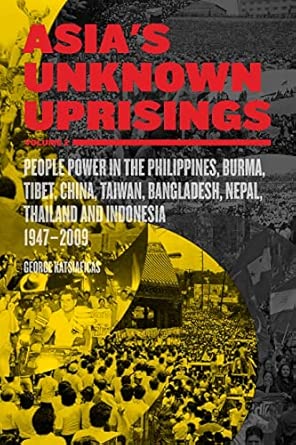
Asia's Unknown Uprisings Vol.2: People Power in the Philippines, Burma, Tibet, China, Taiwan, Bangladesh, Nepal, Thailand, and Indonesia, 1947-2009 2nd Edition
Author(s): George Katsiaficas (Author)
- Publisher: PM Press
- Publication Date: 25 April 2013
- Edition: 2nd
- Language: English
- Print length: 520 pages
- ISBN-10: 1604864885
- ISBN-13: 9781604864885
Book Description
Editorial Reviews
Review
“Through Katsiaficas’s study of Asia’s uprisings and rebellions, readers get a glimpse of the challenge to revolutionaries to move beyond representative democracy and to reimagine and reinvent democracy. This book shows the power of rebellions to change the conversation.”
–Grace Lee Boggs, activist and coauthor of Revolution and Evolution in the Twentieth Century
“In Asia’s Unknown Uprisings, George Katsiaficas inspires readers with an exciting yet scholarly examination of the rise and interlinking of mass revolutionary waves of struggle.”
–Bill Fletcher Jr., coauthor of Solidarity Divided
“George Katsiaficas has written a majestic account of political uprisings and social movements in Asia–an important contribution to the literature on both Asian studies and social change that is highly-recommended reading for anyone concerned with these fields of interest. The work is well-researched, clearly-argued, and beautifully written, accessible to both academic and general readers.”
–Carl Boggs, author of The Crimes of Empire: The History and Politics of an Outlaw Nation
“George Katsiaficas is America’s leading practitioner of the method of ‘participant-observation, ‘ acting with and observing the movements that he is studying. This study of People Power is a brilliant narrative of the present as history from below. It is a detailed account of the struggle for freedom and social justice, encompassing the different currents, both reformist and revolutionary, in a balanced study that combines objectivity and commitment. Above all, he presents the beauty of popular movements in the process of self-emancipation.”
–James Petras, professor of sociology at Binghamton University
About the Author
George Katsiaficas is author or editor of eleven books, including The Imagination of the New Left: A Global Analysis of 1968, the first book to place sixties movements in their worldwide context. Together with Kathleen Cleaver, he co-edited Liberation, Imagination and the Black Panther Party. His book, The Subversion of Politics: European Autonomous Social Movements and the Decolonization of Everyday Life, was co-winner of the 1998 Michael Harrington Award for best new book in political science. In 2010, the May Mothers’ House–widows and mothers of men killed in the 1980 Gwangju Uprising–awarded his service and commitment. A longtime activist for peace and justice, he was a student of Herbert Marcuse and twice granted Fulbright fellowships. Currently, he is based at Wentworth Institute of Technology in Boston, MA.
Excerpt. © Reprinted by permission. All rights reserved.
Asia’s Unknown Uprisings
Volume 2: People Power in the Philippines, Burma, Tibet, China, Taiwan, Bangladesh, Nepal, Thailand, and Indonesia, 1947–2009
By George Katsiaficas
PM Press
Copyright © 2013 George Katsiaficas
All rights reserved.
ISBN: 978-1-60486-488-5
Contents
List of Tables,
List of Charts and Graphs,
List of Photographs,
List of Abbreviations,
PREFACE,
CHAPTER 1 A World of Uprisings,
CHAPTER 2 The Philippines,
CHAPTER 3 Burma,
CHAPTER 4 Tibet,
CHAPTER 5 China,
CHAPTER 6 Taiwan,
CHAPTER 7 Nepal,
CHAPTER 8 Bangladesh,
CHAPTER 9 Thailand,
CHAPTER 10 Indonesia,
CHAPTER 11 People Power and Its Limits,
CHAPTER 12 The Commune: Freedom’s Phenomenological Form,
CHAPTER 13 Organizations and Movements,
CHAPTER 14 The Changing Face of the Proletariat,
CHAPTER 15 Uprisings in Comparative Perspective,
CHAPTER 16 The System Is the Problem,
Interviews,
Credits,
About the Author,
Index,
CHAPTER 1
A World of Uprisings
The likelihood of democratic development in Eastern Europe is virtually nil. … With a few exceptions, the limits of democratic development in the world may well have been reached.
— Samuel Huntington, 1984
We, the old ones, may never see the decisive battles of the coming revolution.
— V.I. Lenin, January 1917
UPRISINGS ARE TERRIBLE, beautiful events. They break out so unexpectedly that they surprise their partisans as much as they bewilder their opponents. Far more than we realize, the world we live in has been created by revolutionary insurgencies. From the American Revolution to the Russian, from the Gwangju Uprising to the Arab Spring, uprisings occur with astonishing regularity.
Leading up to the 1980s, East Asian dictatorships had been in power for decades and seemed unshakable, yet a wave of revolts soon transformed the region. These insurgencies threw to the wind the common bias that Asians are happier with authoritarian governments than democracy. They ushered in greater liberties and new opportunities for citizen participation — as well as for international capital. One of the purposes of this book is to assess the contradictory character of these changes and the forces that produced them.
Asia’s Unknown Uprisings focuses on people’s forms of interaction with each other during moments of confrontations with the forces of order. I seek to let the actions of hundreds of thousands of people speak for themselves as a means to portray freedom’s concrete history. The oft-repeated phrase “the people make history” cannot be comprehended without a central focus on popular uprisings. In the first volume, I provided a view of Korean history through the prism of social movements. In a country whose unique character meant three consecutive dynasties each lasted nearly half a millennium, Korea’s long twentieth century produced an unmatched richness of uprisings and upheavals. From the 1894 Farmers’ Movement against Japanese colonialism to the 2008 candlelight protests against U.S. “mad cow” beef, insurgencies continually built upon each other. Popular movements assimilated lessons from previous protest episodes, and people improvised tactics and targets from their own assessments of past accomplishments and failures.
This volume is international in scope and deals with uprisings in nine places, yet connections can be found in popular insurgencies’ capacities to learn from each other, to expand upon preceding examples, and to borrow each other’s vocabulary, actions, and aspirations. Almost overnight, “People Power” simultaneously became activists’ common global identity — cutting across religious, national, and economic divides. Through empirical analysis of specific uprisings, this book’s focus is the unfolding development of Asian uprisings in the Philippines (1986), Burma (1988), Tibet (1989), China (1989), Taiwan (1990), Nepal (1990), Bangladesh (1990), Thailand (1992), and Indonesia (1998).
The 1989 revolutions in Eastern Europe against Soviet regimes are well known, yet Eurocentric (and anticommunist) bias often diminishes the significance of their Asian counterparts, rendering them largely invisible. Although the accomplishments of Asian uprisings are noteworthy and their character significantly more grassroots than contemporaneous turmoil in Eastern Europe (where Gorbachev’s willingness to abandon the Russian empire triggered the movements), they remain unknown, even within the region where they transpired. East Asia’s string of uprisings from 1980 to 1998 had a huge political impact, overthrowing eight entrenched regimes: Philippine dictator Ferdinand Marcos was forced into exile; South Korea’s Chun Doo-hwan was disgraced and compelled to grant direct presidential elections before being imprisoned; Taiwan’s forty-year martial law regime was overturned; Burma’s mobilized citizenry overthrew two dictators only to see their successors massacre thousands; Nepal’s monarchy was made constitutional; military ruler Muhammad Ershad in Bangladesh was forced to step down and eventually sent to prison; Army Chief Suchinda Kraprayoon in Thailand was forced to vacate the office of prime minister; and Indonesia’s longtime dictator Suharto was ousted after three decades in power.
Despite more than a century of research, modern social science is utterly incapable of predicting political upheavals. Democratization theorists have identified an array of major variables posited to be significant indicators of the possibility for lasting democracy. Half a century ago, Seymour Martin Lipset hypothesized a correlation between economic development and democracy, asserting that once societies reach a wealth threshold, their chances of being democratic are significantly higher than those of poorer societies. Various theorists have subsequently operationalized Lipset’s “modernization theory” with specific quantitative predictions correlating wealth and survival rate of democratic systems of governance. Samuel Huntington’s observation that urbanization is a prerequisite for democratization led him to recommend “forced-draft urbanization,” a notorious policy that resulted in free-fire zones and rural saturation bombing of Vietnam as a means of forcing peasants into cities. The United States dropped more bombs on Vietnam to “create the preconditions for democracy” than had been used everywhere during World War II, yet Vietnamese nationalism prevailed. Max Weber’s notion of a correlation between capitalism and the Protestant ethic was adapted to Asia through analysis asserting an inverse relationship between Confucian values and democratization. Although East Asia’s economic rise has given such theorists pause, communal Confucian values remain seen as the “kernel of traditional culture that is unfavorable to democracy.” For Huntington, Confucian democracy was an oxymoron, a “contradiction in terms.” Following his lead, Euro-American theorists have understood a dearth of American-style “civil society” as a reason for an absence of democracy.
To the above list of explanatory variables for democratic governance should be added the precise character of uprisings. Protesters’ mutual relationships (their capacity to bond and organize themselves in moments of extreme crisis, their hierarchical or horizontal patterns of authority, and their behavior toward those within their own ranks who violate group norms and values) are significant predictors of future political relationships. Similarly, insurgents’ interaction with opposing forces (their treatment of prisoners, tactics of mobilization and confrontation, and forms of justice meted out to traitors and enemy combatants) give insight into the quality of democratic norms that likely would become operative if the movement were successful. Comparing the intensity of peaks of protest may also be a means of gauging democratization’s subsequent depth. Noting with care specific social strata that mobilize during crises may be a better means of comprehending political opinions than one hundred telephone opinion polls conducted in quieter moments. Individuals who seem to be agreeing with the course of politics-as-usual often have other streams of thought in the back of their minds. The tremendous power of the mass media notwithstanding, uncontrolled intuitions and insights remain operative even when they are not overtly expressed.
Seeking to better understand social movements is one reason for my admittedly belabored reconstruction of civil insurgencies in this book, but it is not my only one: I hope to glean useful lessons and insights for future generations’ freedom struggles. In my view, without a fundamental break with a few hundred billionaires’ control of humanity’s vast social wealth and the allocation of that wealth through the profit motive, our planet will continue to be ravaged by reckless industrialization and unending wars. Without systematic transformation of corporate capitalism, hundreds of millions of people will remain condemned to live in hell on earth because of poverty, starvation, and disease. As I see it, it is entirely unlikely that the kind of social reorganization required for lasting peace, environmental salvation, and shared prosperity can be achieved through continuing evolution of inherited economic and political structures. Rather, global revolutionary change is a prescriptive remedy needed in large doses to cure the diseases of militarized nation-states, power-hungry politicians, and wealth-grabbing billionaires.
Like art, revolution is an important dimension of uniquely human activity, a form of species-constitutive behavior that contains its own grammar and logic. While it is true that humans are creatures of habit and routine, we are also capable of enormous changes. We grow accustomed to our daily lives, and fantasize — or fear — that our current conditions will last forever. Nation-states today are everywhere hegemonic, yet uprisings can transform overnight even the most apparently entrenched social relationships.
One of the problems with a nationalist construction of history is that it refutes in advance the idea that human beings in various places might actually be more closely tied to each other than they are to their own “countrymen,” that ordinary people’s aspirations and dreams, their conscious and unconscious desires and needs, might be more similar to each other’s than to those of their nations’ elites. Even addition of one country’s history to another can lead to assertions that are both untrue and unimportant, while obscuring transnational simultaneity, commonalities, and parallel grassroots developments. It matters little whether or not the first nationalist revolution in Asia took place in the Philippines with the uprising against the Spanish in 1896. Korea’s Great Farmers’ War, or Tonghak movement, came two years earlier. What is important is they both fought for freedom from foreign conquest. The great international synthesis achieved by Tonghak, China’s Taiping Rebellion, and Vietnam’s Cao Dai have much more in common than many scholars realize precisely because of nationalist constraints on research.
Today, as planetary integration accelerates, human beings are rapidly becoming self-conscious as a species — one of the very best dimensions of globalization. World history opens new possibilities, and it is also a necessary means to assimilate properly the recent past. If citizens in country A were motivated to overthrow their ruler because they witnessed people in country B do so, then a history of either country alone would not do justice to its freedom movement. Even more significant is the simultaneous emergence of freedom struggles in many places. When conceptualized across national boundaries, a more accurate representation of uprisings becomes possible, and a more promising future comes into focus. This endeavor lies at the center of all my books on urban insurgencies in the late twentieth century.
The inability of analysts to comprehend the global nature of social movements is due in part to a lack of empirical studies of uprisings, even in national contexts. With respect to Korea, the best English-language historians have often neglected (and sometimes misstated) basic facts related to insurgencies and paid scant attention to their significance, emphasizing instead “Great Men” and “Great Women.” In the case of Thailand, as Somchai Phatharathananunth wrote in 2006, “There are still few major works on Thai civil society organizations in the form of social movements.” Much as I tried, I could find no comprehensive German or English-language history of many of the uprisings discussed in this book, so I wrote them myself.
Moving from periphery to center of the world system (a phenomenon commonly understood in economic terms), East Asia is positioned today to take the lead in the unfolding of world politics. The huge losses of indigenous people’s lives in U.S. wars — more than three million killed in the Korean War and at least two million more in Indochina — served as crucibles of fire, precipitated refugees by the tens of millions, and conditioned unprecedented social movements that sought to transform their societies. In three devastating years, Korea’s yangban aristocracy was decimated and the country completely destroyed, compelling its citizens arduously to rebuild.
Koreans’ spirit and energy through destruction and reconstruction positioned them in the center of the groundswell of Asian popular uprisings, and their subsequent cultural wave (hallyu) swept the continent at the end of the twentieth century. In 1960, South Korean students led the country against U.S.-imposed dictator Syngman Rhee. After police slaughtered 186 young people in the streets of Seoul, Rhee was forced into exile, and democracy won. In 1973, Thai students mobilized hundreds of thousands of citizens against their military dictator, and after seventy-three were gunned down, they also won a short-lived democracy. In 1980, citizens in Gwangju courageously rose up against the brutality of the South Korean army. After driving the military out of the city, they governed themselves through citizens’ general assemblies. Although overwhelmed by the army (abetted by U.S. President Carter) at the cost of hundreds of lives, they continued their struggle to overthrow the junta in 1987 and to imprison former dictators Chun Doo-hwan and Roh Tae-woo a decade later.
Asia’s People Power Insurgencies
Even in defeat, popular insurgencies transform people and subsequently reappear in unexpected forms. The sudden emergence of eight People Power uprisings within six short years from 1986 to 1992 is a case in point. The term “People Power” was born in the actions of hundreds of thousands of Filipinos in February 1986, when citizens overthrew the Marcos dictatorship in an eighteen-day uprising. Set off by electoral fraud and a mutiny by key elements of the military, people stubbornly took to the streets to block loyalist tanks and troops. Despite being continually threatened with great harm, people’s courageous flooding of public space provided critical support to the mutineers. While mythologized today, people’s nonviolent resistance should not obscure the critical roles played by armed soldiers, whose guns and helicopters were vital to the ouster of Marcos. Nor should the grassroots rebellion obscure the importance of the Catholic Church hierarchy, which called for citizens to go into the streets of Manila. After the uprising began, U.S. President Ronald Reagan continued to support his longtime friend Marcos, but once the bulk of the military defected to the side of the opposition, the United States insisted the time had come for Marcos to go. Soon thereafter he went reluctantly into exile, but not before the phrase “People Power” became well known enough to frighten entrenched dictators no matter where in the world they ruled.
The overthrow of Marcos helped to animate the 1987 June Uprising in South Korea, a marathon endeavor of nineteen consecutive days of illegal protests in which more than one million people mobilized on three separate days. Hundreds of thousands of Koreans evidently were inspired and instructed by their Filipina fellows. Alongside Korea’s legendary student movement, Christian groups also played a leading role in winning direct presidential elections and other political reforms. Civil society played a crucial role in the popular uprising through formation of a “grand coalition with the opposition political party, ultimately pressuring the authoritarian regime to yield to the ‘popular upsurge’ from below.”
As South Koreans won democracy, people’s movements sprang up in many neighboring countries. An end to thirty-eight years of martial law was won in Taiwan in 1987, less than a month after the Korean military capitulated to opposition demands. Anecdotal evidence tells of people singing Korean democracy movement songs in the streets of Taipei. Three more years of struggles culminated in students taking over Chiang Kai-shek Square in March 1990 to insist upon — and gain — democratic elections for president and parliament (the Legislative Yuan).
In Burma, popular aspirations for loosening central controls bloodily collided with the forces of order beginning in March 1988. As in 1980 in Gwangju, students in Rangoon led the population into the streets, and the military went on a killing spree ordered by ruthless generals at the highest levels of power. Despite horrific repression, popular resistance continued, compelling President Ne Win to step down after twenty-six years of rule. When he named the police commander responsible for the butchery of so many innocent lives as his replacement, five days of new student-led protests forced yet another resignation. In the resulting vacuum of power, popular councils of workers, writers, monks, ethnic minorities, and students emerged as the leadership of a nationwide movement for multiparty democracy. Undeterred by people’s clear desire for more freedom, the military decided to preserve its rule by massacring even more protesters — killing at least three thousand people before order was restored. Arresting thousands in 1990, including over a hundred newly elected parliamentarians, the Burmese military government ignored the huge electoral mandate won by Aung San Suu Kyi’s National League for Democracy (NLD) and kept her under house arrest for most of the next twenty years.
In March 1989, three decades after their failed uprising against Chinese invasion, Tibetans rose again. When Chinese police attacked small protests against Han settler-colonialism, demonstrators counterattacked, turning their wrath on Chinese businesses. Party leaders sent in the army and declared martial law in Lhasa on March 8, a precursor of what would come to Beijing less than two months later. In May 1989 — months before Eastern European communism faced its stiffest challenges — student activists in Tiananmen Square activated a broad public outcry for democracy. Hundreds of thousands of workers and citizens soon joined the movement as it spread to nearly all cities and grew beyond anyone’s expectations. Following the tactics of Filipinos who had mobilized to stop Marcos’s army in Manila, citizens of Beijing held off the People’s Liberation Army for days and prevented it from implementing the government’s declaration of martial law. Despite splits in the armed forces and inside the Communist Party, order was ultimately imposed after hundreds were killed around Tiananmen Square. For years afterward, activists were hunted and imprisoned.
(Continues…)Excerpted from Asia’s Unknown Uprisings by George Katsiaficas. Copyright © 2013 George Katsiaficas. Excerpted by permission of PM Press.
All rights reserved. No part of this excerpt may be reproduced or reprinted without permission in writing from the publisher.
Excerpts are provided by Dial-A-Book Inc. solely for the personal use of visitors to this web site.