Wow! eBook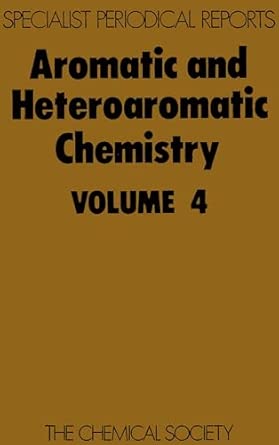
Aromatic & Heteroaromatic Chemistry, Vol 4: Volume 4 Edition. ed. Edition
Author(s): C W Bird
- Publisher: CRC Press
- Publication Date: 31 Mar. 1989
- Edition: Edition. ed.
- Language: English
- Print length: 520 pages
- ISBN-10: 0851867839
- ISBN-13: 9780851867830
Book Description
Indispensable reference source for researchers in the pharmaceutical and allied industries, and at the biology/chemistry interface in academia.
Editorial Reviews
Excerpt. © Reprinted by permission. All rights reserved.
Aromatic and Heteroaromatic Chemistry Volume 4
A Review of the Literature Abstracted between July 1974 and June 1975
By C. W. Bird, G. W. H. Cheeseman
The Royal Society of Chemistry
Copyright © 1976 The Chemical Society
All rights reserved.
ISBN: 978-0-85186-783-0
Contents
Chapter 1 Ring Systems of Topical Interest By P. J. Garratt, 1,
Chapter 2 Intermolecular and lntramolecular Cyclization Reactions in Ring Synthesis By P. A. Lowe and A. W. Somerville, 59,
Chapter 3 Cycloaddition Reactions By G. V. Boyd, 106,
Chapter 4 Ring Transformations By H. C. van der Plas and J. W. Street, 146,
Chapter 5 Electrophilic Substitution on Carbon By R. Taylor, 227,
Chapter 6 Electrophilic Substitution on Heteroatoms By J. H. Lister, 261,
Chapter 7 Nucleophilic Substitution By G. B. Barlin, 277,
Chapter 8 Aromatic Substitution by Free Radicals, Carbenes, and Nitrenes By S. R. Challand, 296,
Chapter 9 Addition Reactions By G. V. Boyd, 317,
Chapter 10 Ring-cleavage Reactions By T. L. Gilchrist, 360,
Chapter 11 Reactions of Substituents By B. C. Uff, 374,
Chapter 12 Porphyrins and Related Compounds By K. M. Smith, 397,
Chapter 13 Naturally Occurring Oxygen-ring Compounds By R. D. H. Murray, 414,
Chapter 14 Other Naturally Occurring Compounds By J. R. Lewis, 442,
Author Index, 485,
CHAPTER 1
Ring Systems of Topical Interest
BY P. J. GARRATT
1 Introduction
The general organization of this chapter is the same as that used in the previous volumes. A collection of reviews on non-benzenoid aromatic chemistry has appeared. Herndon and Ellzey have shown that the appropriate use of resonance structures leads to qualitative results in good agreement with SCF calculations. Graph theory has been applied to an analysis of the orbital levels in conjugate hydrocarbons. Calculations of the diamagnetic susceptibilities of non-alternant hydrocarbons have been made, and a geometric correction has been applied to calculations of ring current. Maier has reviewed recent work on cyclobutadiene and tetrahedrane, to which his group have made important contributions. Cyclopropanol chemistry has been reviewed.
2 Valence Isomers
An ab initio study of tetrahedrane (1) suggests that it is a local minimum on the (CH)4 surface. The C-C bond lengths were calculated to be 1.48 Å, and the C — H bonds 1.05 Å. A gas-phase electron-diffraction study of benzvalene (2) has been reported, and the derived bond lengths and angles are in good agreement with those obtained in the microwave study (see Vol. 3, p. 2). The Raman spectra of (2) and of Dewar-benzene (3a) have been reported. The i.r., Raman, and photoelectron (p.e.) spectra of hexa-methyl-Dewar-benzene (3b) have been obtained, and bond orders of 0.87 for C(1) — C(4), 1.64 for C(2) —C (3), and 1.0 for C(1) — C(2) are suggested. A gas-phase electron-diffraction study of hexafluoro-Dewar-benzene (3c) gave bond lengths of 1.597 [C(1) — C(4)], 1.503 [C(1) — C(2)], and 1.356 A [C(2) — C(3)], and [angle] C(6)C(1)C(2) is 115.3°. A similar study on hexamethylprismane (4) gave C(1) — C(2) 1.540 and C(2) — C(3) 1.551 A, using the author’s preferred model. The preparation of benz-valene is now available from Organic Syntheses. Benzvalene (2) reacts with di-imide to give dihydrobenzvalene (5), which at 240°C is transformed into hexa-1,3-diene (6) (Scheme 1). Ozonolysis of (2) gave the ozonide (7), which on treatment with LiAlH4 gave the bicyclobutane (8). Thermolysis of the carbene adducts (9) (see Vol. 2, p. 3) gave the olefin (10), and thermolysis of (10c) in TMEDA at 135°C gave (11). The reaction of (2) with dichloroketen gave (12), which on reduction with triphenyltin hydride gave the ketone (13a). The lithium salt of the corresponding tosylhydrazone (13b) was pyrolysed to the (CH)8 hydrocarbon (14), a valence isomer of cyclo-octatetraene (Scheme 1).
The bicyclopropenyls (15a, b) were rearranged by Ag1 ions to the Dewar-benzenes (16a — c). The reaction of hexamethyl-Dewar-benzene (3b) with dichlorocarbene has been re-investigated and the structure of the products re-interpreted. The mechanism of the reaction of dimethylacetylene with AlCl3 has been studied, and it has been shown that the intermediate carbonium ion (17) can be trapped by dimethyl acetylene-dicarboxylate. Using this method, the chiral Dewar-benzene (18) was synthesized and then resolved. Optically active (18) gave an active prismane derivative on photo-irradiation and an inactive biphenyl derivative on thermolysis.
Electrophilic addition to (3b) gave almost exclusively the endo-adduct (19). The reactions of the Dewar-benzenes (20a, b) with cyclobutadiene gave the tetracyclo-[4,4,0,02,507,10]deca-3,8-diene derivatives (21a, b). The non-adiabatic thermal re-arrangement of Dewar-acetophenone (22) gave a low yield (0.1 — 0.3%) of triplet aceto-phenone, which can be detected by chemiluminescence with 9,10-dibromoanthracene (see Vol. 3, p. 4). A full account of the chemistry of (23) has appeared. The kinetics of the thermal rearrangement of (24) have been shown to depend on the history of the sample of hexamethyl-Dewar-benzene from which it was prepared. A considerable interest has been shown in the preparation of 1,4-and 1,2-bridged Dewar-benzenes (Scheme 2). N-Chlorosuccinimide with (25) gave (26), which on treatment with KOBu1 gave (27). Treatment of (28a, b) with silver perchlorate gave (27a, b) and (29a, b). Whereas (27a, b) were stable, (29a, b) rearranged readily to indane and tetralin, respectively. The cyclobutadiene complex (31) gave (33) on treatment with cerium(1v) ions, presumably via the 1,2-bridged Dewar-benzene (32). Russian workers have reported that treatment of (34) with CsF gave the bridged Dewar-benzene (36), presumably via (35). Thermolysis of (36) gave (37).
3 Polybenzenoid Systems
A convenient synthesis of 2,7-dimethylpyrene has been reported that is applicable to other similarly substituted pyrenes. Photoirradiation of (38) in the presence of I2 gave a mixture of (39), (40), and (41). A similar irradiation of (42) gave (43) and (44) plus a third unidentified product. A mechanism for these reactions is suggested. See also Section 4.
4 Helicenes
Martin has reviewed the synthesis and chemistry of the helicenes. Optically pure (+)-pentahelicene (46) has been prepared by treatment of the phosphonium periodate (45) with LiOEt. Irradiation of (47) in the presence of I2 gave a 7% yield of the substituted pentahelicene (48) together with 42% of benzo[a]coronene (49), which arose from photoirradiation of (48). The double helicenes (50) and (51) have been prepared.
5 Sterically Overcrowded Molecules
The p.e. spectra of a number of sterically crowded hydrocarbons have been reported, and the non-planar can be distinguished from the planar compounds. Some reactions of overcrowded molecules are discussed in Sections 3 and 4.
6 Bridged Aromatic Compounds
A further report on the p.e. spectra of cyclophanes has appeared. 9,9′,10,10′-Tetra-dehydrodianthracene (53) has been prepared by oxidation of (52). It is a stable compound, and an X-ray crystallographic analysis gives a value of 1.35 Å for the C(9) — C(9′) double bond, and bond angles C(4a)C(9a)C(9) 109.7° and C(9a)C(9)C(8a) 109.2°.
[2,2]Paracyclophanes. — A paper describing the detailed chemistry of [2,2]paracyclophane (54) has appeared, with special emphasis being placed on stereochemistry, proximity effects on substitution, and the relief of strain. Birch reduction of (54) gives the dl-tetrahydro-product (55), not the meso-compound. The structure of (55) was deduced by its oxidation to (56). Rebafka and Staab have now reported the synthesis of the syn-quinone (57), which can be reduced to the quinone-hydroquinone (58). In this compound, but not in the anti-isomers (see Vol. 3, p. 11), intramolecular redox transfer occurs. Davatz and Jenny have pyrolysed the ammonium salt (59) to give a mixture of (61a) (3%) and (61 b) (34%), presumably via (60). The bis-allene (61c) reacts with disubstituted acetylenes (61d) to give the tetrasubstituted paracyclophanes (6lf), presumably via the quino-dimethane (61e). With methyl propargylate the four possible stereoisomers were obtained. Substituted [2,2]paracyclophanes such as (62) have been used as host compounds,(62) forming the 1 : 2 complex with mono-t-butylammonium thiocyanate.
[2,2]Metacyclophanes. — The Wittig rearrangement has been reported to be superior to the Stevens rearrangement for the conversion of compounds of type (63) into the corresponding [2,2]metacyclophanes (64). Photoirradiation of (65) at 254 nm in degassed cyclohexane gave 4,5,9,10-dihydropyrene (67) by loss of hydrogen. The biradical intermediate (66) was postulated. Wurtz coupling of (68) gave a mixture of the metacyclophanes (69) and (70), and not just (70), as had previously been claimed.
Other Bridged-ring Systems. — A full paper on the preparation of [7]paracyclophane by the ring-contraction route has appeared. An X-ray crystallographic analysis of 3-carboxy-[7]paracyclophane shows that the benzene ring is bent, the bridged atom being 17° out of the plane of the non-bridged atoms. Photoirradiation of (71) gave (72), which on treatment with silica gel gave the paracyclophane (73). Parham and Olson have further investigated the chemistry of [10](2,4)pyridinophane (see Vol. 3, p. 15). Treatment of (74) with acetic anhydride gave a mixture of the acetates (75) and (76), in which stereochemistry had been retained. Oxidation of the Grignard reagent (77) gave only a low yield of the ketone (78), the hydrocarbon (79) being a major product. The mechanism of the reaction is discussed. A number of (2,4)heterophanes (80) have been prepared by the reaction of the corresponding diketone with P2S5 or arylamines. [8] (3,6)Pyridazinophane (8la) has been prepared by a similar route, and the kinetics of bridge flipping have been studied for the derived N-oxide (81b). Irradiation of (82) with sunlight gave the dimer (83) via a cumulene intermediate, which can be trapped with furan or cyclopentadiene.
Pyrolysis of the styrene derivative (84) gave (86), presumably via the polyene (85). Photoirradiation of the sulphide (87) gave a 4 : 3 mixture of the achiral (88) and chiral (89) [2,2](1,5)naphthalenophanes. The rearrangement of (90) caused by AlCl3 and HCl gave (91), whereas with SnCl4 and HCl a mixture of (92) and (93) was obtained.
Photoirradiation of (94) led to a mixture of (95) and (96). The deuterium-decoupled spectrum of (97) remained unchanged up to 190°C, indicating a barrier of more than 27 kcal mol-1 for the pseudo-chair–chair interconversion. Using the now standard co-pyrolysis technique, low yields of the anti-(98) and syn-(99) [2,2](1,4)naphthaleno-(2,5)thiophenophanes can be prepared. In related systems it has been shown that the thiophen ring cannot flip whereas that of the equivalent furan system can. A series of metacyclophanes of type (100) have been prepared with a variety of inner substituents, and the chemistry of the inner NH2 group has been investigated in detail. Polymerization of the copperr acetylide (101) in pyridine gave the hexamer (102), which on hydro-genation gave [2,2,2,2,2,2]metacyclophane (103).
7 Heterocyclic Compounds
The criteria suggested for the determination of aromaticity in heterocycles have been reviewed. There is some controversy regarding the method of calculation of ring currents in five-membered heterocycles.
Phosphorus and Silicon. — The phosphorin (104) rearranges at 110°C to give (106), presumably via a Claisen-type rearrangement to (105a, b) and a subsequent intra-molecular Diels–Alder reaction. The reaction of silylene with acetylene is suggested to proceed via (108a), which can add a further molecule of the acetylene to give the 1,4-disilacyclohexadiene (109), presumably via (108b). Some evidence in support of this mechanism is provided by the reaction of (108a) with dimethylacetylene, which also gives (109)
Oxygen, Nitrogen, and Sulphur. — A comparison of the p.e. spectrum of thiiren dioxide (110) with those of tropone and cyclopropenone suggests the order of increasing aromaticity to be from (110) to cyclopropenone. Irradiation of (111) in the presence of furan gave the adduct (113), presumably via the 5-thiabicyclo[2,1,0]pentene derivative (112).
Diketones of type (114) react with a Zn-Cu couple to give compounds of type (115), which with trimethylsilyl chloride give the benzo[c]heterocycles (116). Compounds (115) react with DDQ to give compounds (117). 4,5,6,7-Tetrabromoisoindole (119) has been obtained by the dehydration of the N-oxide (118), and by prototropic re-arrangement of (120). Compound (119) is a stable, yellow, crystalline material. Treatment of (121) with triethylamine and then N-phenylmaleimide gave (123), presumably via th1e bromoisothianaphthene 2,3-dioxide (122). Phenanthro[9,10-c]-thiophen (125), originally prepared by Hinsberg, has been synthf-sized by a number of methods, including the dehydration of (124).
Mislow and his co-workers have carried out a re-investigation of previously claimed syntheses of thiabenzenes and have shown a number of these to be incorrect. Thus the reaction of (126) with phenyl-lithium gave only a polymeric, amorphous product which was not S-phenylthiabenzene (127). The reactions of the salts (128a — d) with the dimsyl anion gave the corresponding fairly stable thianaphthalenes (129a — d). Compound (129b) undergoes a Stevens rearrangement at ca. 40°C to (130), whereas (129d), an orange-red crystalline solid, decomposes at its melting point (107 — 108°C). The sulphur atom in (129a) is stably pyramidal, the barrier to inversion being greater than 22.3 kcal mol-1. These thianaphthalenes are suggested to have ylide-like properties. Full papers on the synthesis of non-classical thiophens have appeared which include the preparation of (131a), (131b), (132a), (132b), and (132c). An account of work directed towards the corresponding bisthia-anthracene (133) has appeared. A variety of 1,3-thiazine anions (134) have been prepared. The syntheses and studies of a number of meso-ionic compounds have been reported, including those of the 1,3,4-oxadiazolium-2-aminides (135). Furazan oxide derivatives of tropone (136) and biphenylene (137) have been prepared, the n.m.r. spectrum of (136) showing no change up to 140°C.
8 Annulenes
Graph theory has been used to enumerate and describe the valence isomers of benzo-annulenes and hetero-annulenes. MINDO/3 has been used to predict the structure of dehydrobenzenes. The 13C n.m.r. spectra of a number of 15,16-disubstituted 15,16-dihydropyrenes and the corresponding 2,7-dihydro-derivatives have been compared, and, for carbon atoms inside the ring-current, the 13C chemical shifts parallel those found for the 1H chemical shifts, both series falling on the Johnson–Bovey curve. Günther and co-workers have suggested a method for determining the delocalization of benzo-annelated annulenes on the basis of π-bond orders (P). These are determined from the vicinal H,H coupling constant [3J(H,H)]. The ratio (Q) of the bond order of the 2,3-over the 3,4-bond is determined [see (138)]; where Q > 1.10 the annulene is deloc:alized and aromatic, and where Q<1.04 it is anti-aromatic, values between these two corresponding to non-aromaticity.
Carbocyclic Annulenes — Cyclobutadiene ([4]Annulene). Maier has reviewed this area. The X-ray crystallographic structure of methyl tri-t-butyl[4]annulene carboxylate has been reported and is shown in Figure 1. The molecule clearly has a rectangular structure, the distortions arising from steric interactions, and the four carbon atoms of the ring are coplanar, with the carboxy-group moved out of the ring plane by ca. 6°, again, presumably, due to interaction with the t-butyl groups. The p.e. spectrum of (139) shows it to be a [4]annulene, unperturbed by the sulphur atoms, and to exist in the singlet ground state, no detectable population of the triplet state being observed. Comparison of the p.e. spectrum of tri-t-butyl[4]annulene (140) with those of (139) and model compounds suggests that (140) has a singlet, rectangular structure with bond lengths of 1.600 and 1.344 Å.
A normal-co-ordinate analysis of the i.r. spectrum of cyclobutadiene iron tricarbonyl has been reported. Photoirradiation of the pyrone (141) in the presence of penta-carbonyliron gave the cyclobutadiene ester iron tricarbonyl (142a), which could be saponified to produce the corresponding acid (142b). Photoirradiation of cyclo-butadiene iron tricarbonyl gave the complex (143). Complexes have been prepared in which cyclobutadiene is bonded through only one rather than both double bonds. The dinuclear complex (145) was prepared by treatment of (144) with Ag1 ions or the trityl cation. The reaction of (146) with silver hexaftuorophosphate in the presence of cyclopentadiene gave the adduct (148), presumably via the η2-cyclobutadiene complex (147). The possibility that η2-cyclobutadiene complexes may be involved in the formation of cyclobutadiene-diene adducts is suggested. A full paper on the preparation of optically active cyclobutadiene iron tricarbonyl complexes has appeared. The reaction of the borabenzene complex (149) with diphenylacetylene at 150°C gave the complex (150).
(Continues…)Excerpted from Aromatic and Heteroaromatic Chemistry Volume 4 by C. W. Bird, G. W. H. Cheeseman. Copyright © 1976 The Chemical Society. Excerpted by permission of The Royal Society of Chemistry.
All rights reserved. No part of this excerpt may be reproduced or reprinted without permission in writing from the publisher.
Excerpts are provided by Dial-A-Book Inc. solely for the personal use of visitors to this web site.