Wow! eBook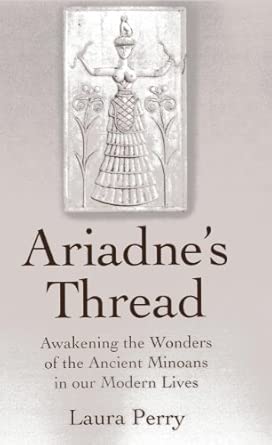
Ariadne`s Thread – Awakening the Wonders of the Ancient Minoans in our Modern Lives
Author(s): Laura Perry (Author)
- Publisher: John Hunt Publishing
- Publication Date: 30 Aug. 2013
- Language: English
- Print length: 222 pages
- ISBN-10: 1782791108
- ISBN-13: 9781782791102
Book Description
Editorial Reviews
About the Author
Excerpt. © Reprinted by permission. All rights reserved.
Ariadne’s Thread
Awakening the Wonders of the Ancient Minoans in our Modern Lives
By Laura Perry
John Hunt Publishing Ltd.
Copyright © 2013 Laura Perry
All rights reserved.
ISBN: 978-1-78279-110-2
Contents
List of Illustrations………………………………………………viiPreface…………………………………………………………..viiiIntroduction………………………………………………………1Part One: Work, Play and Worship in Ancient Crete……………………..5Chapter 1: A Brief History of Crete………………………………….6Chapter 2: Daily Life in Ancient Crete……………………………….10Chapter 3: Minoan Spirituality: From Caves to Temples to Caves………….21Chapter 4: The House of the Double Axe……………………………….43Chapter 5: Ariadne’s Tribe: The Minoan Pantheon……………………….50Chapter 6: Ritual Overview: The Wheel of the Year and Rites of Passage…..88Part Two: The Wheel of the Year: Moon Rites and Seasonal Festivals………99Full Moon Ritual…………………………………………………..101New Moon Ritual……………………………………………………107Spring Sun Festival………………………………………………..113Summer Fertility Festival…………………………………………..119Autumn Harvest Festival…………………………………………….125Midwinter Festival…………………………………………………133Part Three: Rites of Passage: From Birth to Death and Beyond……………139The Blessing of a New Child…………………………………………141Rite of First Blood………………………………………………..147Rite of Manhood……………………………………………………157Initiation………………………………………………………..163Rite of Betrothal………………………………………………….171Ceremony of Marriage……………………………………………….179Rite of Parting……………………………………………………185Memorial Rite……………………………………………………..191Ceremony to Honor the Ancestors……………………………………..197Bibliography………………………………………………………203Index…………………………………………………………….208
CHAPTER 1
A Brief History of Crete
For having made such a great impression on the ancient world,Crete is remarkably small. The island itself is only 150 miles longand barely 20 miles wide, resting in the blue-greenMediterranean Sea just southeast of Greece. It is almost equallydistant from Europe, Asia and Africa, an ideal position fromwhich to wield social as well as economic influence in the ancientworld. The island is dramatic to behold. The rocky beaches andlowlands turn sharply upward toward a steep and craggy centralmountain range. These sacred mountains reach an incredible8,000 feet in altitude at their height, a truly spectacular home forCrete’s goddesses and gods.
Although the mountainous highlands are too barren to plowand can only be used to graze sheep and goats, the area aroundthe perimeter of the island has always been fertile, if somewhatrocky. The lowlands were heavily wooded at the height of Crete’sglory (2000-1500 BCE) but have unfortunately been cleared inrecent times. The temperate climate with its hot summers, mildwinters and a constant sea breeze has long been responsible forthe abundance of such traditional Mediterranean crops as grains,olives, beans and grapes. Since Crete is an island, it has its shareof fog, damp and mist, but only high in the mountains does thewind come sharp and frigid in the winter.
Many people refer to those who lived on Crete in ancienttimes as Minoans. This name is derived from the title of theMinos, the bull-king or bull-god priest who presided at thetemple at Knossos. Technically, the term Minoan refers only to theBronze Age culture on Crete, from approximately the 27th to the15th century BCE. But since it is such a well-known term, andsince the word Cretan is often confused with the derogatorycretin, I will use Minoan in reference to the ancient people andtheir culture across the centuries.
Though archaeologists have found traces of early hominidsdating back 130,000 years in southern Crete, most scholars agreethat human settlement did not occur until about 9,000 years ago,in the Late Stone Age. These early farmers and herders probablycame across the Mediterranean from Asia Minor. First theysettled along the eastern tip of Crete, then slowly expandedwestward over the island. They built small houses of stone orwattle-and-daub, and buried their dead in caves.
By 2,000 years later (about 5000 BCE), the islanders werepracticing advanced agriculture and expanding their settlements.Over the following three millennia they developed acomplex society with villages and towns populated by artisans,farmers and merchants.
By the beginning of the Bronze Age, about 3000 BCE, theMinoans had regular trade contact with the Cycladic Islands andEgypt. They built tombs rather than bury their dead in caves.And they began the creation of one of the most successfulcultures in the ancient world.
For the next 2,000 years they flourished, building a societybased not on military conquest but on mercantile activities. Theytraded the wares of their own talented artists and craftspeople aswell as items they brought back from foreign lands. Minoangoods such as colorful painted pottery, delicate jewelry, carvedstone vases and ornate jeweled daggers were popular withmerchants throughout the known world.
From the time of the earliest European civilization, Crete wasa trade center not only for Europe but also for the Middle Eastand other areas as well. The Minoans traded closely with Egyptfor centuries; Egyptian influence is evident in Minoan art andarchitecture. In fact, the artisans and merchants from Creteshipped their goods as far away as Spain. They traded and establishedcolonies in Asia Minor and southern Palestine, includingthe town of Gaza, whose earlier name was Minoa.
On Crete itself four port towns along the north and east coastsof the island grew large and rich enough to become knownthroughout the ancient world. Crowned with expansive temples,these cities were the strength and glory of Minoan civilization.From Knossos and Malia on the north coast around to Zakros inthe east and Phaistos in the south, they provided a focus for theflow of goods and wealth that gave the Minoans their lavishlifestyle. Each city ruled itself and the surrounding farmland, butthey remained independent from each other, much like the laterGreek city-states.
The people of Crete had their own writing systems, an earlierhieroglyphic script and a later syllabary called Linear A. We stilldo not understand the language that it symbolized, though manypeople have attempted to decipher it.
Nature herself appears to have caused the downfall of Minoansociety. During the 17th century BCE the volcanic island of Thera(modern Santorini) in the eastern Mediterranean explodedviolently. The resulting earthquakes, tidal wave and ash falloutdid extensive damage to Crete and some buildings wereabandoned at that time.
The Minoans managed to rebuild many of their mostimportant structures, including the temples at Knossos, Phaistosand Malia. In fact, the new buildings grew to a far grander scalethan the original ones. But just two centuries later anothernatural disaster occurred and all the temples except the one atKnossos were either abandoned or destroyed. Archaeologists andhistorians still argue over the exact nature of the catastrophe thatoccurred at that time, but general consensus leans towardanother volcanic eruption with its attendant earthquake, tidalwave, ash cloud and resulting fires and crop failures.
Knossos remained a center of religious and economic activityfor about a century after the widespread collapse, but during thistime large numbers of mainland Greeks (Mycenaeans)immigrated to Crete. They introduced their own language andmodified the Minoan Linear A script into Linear B to use forwriting Mycenaean Greek. Under the influence of the Greeks andtheir foreign, male-dominated culture, by the 12th century BCEMinoan society had effectively ceased to exist.
Through this vast expanse of time, the population on Cretegrew from a few small settlements to a network of sprawlingtowns. Minoan religious centers grew from a few scatteredtombs and sanctuaries to a network of highly organized,complex temples, only to fall prey to the power of Mother Naturein the end. Now that we know something of their history, let’sexplore the culture and religious practices of this fascinatingancient people.
CHAPTER 2
Daily Life in Ancient Crete
Two Sides of One Coin
We know from the archaeological record that the grand Minoan’palaces’ functioned as temples, housing the priestly class andproviding a setting for rituals and ceremonies. But the templeshad another function as well, one we tend to forget from ourvantage point in a separation-of-church-and-state society. Thetemples also played a major role in the economic and political lifeof ancient Crete. We modern folk tend to think of people andinstitutions as belonging to either the religious sector of societyor the economic/industrial sector but not both. On Crete,however, religion and commerce were intertwined to the pointthat we often cannot discern the boundaries. This was a commonsituation in the ancient world.
The priestly class, both women and men, who lived in thetemples, wielded a great amount of power in Crete’s society. Thewealthy merchants who lived around the temples also exerted acertain amount of influence. For the Minoans, religion was anintegral part of their daily lives. Craftsmen performed rituals inthe process of creating their products. Most ordinary housesincluded shrines and altars. Grand public ceremonies and ritualsdisplayed the Minoans’ wealth to visiting merchants, furtherencouraging trade. Although we cannot call ancient Crete a fulltheocracy, since as far as we know the priestly class was not thesole ruling group on the island, there is truly no way to separatereligion from any other aspect of life there.
How did so many facets of Minoan society and daily liferevolve around the temples? First of all, we are well-acquaintedwith the temples’ use as grain storage sites, a common function ofreligious centers in the ancient world. From the early granariessituated alongside the ceremonial courts to the later storagerooms filled with pottery jars of grain as tall as a robust adult,the temples were a repository for the island’s surplus grainsupply.
It is possible that this excess was saved for ritual feasting,although some of it was certainly held back as insurance in caseof famine, as was common in the ancient world. The grainstorage areas in the temples, as well as in some of thesurrounding mansions, are full of ritual artwork and symbology.We find religious symbols such as double axes and Linear Awriting on the walls of the storerooms. A number of the storageareas also encompass shrines or lead directly to shrine or ritualareas. Thus we can imagine a ritual blessing or protection of thisbasic foodstuff, either when it was first stockpiled or as it waslater distributed to buyers or ritual participants.
The temples also provided workspace for artists and craftspeoplewho produced jewelry, pottery, sculpture, paintings andmany other fine wares. Some of the most intricately worked,valuable pieces of jewelry and pottery have been found in theshrines, sanctuaries and public areas of the temple complexes. Itis probable that temple-produced goods commanded a highprice due to their association with the sacred center. Of course,many artisans also lived and worked in the towns, selling theirwares in the lively, well-traveled markets. But it must have beenquite an honor to earn a place in the workrooms of one of thetemples.
There is one aspect of the Minoan temples which is notobvious at first, perhaps because it is characterized by theabsence of something rather than its presence. Unlike so many ofthe great religious complexes built by other ancient civilizations,the temples on Crete were not monuments to any particularrulers or leaders. We find no portraits of kings, or queens for thatmatter. We find no lists of battles won or conquests made, nodepictions of conquered peoples being enslaved or killed. TheMinoan temples are remarkably bare of depictions of violence ordomination of any kind.
The temples, in fact, appear to have been built with aestheticrather than monumental purposes in mind. They were designedfor the worship of the deities and ancestors of this world, toreinforce the connection between the human and the divine. And,unlike the Christian cathedrals which sought to dwarf and intimidatepeople and make them feel inferior to the great ChristianGod, the Minoan temples sought to draw people into the order ofbeing and make them feel a part of the divine that surroundedand penetrated them.
Life in Town
When we talk about ancient Crete we often focus on the templesdue to their imposing presence and architectural beauty. But wemust remember that most of the Minoan population lived outsidethe temple grounds, in the towns and nearby farming areas. Theirlives would not be as foreign to us as we might think.
The developed areas of Crete ringed the eastern half of thecoastline, with the towns sloping up from low-lying harborstowards the villas and temples. We often think of wealthy ancientcivilizations in terms of highly stratified societies such as Egyptand Rome. In those empires, though the upper echelons enjoyedgreat wealth and luxury, the poorer people labored long and hardin subhuman living conditions. Crete, however, grew out of adifferent paradigm. The Minoans, more than perhaps any otherearly society, shared the accumulated wealth of their tradingempire among all the island’s inhabitants. Yes, there were poorpeople and there were vastly rich people, but even the poorestMinoans still lived in a clean, relatively safe environment alongpaved, well-drained streets.
The poorest families lived near the harbors in simple, smallplaster houses built close together. These houses often had onlyone main room, with little furniture and few cooking implements.Built along a design familiar to modern Americans from thepioneer days, these houses included a sleeping loft above themain living area. Though the people who lived in these houseswere poor, they had plenty of food from the island’s harbors.They had a clean supply of water from town cisterns andviaducts and they lived in what was likely the safest of theancient civilizations, street crime being largely unknown on theisland.
The people who lived down by the harbors were the manuallabor so necessary for Crete’s vast trade empire. These peoplecarried merchandise from the many ships up to the markets,cared for the merchants’ pack animals, and occasionally soldtrade goods themselves. They were probably not literate, for onlythose who could afford temple schooling or private tutorslearned to read and write.
In contrast to the illiterate manual laborers, some Minoanscould afford to pay for schooling. These were the moresuccessful merchants and artisans who lived farther into thetowns, away from the harbors (and the smell of fish). Thesepeople held jobs we would probably find familiar. Some of themwere traders and merchants who had permanent shops or stallsin the marketplaces. They traded in foodstuffs from nearby andfaraway lands – dates, fruit, wines, nuts. They bought and soldthe basic necessities as well as the luxuries the Minoans sodesired. Through the harbors and marketplaces of ancient Creteflowed shipments of cooking pots and dishes, decorative pottery,lumber, perfume oil, raw gold, silver and precious stones, toolsfor woodworking and metalsmithing, in short, many of the sortsof things we buy and sell in our world today.
Let us not forget the rural islanders who lived in the foothillsof the jagged central mountain range. These people farmed therocky soil, producing the staple foods of Minoan society. Theyalso herded goats and sheep, animals that can easily adapt torugged, mountainous terrain. The crops, the animals and thepeople all benefited from the extensive irrigation system whosecanals carried water across the island’s farmlands.
One class of people we would not find in ancient Crete is themilitary. Crete had no army or navy of its own and, until theMycenaean incursions toward the end of the empire, did not hiremercenaries or guards from other lands. The Minoans preferredto concentrate their energies and capital on trade rather thanwarfare. They wanted no land other than their own small islandand thus posed no threat to the surrounding nations.
One interesting outgrowth of this lack of military is a sort ofwarrior cult that grew up among the young men of Crete. Havingno other outlet for their competitive or aggressive energy, theydeveloped a subculture within Minoan society. These young menparticipated in ritualized displays of hunting skill, flaunting theirprowess with weapons such as the spear and dagger. They oftenincluded hunting forays as part of initiation rituals, proving theirmanliness by their skill with their chosen weapons.
This subsection of Minoan culture looked to the young god astheir role model. They depicted him as a muscular, handsomeyouth who carried a tall spear and wore a dagger at his belt. Theyoung men who worshiped this god often wore ornatelydecorated daggers as part of their dress as well, emphasizingtheir economic and spiritual stature with such weapons.Interestingly enough, though, the young men of Crete limitedtheir aggression to the animals they hunted rather than warringon each other or neighboring peoples.
The Minoans had no centralized government. Each town ruleditself through the guidance of the priestly class and the wealthiestmerchants. There was enough trade and wealth flowing throughthe harbors of Crete that the towns’ inhabitants had no desire totake over anyone else’s territory. By concentrating on the flow oftrade rather than spending money on a destructive and unnecessarymilitary, the Minoans built up the strongest, farthest-reachingmercantile empire of the classical world.
Many of the raw materials that were shipped into Crete’sharbors made their way to the island’s artisans. By the time of thegreat temples and the height of Crete’s renown, the island washeavily populated with expert architects, engineers, engravers,weavers, metalsmiths, fresco painters, faience workers, pottersand all manner of other artisans. They ran a thriving trade ineverything from the most expensive, precious handmade itemscommissioned by the rich merchants and temple residents tomass-produced commercial jewelry and cooking pots. Theirmetalsmiths worked copper, bronze, silver and gold, fashioningit into jewelry, decorative containers, knives and daggers.Minoan potters crafted vases, jugs, bowls and cups of fineceramic, intricately painted with beautiful, brightly coloredscenes and designs.
(Continues…)Excerpted from Ariadne’s Thread by Laura Perry. Copyright © 2013 Laura Perry. Excerpted by permission of John Hunt Publishing Ltd..
All rights reserved. No part of this excerpt may be reproduced or reprinted without permission in writing from the publisher.
Excerpts are provided by Dial-A-Book Inc. solely for the personal use of visitors to this web site.