 Wow! eBook
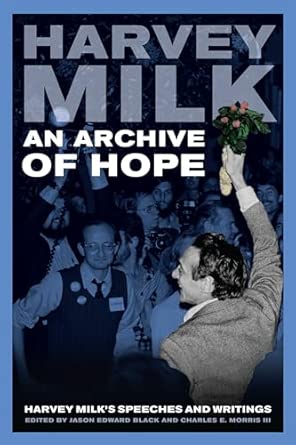
Archive of Hope: Harvey Milk's Speeches and Writings
Author(s): Jason Edward Black (Editor), Charles E. Morris (Editor), Harvey Milk (Author)
- Publisher: University of California Press
- Publication Date: 15 Feb. 2013
- Edition: First Edition
- Language: English
- Print length: 280 pages
- ISBN-10: 0520275497
- ISBN-13: 9780520275492
Book Description
The volume opens with a foreword from Milk’s friend, political advisor, and speech writer Frank Robinson, who remembers the man who “started as a Goldwater Republican and ended his life as the last of the store front politicians” who aimed to “give ‘em hope” in his speeches. An illuminating introduction traces GLBTQ politics in San Francisco, situates Milk within that context, and elaborates the significance of his discourse and memories both to 1970s-era gay rights efforts and contemporary GLBTQ worldmaking.
Editorial Reviews
Review
"An important contribution to the corpus of work on Harvey Milk as a writer and an orator."-- "Gay & Lesbian Review Worldwide"
"The collected speeches assembled in this excellent book show Milk as obsessive, determined and resourceful."-- "Law Society Journal"
"These selections capture the voice of this coalition builder who worked to forge connections between unions and gay people and poorer and other people in the Castro district. . . . Recommended."-- "CHOICE"
"
An Archive of Hope is a remarkable contribution to GLBTQ history and the ways in which that history might shape our presents and futures."-- "Rhetoric & Public Affairs"From the Inside Flap
"I was lucky enough to hear Harvey speak and through some unexpected alchemy every piece printed here sounds just like him, so you can hear him speak too. Equally amazing is that this self-made, store-front politician thought about more than his city or gay rights. His longer views on issues of national political life in this book form a philosophy as relevant today as they were decades ago. Clearly an essential addition to GLBT studies--every library needs this wonderful collection." Felice Picano, author of
Art and Sex in Greenwich Village and Like People in HistoryFrom the Back Cover
"I was lucky enough to hear Harvey speak and through some unexpected alchemy every piece printed here sounds just like him, so you can hear him speak too. Equally amazing is that this self-made, store-front politician thought about more than his city or gay rights. His longer views on issues of national political life in this book form a philosophy as relevant today as they were decades ago. Clearly an essential addition to GLBT studies--every library needs this wonderful collection."—Felice Picano, author of
Art and Sex in Greenwich Village and Like People in HistoryAbout the Author
Excerpt. © Reprinted by permission. All rights reserved.
An Archive of Hope
Harvey Milk's Speeches and Writings
By Harvey Milk, Jason Edward Black, Charles E. Morris III
UNIVERSITY OF CALIFORNIA PRESS
Copyright © 2013 The Regents of the University of California
All rights reserved.
ISBN: 978-0-520-27549-2
Contents
Preface, xi,
Foreword: "Harvey" Frank M. Robinson, xvii,
Introduction: Harvey Milk's Political Archive and Archival Politics, 1,
PART ONE. MILK AND THE CULTURE OF POPULISM, 6l,
1. "Interview with Harvey Milk" Kalendar, August 17, 1973, 63,
2. "Address to the San Francisco Chapter of the National Women's Political Caucus" Speech, September 5, 1973, 69,
3. "Address to the Joint International Longshoremen & Warehousemen's Union of San Francisco and to the Lafayette Club" Speech, September 30, 1973, 71,
4. "An Open Letter to the Mayor of San Francisco" Public letter, September 22, 1973, 75,
5. "MUNI/Parking Garage" Press release, September 27, 1973, 78,
6. "Alfred Seniora" Press release, September 28, 1973, 80,
7. "Who Really Represents You" Campaign flyer, September 1973, 82,
8. "Milk Note" Column, Vector, February 1, 1974, 85,
9. "Anyone Can Be a Movie Critic: How Not to Find Leadership" Editorial, San Francisco Crusader, February 1974, 88,
10. "Letter to the City of San Francisco Hall of Justice on Police Brutality" Public letter, February 14, 1974, 92,
11. "Where I Stand" Article draft, Sentinel, March 28, 1974, 95,
12. "Where There Is No Victim, There Is No Crime" Press release, April 1, 1974, 99,
13. "Political Power" Article draft, Sentinel, May 23, 1974, 102,
14. "Letter to the San Francisco Chronicle about Anti-Gay Editorials" Letter draft, July 1, 1974, 105,
15. "Library or Performing Arts Center" Press release, December 4, 1974, 107,
PART TWO. THE GRASSROOTS ACTIVIST BECOMES "THE MAYOR OF CASTRO STREET", 111,
16. "Au Contraire ... PCR Needed" Column, Bay Area Reporter, February 9, 1975, 113,
17. "Harvey Milk for Supervisor" Campaign letter, February 26, 1975, 117,
18. "Statement of Harvey Milk, Candidate for the 16th Assembly District" Campaign material, March 9, 1976, 121,
19. "Reactionary Beer" Column, Bay Area Reporter, March 18, 1976, 124,
20. "Nixon's Revenge—The Republicans and Their Supreme Court" Column, Bay Area Reporter, 15 April 1976, 127,
21. "My Concept as a Legislator" Column, Bay Area Reporter, May 27, 1976, 130,
22. "Uncertainty of Carter or the Certainty of Ford" Column, Bay Area Reporter, September 2, 1976, 134,
23. "A Nation Finally Talks About ... It" Column, Bay Area Reporter, June 9, 1977, 138,
24. "Gay Economic Power" Column, Bay Area Reporter, September 15, 1977, 141,
25. "You've Got to Have Hope" Speech, June 24, 1977, 145,
PART THREE. SUPERVISOR MILK SPEAKS, 157,
26. "Harvey Speaks Out" Interview, Bay Area Reporter, December 8, 1977, 159,
27. "A City of Neighborhoods: First Major Address I and II" Reprinted speech, Bay Area Reporter, January 10, 1978 and February 2, 1978, 166,
28. "The Word is Out" Public letter, February 1, 1978, 173,
29. "Letter to 'Abe' on Domestic Politics" Private letter, February 7, 1978, 175,
30. "Letter to Council Members re Judging People by Myths" Public letter, March 13, 1978, 178,
31. "Resolution Requiring State Department to Close the South African Consulate" and "Closing the Consulate" Press releases, March 22, 1978, 181,
32. "Letter to President Jimmy Carter" Private letter, April 12, 1978, 185,
33. "Untitled (on Gay Caucus and Gay Power)" Column, Bay Area Reporter," April 27, 1978, 188,
34. "California Gay Caucus" Article draft, Alternate, May 12, 1978, 192,
PART FOUR. MILK AND THE POLITICS OF GAY RIGHTS, 195,
35. "Keynote Speech at Gay Conference 5" Tape cassette transcription of speech, June 10, 1978, 197,
36. "Gay Rights" Article draft, Coast to Coast, June 16, 1978, 211,
37. "Gay Freedom Day Speech" Reprinted speech, Bay Area Reporter, June 25, 1978, 215,
38. "To Beat Briggs" Column, Bay Area Reporter, August 3, 1978, 221,
39. "I Have High Hopes Address" Stump speech, 1978, 224,
40. "Harvey Milk vs. John Briggs" Televised debate transcription, August 6, 1978, 227,
41. "The Positive or the Negative" Column, Bay Area Reporter, August 31, 1978, 230,
42. "Statement on Briggs/Bigotry" Public letter, September 22, 1978, 233,
43. "Overall Needs of the City" Speech, September 25, 1978, 236,
44. "Ballot Argument Against Proposition 6" Public letter (with Frank Robinson), November 7, 1978, 239,
PART FIVE. HARVEY'S LAST WORDS, 243,
45. "Political Will" Tape cassette transcription, November 18, 1977, 245,
Document List, 251,
Editor Biographies, 256,
CHAPTER 1
"Interview with Harvey Milk"
Kalendar, August 17, 1973
Harvey Milk's political career began in the summer of 1973 in a campaign for San Francisco Board of Supervisors, launched in a principled yet soon-to-become signature emotional outburst against systemic class bias and its material harms, increasing corporate power at the expense of hard-working ordinary people, and the abuses of Watergate. Milk was an unknown, unlikely candidate, a hippie Castro Street merchant without political connections or experience, whose passion and populist vision had to overcome knee-jerk negative reactions to his ponytail, his being openly gay, and his candor and outspokenness. But as everyone—friends and foes alike—would soon discover, Milk was a "natural" political performer and activist.
This interview fittingly was published in the San Francisco free gay paper, Kalendar, given shortly after declaring on Castro Street his candidacy for Board of Supervisors, while standing upon that wooden box inscribed "soap." Milk's motives and mission as a "gay candidate" seeking a diverse constituency and wide-reaching transformative vision are here first articulated, a political platform that remained remarkably cohesive throughout his career. Milk's preoccupations included homophobic discrimination; gay rights and the means to achieve them; bureaucratic privilege, abuse, and obligation; the economy; victimless crime; answering the needs of ordinary citizens; and nurturing neighborhoods. We also get a glimpse of what would become Milk's unmistakable political demeanor. Here we experience Milk's strong and long-lasting first impression.
* * *
"Freedom of speech and action is only tokenism in this country. Where there is repression there is violence that makes a mess of the world. It's force and repression," he said.
It was Saturday morning. I sat in a hill-top Castro apartment looking past a lavender-leaved Wandering Jew at the lazy skyline of San Francisco.
Assignment: Harvey Milk, outspoken gay candidate for Board of Supervisors. The Place: His apartment. I had met him a few minutes earlier in the camera shop he runs with his lover Scott. The shop was large with the air of an art studio in the beginning days. (The shop is, in fact only three months old).
Harvey was at the front desk grinning broadly at me as I came through the door.
First impression? A rush of invigorating air. Gemini. It figured.
He showed me photography displays on the walls, telling me he encouraged people to hang their best prints there as a kind of unofficial show of the week. The project obviously excited him.
I made quick physical appraisal of him as...


