Wow! eBook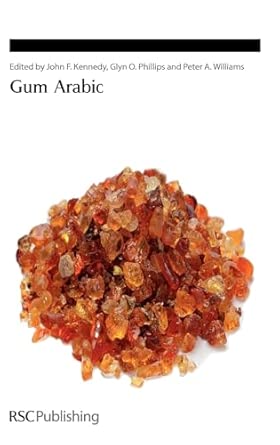
Gum Arabic: Volume 333
Author(s): John F Kennedy
- Publisher: Royal Society of Chemistry
- Publication Date: 7 Nov. 2011
- Language: English
- Print length: 372 pages
- ISBN-10: 1849731934
- ISBN-13: 9781849731935
Book Description
The proceedings of the World Conference on “New developments in Acacia Gums Research and Products” demonstrating the latest frontiers in gum Arabic production, identification, classification and production.
Editorial Reviews
From the Back Cover
About the Author
Excerpt. © Reprinted by permission. All rights reserved.
Gum Arabic
By John F. Kennedy, Glyn O. Phillips, Peter A. Williams
The Royal Society of Chemistry
Copyright © 2012 The Royal Society of Chemistry
All rights reserved.
ISBN: 978-1-84973-193-5
Contents
SECTION 1: Overview, 1,
SECTION 2: Commercial Development, 39,
SECTION 3: Harvesting and Yield, 87,
SECTION 4: Processing, 143,
SECTION 5: Structure and Physicochemistry, 177,
SECTION 6: Rheology and Emulsification, 219,
SECTION 7: Health Benefits, 283,
SECTION 8: Applications, 309,
CHAPTER 1
Section 1: Overview
GUM ARABIC’S (GUM ACACIA’S) JOURNEY FROM TREE TO END USER
O.H.M. Idris and G.M. HADDAD
1 INTRODUCTION
Gum acacia, also known as gum arabic, is exuded from Acacia trees – mainly from Acacia senegal and Acacia seyal. The main gum acacia producing countries are Sudan, Nigeria, Chad and Senegal. Sudan is considered to be the world’s largest producer of gum acacia. Gum acacia is the oldest and best known of all the polysaccharide plant exudates. It was used by the Ancient Egyptians in their paintings as an adhesive for mineral pigments and as an adhering agent to make flaxen wrappings for embalming mummies. It has been reported that the gum acquired the name “gum arabic” after its place of origin or port of export to Europe. A different explanation has been given by a Sudanese researcher who concludes that the name originates from a Sudanese tribe called Beja who live near the Red Sea and ports of export. In the Beja language, arabic means “transparent” and gum arabic refers to “excellent quality of gum that is transparent and free from bark”.
Gum acacia (INS No. 414) is defined by FAO/WHO Joint Expert Committee on Food Additives (JECFA) in FNP 52 Add 7 (1999) as: “Gum arabic is a dried exudate obtained from the stems and branches of Acacia senegal (L.) Willdenow or Acacia seyal (fam. Leguminosae)“. Acacia gum is defined by the European Pharmacopoeia 6.8 as: “Air- hardened, gummy exudates flowing naturally from or obtained by incision of the trunk and branches of Acacia senegal L. Willdenow, other species of Acacia of African origin and Acacia seyal Del.“. United States Pharmacopoeia Official Monograph for NF26 (USP 31) defines gum acacia as: “Acacia is the dried gummy exudates from the stems and branches of Acacia senegal (Linné) Willdenow or of other related African species of Acacia (Fam. Leguminosae)“. The Japanese Official monograph for part II / Powdered Acacia (JP XIV) defines gum acacia as: “Acacia is the secretions obtained from the stems and branches of Acacia senegal Willdenow or other species of the same genus (Leguminosae)“.
Gum acacia is a highly heterogeneous complex polysaccharide consisting of galactose, arabinose, rhamnose, glucuronic acid and 4-O-methylglucuronic acid. The carbohydrate composition can vary, depending on the location, the age of the tree and site of tapping, and from season to season. Also, gum acacia consists of a small amount of protein (~0.8% with A. seyal ~2.0% with A. senegal gums), which forms an integral part of the gum structure. Gum acacia has been fractionated by hydrophobic chromatography into three principle fractions, which are Arabinogalactan (AG), Arabinogalactan-protein (AGP) and glycoprotein (GP).
The physicochemical and nutritional data for A. senegal and A. seyal gums are shown in Table 1. The data shows that A. senegal gum has a higher potassium content and emulsion capacity compared to A. seyal gum, while A. seyal shows a slightly higher calcium content and slightly lower viscosity and ash content. Specific optical rotation is one of the most important quality control tools used by the gum acacia suppliers and manufacturers to differentiate between both gums.
2 TAPPING
The weather (temperature) has a considerable influence as to when the gum season starts. If the weather is hot enough directly after autumn (October / November), the leaves will start falling, which is a signal to start tapping the A. senegal trees. The traditional tapping tool was an axe, but modern practise in the Sudan is to use a sharp spear (Sonke) to pierce through an upper branch (or stem) just beneath the bark (not to damage the cambial zone). The spear is then moved up and down along the length of the branch to remove part of the bark and expose an area of the cambial layer about 30 cm long and 5 cm wide. Expert tappers always ensure that no peeled bark is left on the tree, which could stick to the gum nodules. A. seyal trees normally exude the gum naturally although recently farmers have started to tap these trees also.
3 GUMMOSIS
The gum oozes from the stems and branches of the tree within a zone between the inner bark and the cambial zone, when the tree is subjected to stress conditions such as drought (A. seyal) and wounding. The trees must be 5 years or older for gum production to occur, suggesting therefore that gum production is in direct competition with tree growth. Gum exudes in nodule form up to 60 mm in diameter, which then dries in the sun. A. senegal forms hard, glass like lumps which are transparent to amber in colour. A. seyal forms fragile fragments which are amber to brown in colour. A number of hypotheses have been suggested for the biosynthesis of the gum, which is referred to as “gummosis”. It was proposed that gummosis is a pathological process resulting from a bacterial or fungal infection of the injured tree, and efforts were made to isolate the bacteria and moulds that may be involved in the formation of the gum. Others believe that gummosis is part of the normal plant metabolism or directly related to starch metabolism and the gum acacia is produced in response to physiological disturbances induced by stress.
4 COLLECTION
The exudate gum hardens in the sun to form nodules, which are manually collected after 4-6 weeks from tapping, followed by 3-5 collections every 2 weeks, depending on the weather conditions and the health of the tree.
5 DRYING
Drying the gum after collection is a very important process to prevent fermentation and forming of agglomerated gum nodules (jammed gum). The gum is spread evenly to dry for a few days. It is recommended to avoid direct sun drying as the gum nodules break into small fragments and siftings. Drying the gum under 45% shade will help in drying the gum nodules without compromising the hand picked selected (HPS) and lump quality gums.
6 MANUAL CLEANING
The crude gum is pre-cleaned manually from sand and bark using sieves and trays. This is traditionally done by women, who manually sort the gum according to the size of the lumps and remove foreign matter.
The processing of gum acacia can be split into three categories:
Mechanical processing
Spray-Drying
Agglomeration
7.1 Mechanical processing
Figure 1 shows the mechanical processing, which involves cleaning, grading and generating a range of different particle sizes from the original lump gum. The mechanical processing also includes the Kibbling stage – a grinding process which breaks up the gum nodules into various specific particle sizes of approximately 0.5 mm to 6.0 mm. The Kibbling process increases the surface area of the gum particles and this allows the gum to dissolve faster in water compared with the lump gum. Mechanical powder can also be produced by further milling the kibbled gum, using mostly pin mills. Although the produced kibbled and milled gums are subjected to various mechanical cleaning steps, they still contain some amount of bark and foreign materials.
7.2 Spray-drying
The spray drying process shown in Figure 2 starts by dissolving the Kibbled gum in water followed by several filtration stages to remove the impurities. The gum solution is then decanted, centrifuged, and then passed through ultra fine filters to remove the fine insoluble material. In order to free the gum from any contaminated pathogenic micro-organisms and to reduce the total bacterial yeasts and moulds count, the gum solution is subjected to a pasteurisation process. The pasteurised gum solution is sprayed into fine droplets by atomisation or jets in a stream of hot air, which rapidly evaporates the water. Cyclones are used to separate dry gum powder from dry air.
The spray-drying process allows gum to be efficiently purified to give a consistent product. This can then be used directly in applications without recourse to further cleaning, chemical, physical, or microbiological procedures. The vast majority of the food and pharmaceutical industries now specify spray-dried gum acacia because of its benefits in all types of applications.
7.3 Agglomeration
The agglomeration process summarised in Figure 3 involves suspending the spray dried gum acacia powder on a bed of air, then spraying water or gum solution onto this to cause particles to stick together. The produced agglomerated powder is then dried and sieved to produce a product with a consistent and narrow range of particle size. The advantage of the agglomeration process is that it produces environmentally friendly, dust-free gum acacia powder products and improves significantly the dispersability, sinkability, solubility and dissolving characteristics of the spray-dried gums. Customers using the agglomerated gum powder do not need very powerful mixers to dissolve the gum.
8 FUNCTIONAL PROPERTIES
Gum acacia has many properties that make it unique.
8.1 Solubility
Gum acacia is unique among natural hydrocolloids in that it is highly soluble in hot and cold water. Most gums cannot be dissolved in water at concentrations higher than 5% due to their high viscosity, but gum acacia can yield solutions up to 50% concentration. The ability of gum acacia to form these concentrated solutions without an excessive increase in viscosity is due to the high degree of branching within the gum structure and therefore small hydrodynamic volume.
Gum acacia is insoluble in oils and in most organic solvents and is soluble in aqueous ethanol up to a limit of about 60% ethanol.
8.2 Emulsifying properties
Gum acacia from A. senegal is a very effective emulsifying and stabilising agent and has found widespread use in the preparation of varied oil-in-water beverage emulsions. It is not less than the gold standard of emulsifiers used in beverages.
The gum contains a protein deficient, low molecular weight arabinogalactan (AG), a protein rich glycoprotein (GP) and a high molecular weight arabinogalactan-protein complex (AGP). The AGP complex is preferentially adsorbed onto the oil droplets and it is this which stabilises the emulsion. The large hydrophilic polysaccharide blocks of the AG fraction extend into the aqueous phase and prevent coalescence due to the steric repulsion between droplets.
Processing factors such as pasteurisation and demineralisation of the gum promote emulsion stability, most likely by promoting protein unfolding and eliminating the screening effect, respectively.
8.3 Viscosity
Most gums form highly viscous solutions at low concentrations (<5%). However, at such relatively low concentrations, gum acacia yields solutions that are essentially Newtonian in behaviour and have very low viscosities compared to other polysaccharides of similar molecular mass.
Table 2 and Table 3 show study results of the effect of concentration and temperature on the viscosity of Agri-Spray Acacia RE (A. senegal gum) and Agri-Spray Acacia MGH (A. seyal gum) products. The viscosity results of the products produced from both A. senegal and A. seyal gums show an increase in viscosity following an increase in concentration, and a decrease in viscosity when the gum solution is subjected to an increase in temperature. A. senegal gum shows slightly higher viscosity results than A. seyal gum.
At concentrations above 40%, both A. senegal and A. seyal gums produced solutions with a considerably higher viscosity. These findings agreed with previous studies that showed hydrated gum acacia molecules above 30% concentration effectively overlap, and steric interactions result in a much higher solution viscosity.
8.4 Effect of pH and electrolytes
The viscosity of gum acacia solutions decreases with the addition of electrolytes and this is explained by a reduction in the effective volume due to the suppression of the electrostatic charge. Solutions of gum acacia are slightly acidic (typical pH is 4.5) and at this pH, the gum is at its maximum viscosity. Gum acacia is stable over a wide range of pH from 3.0 to 9.0.
8.5 Compatibility
Gum acacia has a broad range of compatibilities and is compatible with most gums, starches, carbohydrates and proteins. It is incompatible with sodium alginate and gelatine. With gelatine, gum acacia forms a well-known coacervate utilised in the preparation of encapsulated oils. A synergistic viscosity decrease was reported with a mixture of gum tragacanth and gum acacia, which reached minimum viscosity at 80% gum tragacanth and 20% gum acacia.
8.6 Effect of heat
Prolonged heating causes the thermal destruction of gum acacia. It results in the denaturation and precipitation of the proteins from the high molecular weight AGP and GP complexes and this causes a reduction in the emulsification capacity and solution viscosity.
8.7 Sensory properties
A. senegal gum is generally odourless, colourless and tasteless, while A. seyal gum is slightly dark in colour.
8.8 Nutraceutical properties
Gum acacia is a complex, non-starch polysaccharide, indigestible to both humans and animals but fermented in the colon to produce short-chain fatty acids, leading to a wide range of potential health benefits. It thus meets dietary fibre definitions that are adopted by the European Union and Codex Alimentarius. The typical fibre content of gum acacia is in excess of 85% (AOAC method). Due to the complex, highly branched molecular structure of gum acacia, its fermentation is very slow and this reduces the bloating side effect.
Gum acacia is a prebiotic, soluble fibre that feeds and stimulates the growth and activity of the beneficial bacteria (probiotic) in the colon. Probiotic bacteria strengthen the immune system to combat allergies, stress, exposure to toxic substances and other diseases. It has been reported that studies in vivo and in vitro with gum acacia show compatibility in the diet of patients suffering with diabetes mellitus, and a reduction in systolic blood pressure, which may translate into an improved cardiovascular outcome and a reduction in the progression of renal disease.
A calorific value of 1.7 Kcal/g for gum acacia has been confirmed by the Food and Drug Administration (FDA) and can be used for the calculation of gum acacia energy contribution.
9 APPLICATIONS
Gum acacia enjoys a remarkable diversity of applications and this is mainly due to its desirable physicochemical properties and functions as reported earlier. The functions of gum acacia include emulsifier, formulation aid, stabiliser, thickener, surface finishing agent, processing aid, firming agent, texturiser, adhesive, plasticiser, soluble fibre and prebiotic source, and many others.
9.1 Confectionery
Gum acacia has been widely used in the confectionery industry for many centuries. This is due to its ability to prevent sugar crystallisation, modify texture, emulsify and keep fatty components evenly distributed. It can also act as a boundary film in glazing systems.
9.2.1 High Sugar Confectionery (Pastilles, Candies, Gum Drops): In pastilles and candies, gum acacia is used in concentrations up to 45% to inhibit sugar crystallisation and as a binder. The traditional wine gums and gum drops (or fruit gums) were originally prepared exclusively with gum acacia, as a higher clarity could be achieved compared to other hydrocolloids, and the resistance to melt-away, shape retention, bland taste and odour, pliable texture, and low adhesion when chewed, are all major benefits of this gum. Other properties of providing slow, controlled flavour release, protecting flavours from oxidation and controlling sugar crystallisation are also valuable. Jelly candies, which are similar to gum drops, are made with gum acacia but can be produced with agar, starch, pectin and gelatine. Depending on the concentration of gum acacia, the sugar types and proportions, and the residual moisture in the confectionery, textures ranging from soft lozenges and pastilles to hard gums can be produced.
(Continues…)Excerpted from Gum Arabic by John F. Kennedy, Glyn O. Phillips, Peter A. Williams. Copyright © 2012 The Royal Society of Chemistry. Excerpted by permission of The Royal Society of Chemistry.
All rights reserved. No part of this excerpt may be reproduced or reprinted without permission in writing from the publisher.
Excerpts are provided by Dial-A-Book Inc. solely for the personal use of visitors to this web site.