Wow! eBook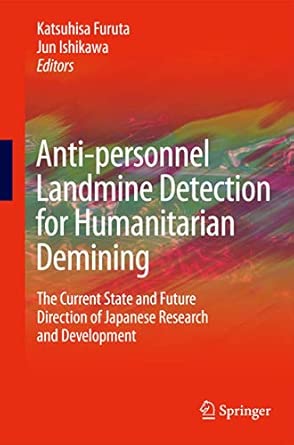
Anti-personnel Landmine Detection for Humanitarian Demining: The Current Situation and Future Direction for Japanese Research and Development 2009th Edition
Author(s): Katsuhisa Furuta (Editor), Jun Ishikawa
- Publisher: Springer
- Publication Date: 9 Feb. 2009
- Edition: 2009th
- Language: English
- Print length: 236 pages
- ISBN-10: 1848823452
- ISBN-13: 9781848823457
Book Description
Anti-personnel Landmine Detection for Humanitarian Demining reports on state-of-the-art technologies developed during a Japanese National Research Project (2002–2007). The conventional method of landmine detection is using metal detectors to sense the metal in mines, but often other metal fragments in minefields camouflage landmines and hinder progress using this form of demining. The challenge is to develop detection systems that can discriminate between AP landmines and random metal fragments.
The JST adopted research proposals and the results are reported here. This book concentrates on aspects of three approaches to AP mine detection: enhancing and confirming the results of metal-detection scans using GPR; using robot vehicles and manipulators to operate within minefields remotely; and methods of sensing the explosives within mines.
Results are presented in the fields of GPR, nuclear quadrupole resonance, neutron thermal analysis and biosensors. The integration of these methods for workable robot operation is demonstrated. The project was carried out in conjunction with mine action centers in Croatia, Cambodia and Afghanistan. Evaluation data from field trials are also given.
Editorial Reviews
From the Back Cover
There are more than 70 countries in the world that suffer from the presence of landmines. Annually, between 15,000 and 20,000 people are killed or injured by these mines so there is a pressing need for advances in technology to help to remove them.
Anti-personnel Landmine Detection for Humanitarian Demining reports on state-of-the-art technologies developed during a Japanese National Research Project. The conventional, and often reliable, method of landmine detection is to use a metal detector to pick up small amounts of metal within the mine. Unfortunately, minefields are frequently strewn with small metal fragments which can camouflage landmines greatly hindering progress using this form of demining. The challenge, then, is to develop practical detection systems that can discriminate between anti-personnel (AP) landmines and randomly scattered innocent metal fragments.
The results of 12 research proposals from universities and industrial sources and adopted by the Japanese Science and Technology Agency are presented here. This book concentrates on various aspects of three main approaches to AP mine detection:
• enhancing and confirming the results of metal-detection scans using ground-penetrating radar (GPR);
• using robot vehicles and manipulators to operate within minefields remotely; and
•methods of sensing the explosives within mines.
Basic results are presented in the fields of GPR, nuclear quadruple resonance, neutron thermal analysis and biosensors. The integration of these methods for workable robot operation is demonstrated. The project was carried out in conjunction with mine action centers in Croatia, Cambodia and Afghanistan and evaluation data from field trials of the technologies are also reported.
The results will be most useful to anyone who is involved in the use or production of technical equipment associated with landmine removal. In addition, academics researchingadvances in this field and those working in remote sensing, mechatronics and robotics will find much to interest them and a co-ordinated body of work with which to expand their own studies.
About the Author
At present, Katsuhisa Furuta is Professor of School of Science & Engineering and School of Science and Technology for Future Life at Tokyo Denki University as well as Professor Emeritus of Tokyo Institute of Technology. He is to be the President of Tokyo Denki University from June 2008.
Professor Furuta’s research interests lie in the broad areas of System Control, Robotics, Mechatronics, and Computer Vision. He is has done pioneering research in the control of pendulums using the so-called Furuta Pendulum which has been used for control study and education in many countries. He received many awards including of Honorary Doctorate – Helsinki University of Technology (1998), IEEE CSS Distinguished Member (1998), and IEEE Third Millennium Medal (2000). He is a Fellow of SICE (1992), IEEE (1996), IET (2003), IFAC (2006), and Honorary Member of SICE (2006). He also served as Member of Science Council of Japan (1997-2003).