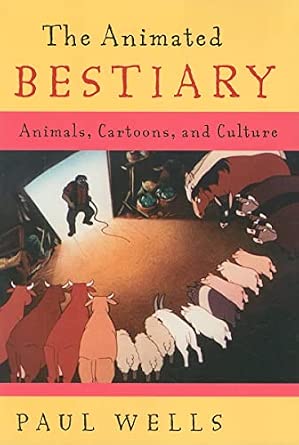
The Animated Bestiary: Animals, Cartoons, and Culture None ed. Edition
Author(s): Paul Wells (Author)
Publisher: Rutgers University Press
Publication Date: 28 Nov. 2008
Edition: None ed.
Language: English
Print length: 236 pages
ISBN-10: 0813544157
ISBN-13: 9780813544151
Book Description
Cartoonists and animators have given animals human characteristics for so long that audiences are now accustomed to seeing Bugs Bunny singing opera and Mickey Mouse walking his dog Pluto.
The Animated Bestiary critically evaluates the depiction of animals in cartoons and animation more generally. Paul Wells argues that artists use animals to engage with issues that would be more difficult to address directly because of political, religious, or social taboos. Consequently, and principally through anthropomorphism, animation uses animals to play out a performance of gender, sex and sexuality, racial and national traits, and shifting identity, often challenging how we think about ourselves.
Wells draws on a wide range of examples, from the original King Kongto Nick Park’s Chicken Run to Disney cartoonsùsuch as Tarzan, The Jungle Book, and Brother Bearùto reflect on people by looking at the ways in which they respond to animals in cartoons and films.
Editorial Reviews
Review
Wells has proven himself to be a leading scholar of animation and has here produced a solid piece of scholarship that shows an incredible breadth of knowledge. — Eric Smoodin ― author of Regarding Frank Capra: Audience, Celebrity,and American Film Studies,
From the Inside Flap
Cartoonists and animators have given animals human characteristics for so long that audiences are now accustomed to seeing Bugs Bunny singing opera and Mickey Mouse walking his dog Pluto.
The Animated Bestiary critically evaluates the depiction of animals in cartoons and animation more generally. Paul Wells argues that artists use animals to engage with issues that would be more difficult to address directly because of political, religious, or social taboos. Consequently, and principally through anthropomorphism, animation uses animals to play out a performance of gender, sex and sexuality, racial and national traits, and shifting identity, often challenging how we think about ourselves.
Wells draws on a wide range of examples, from the original King Kong to Nick Park s Chicken Run to Disney cartoons such as Tarzan, The Jungle Book, and Brother Bear to reflect on people by looking at the ways in which they respond to animals in cartoons and films.
About the Author
Paul Wells is the director of animation in the Animation Academy at Loughborough University. He is the author of several books, including Animation and America(Rutgers University Press), Understanding Animation, and Fundamentals of Animation.
 Wow! eBook