Wow! eBook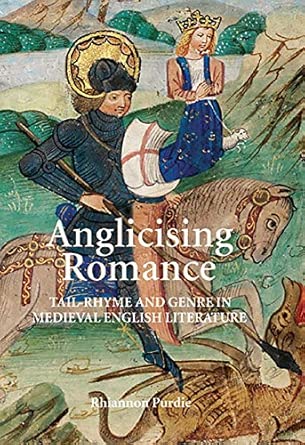
Anglicising Romance: Tail-rhyme and Genre in Medieval English Literature
Author(s): Rhiannon Purdie (Author)
- Publisher: D. S. Brewer
- Publication Date: 18 Sept. 2008
- Language: English
- Print length: 288 pages
- ISBN-10: 1843841622
- ISBN-13: 9781843841623
Book Description
A reappraisal of the tail-rhyme form so strongly associated with medieval English romance, and how it became so appropriated. Tail-rhyme romance unites a French genre with a continental stanza form, so why was it developed only in Middle English literature? For English audiences, tail-rhyme becomes inextricably linked with the romance genre in a way thatno other verse form does. The first examples are recorded near the beginning of the fourteenth century and by the end of it Chaucer’s Sir Thopas can rely on it to work as a shorthand for the entire Middle English romance tradition. How and why this came to be is the question that Anglicising Romance sets out to answer. Its five chapters discuss the stanza’s origins; the use of tail-rhyme in Anglo-Noman literature; questions of transmission and manuscript layout; the romances of the Auchinleck manuscript; and the geographic spread of tail-rhyme romance. The individual entries in the Appendix present newly reassessed evidence for the provenance and date of each of thethirty-six extant tail-rhyme romances. RHIANNON PURDIE is Senior Lecturer in Mediaeval English at the University of St Andrews.
Editorial Reviews
Review
A study of this thoroughness and scope, which also offers new or refined insights into the nature and significance of tail-rhyme romance, is to be warmly welcomed as a significant contribution to the scholarship of Middle English romance and to the study of distinctively regional or national developments in medieval writing. –THE MEDIEVAL REVIEW, June 2009
[An] intriguing and carefully executed study. –SPECULUM, vol. 85, no. 4
Meticulously researched and thoroughly enjoyable, Purdie’s monograph offers a rare and valuable addition to this developing area of study. –YEAR’S WORK IN ENGLISH STUDIES, vol. 89, no 1, 2010
[An] authoritative study that should once and for all re-orientate them as a focus of intelligent and important questions. […] This is a substantial study that is essential reading not only for those working on romances, but for its insights into manuscript production, regional literary culture and the literary expression of Englishness. –ARTHURIANA, vol. 21, no. 2, 2011
About the Author
Rhiannon Purdie is Lecturer in Medieval English at the University of St Andrews.