 Wow! eBook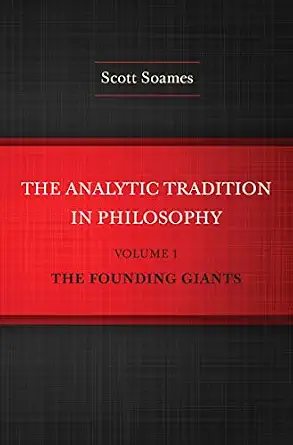
The Analytic Tradition in Philosophy, Volume 1: The Founding Giants
Author(s): Scott Soames (Author)
- Publisher: Princeton University Press
- Publication Date: March 23, 2014
- Language: English
- Print length: 680 pages
- ISBN-10: 9780691160023
- ISBN-13: 9780691160023
Book Description
This is the first of five volumes of a definitive history of analytic philosophy from the invention of modern logic in 1879 to the end of the twentieth century. Scott Soames, a leading philosopher of language and historian of analytic philosophy, provides the fullest and most detailed account of the analytic tradition yet published, one that is unmatched in its chronological range, topics covered, and depth of treatment. Focusing on the major milestones and distinguishing them from the dead ends, Soames gives a seminal account of where the analytic tradition has been and where it appears to be heading.
Volume 1 examines the initial phase of the analytic tradition through the major contributions of three of its four founding giants―Gottlob Frege, Bertrand Russell, and G. E. Moore. Soames describes and analyzes their work in logic, the philosophy of mathematics, epistemology, metaphysics, ethics, and the philosophy of language. He explains how by about 1920 their efforts had made logic, language, and mathematics central to philosophy in an unprecedented way. But although logic, language, and mathematics were now seen as powerful tools to attain traditional ends, they did not yet define philosophy. As volume 1 comes to a close, that was all about to change with the advent of the fourth founding giant, Ludwig Wittgenstein, and the 1922 English publication of his Tractatus, which ushered in a “linguistic turn” in philosophy that was to last for decades.
Editorial Reviews
Review
Review
From the Inside Flap
“This is an incredibly rewarding book. The range of topics and level of detail are breathtaking. Soames is very skilled at turning the prose of other philosophers into clear, precise, and logically transparent arguments. Over and over again he takes an unfiltered passage and turns it into a numbered sequence of premises and conclusion. It is exceptionally useful and productive to have arguments laid out in this standard form. This volume will be a great pedagogical tool, both as a classroom text and as a reference.”–Peter Hanks, University of Minnesota
From the Back Cover
“This is an incredibly rewarding book. The range of topics and level of detail are breathtaking. Soames is very skilled at turning the prose of other philosophers into clear, precise, and logically transparent arguments. Over and over again he takes an unfiltered passage and turns it into a numbered sequence of premises and conclusion. It is exceptionally useful and productive to have arguments laid out in this standard form. This volume will be a great pedagogical tool, both as a classroom text and as a reference.”–Peter Hanks, University of Minnesota
About the Author
Excerpt. © Reprinted by permission. All rights reserved.
The Analytic Tradition in Philosophy
VOLUME 1 THE FOUNDING GIANTS
By SCOTT SOAMES
PRINCETON UNIVERSITY PRESS
Copyright © 2014 Princeton University Press
All rights reserved.
ISBN: 978-0-691-16002-3
Contents
Acknowledgments, ix,
Preface, xi,
PART ONE: FREGE,
CHAPTER 1 Foundations of Logic, Language, and Mathematics, 3,
CHAPTER 2 Critical Challenges, 60,
PART TWO: G. E. MOORE,
CHAPTER 3 Becoming G. E. Moore, 133,
CHAPTER 4 Goodness and the Foundations of ethics, 172,
CHAPTER 5 Truth, Skepticism, Perception, and Knowledge, 206,
CHAPTER 6 The Mixed Legacy and Lost Opportunities of Moore’s ethics, 242,
PART THREE: RUSSELL,
CHAPTER 7 Early Russell: Logic, Philosophy, and The Principles of Mathematics, 263,
CHAPTER 8 Russell’s Theory of Descriptions: “On Denoting”, 328,
CHAPTER 9 Truth, Falsity, and Judgment, 413,
CHAPTER 10 Russell’s Logicism, 473,
CHAPTER 11 Our Knowledge of the external World, 535,
CHAPTER 12 The Philosophy of Logical Atomism, 568,
Looking Ahead, 631,
References, 633,
Index, 647,
CHAPTER 1
Foundations of Logic, Language, and Mathematics
l. Overview
2. The Language of Logic and Mathematics
3. Sense, Reference, Compositionality, and hierarchy
4. Frege’s Logic
5. Frege’s Philosophy of Mathematics
5.1. Critique of Naturalism, Formalism, and Psychologism
5.2. Critique of Kant
5.3. Frege’s Definition of Number
5.3.1. Numerical Statements Are about Concepts
5.3.2. But Numbers Are Objects
5.3.3. Objects and Identity
5.3.4. The Number of F’s, Zero, Successor, and the Numerals
5.3.5. The Natural Numbers
6. The Logicist Reduction
6.1. The Axioms of Logic and Arithmetic
6.2. Informal Proofs of the Arithmetical Axioms
6.3. Arithmetical Operations
6.4. Further Issues
1. OVERVIEW
The German philosopher-logician Gottlob Frege was born in 1848, graduated with a PhD in Mathematics from the University of Gottingen in 1873, and earned his habilitation in Mathematics from the University of Jena in 1874, where he taught for 43 years until his retirement in 1917, after which he continued to write on issues in philosophical logic and the philosophy of mathematics until his death in 1925. While he is now recognized as one of the greatest philosophical logicians, philosophers of mathematics, and philosophers of language of all time, his seminal achievements in these areas initially elicited little interest from his contemporaries in mathematics. Though he did attract the attention of, and have an important influence on, four young men—Bertrand Russell, Edmund Husserl, Rudolf Carnap, and Ludwig Wittgenstein—who were to become giants in twentieth-century philosophy, it took several decades after his death before the true importance of his contributions became widely recognized.
Frege’s main goal in philosophy was to ground the certainty and objectivity of mathematics in the fundamental laws of logic, and to distinguish both logic and mathematics from empirical science in general, and from the psychology of human reasoning in particular. His pursuit of this goal can be divided into four interrelated stages. The first was his development of a new system of symbolic logic, vastly extending the power of previous systems, and capable of formalizing the notion of proof in mathematics. This stage culminated in his publication of the Begriffsschrift (Concept Script) in 1879. The second stage was the articulation of a systematic philosophy of mathematics, emphasizing (i) the objective nature of mathematical truths, (ii) the grounds for certain, a priori knowledge of them, (iii) the definition of number, (iv) a strategy for deriving the axioms of arithmetic from the laws of logic plus analytical definitions of basic arithmetical concepts, and (v) the prospect of extending the strategy to higher mathematics through the definition and analysis of real, and complex, numbers. After the virtual neglect of the Begriffsschrift by his contemporaries—due in part to its forbidding technicality and idiosyncratic symbolism—Frege presented the second stage of his project in remarkably accessible, and largely informal, terms in Die Grundlagen der Arithmetik (The Foundations of Arithmetic), published in 1884. In addition to being among the greatest treatises in the philosophy of mathematics ever written, this work is one of the best examples of the clarity, precision, and illuminating insight to which work in the analytic tradition has come to aspire. The third stage of the project is presented in a series of ground-breaking articles, starting in the early 1890s and continuing at irregular intervals throughout the rest of his life. These articles include, most prominently, “Funktion und Begriff” (“Function and Concept”) in 1891, “Über Begriff und Gegenstand” (“On Concept and Object”) in 1892, “Über Sinn und Bedeutung” (“On Sense and Reference”) in 1892, and “Der Gedanke” (“Thought”) in 1918. In addition to elucidating the fundamental semantic ideas needed to understand and precisely characterize the language of logic and mathematics, this series of articles contains important insights about how to extend those ideas to natural languages like english and German, thereby providing the basis for the systematic study of language, thought, and meaning. The final stage of Frege’s grand project is presented in his treatise Grundgesetze der Arithmetik (Basic Laws of Arithmetic), volumes 1 and 2, published in 1893 and 1903 respectively. In these volumes, Frege meticulously and systematically endeavors to derive arithmetic from logic together with definitions of arithmetical concepts in purely logical terms. Although, as we shall see, his attempt was not entirely successful, the project has proven to be extraordinarily fruitful.
The discussion in this chapter will not strictly follow the chronological development of Frege’s thought. Instead, I will begin with his language of logic and mathematics, which provides the starting point for developing his general views of language, meaning, and thought, and the fundamental notions—truth, reference, sense, functions, concepts, and objects—in terms of which they are to be understood. With these in place, I will turn to a discussion of the philosophical ideas about mathematics that drive his reduction of arithmetic to logic, along with a simplified account of the reduction itself. The next chapter will be devoted to critical discussions of Frege’s most important views, including the interaction between his philosophy of language and his philosophy of mathematics. In what follows I refer to Frege’s works under their English titles—with the exception of the Begriffsschrift, the awkwardness of the English translation of which is prohibitive.
2. THE LANGUAGE OF LOGIC AND MATHEMATICS
I begin with the specification of a simple logical language which, though presented in a more convenient symbolism than the one Frege used, is a direct descendant of his. The first step is to specify how the formulas and sentences of the language are constructed from the vocabulary of the language. After that, we will turn to Fregean principles for understanding the language.
THE SYMBOLIC LANGUAGE LF
Vocabulary
Names of objects: a, b, c, …
Function signs: f( ), g( ), h( ), f'( , ), g'( , ) h'( , , ), … These stand for functions from objects to objects. Function signs are sorted into 1-place, 2-place, …, and n-place. One-place function signs combine with a single name (or other term) to form a complex term, 2-place function signs combine with a pair of names (or other terms) to form a complex term, and so on. Standardly, the terms follow the function sign, but in the case of some 2-place function signs—like ‘+’ and ‘×’ for addition and multiplication—the function symbol is placed between the terms.
Predicate signs: ( ) = ( ), P( ), Q( , ), R( , , ) … Predicate signs are sorted into 1-place, 2-place, etc. An n-place predicate sign combines with n terms to form a formula.
Terms
Individual variables (ranging over objects) are terms: x, y, z, x’, y’, z’, …
Names of objects are terms: a, b, c, …
Expressions in which an n-place function sign is combined with n terms are terms: e.g., if a and b are terms, f and h are 1-place function signs, and g is a 2-place function sign, then [??]f(a)[??], [??]g(a,b)[??], [??]h(f(a))[??], and [??]g(a,f(b))[??] are terms.
Definite descriptions are terms: If Φv is a formula containing the variable v, then [??]the v Φv[??] is a term.
Nothing else is a term.
Formulas
An atomic formula is the combination of an n-place predicate sign with n terms. Standardly the terms follow the predicate sign, but in the case of some 2-place predicate signs—like ‘( ) = ( )’ for identity—the terms are allowed to flank predicate sign.
Other (non-atomic) formulas
If Φ and Ψ are formulas, so are [??]Φ[??], [??](Φ v Ψ)[??], [??](Φ & Ψ)[??], [??](Φ [right arrow] Ψ)[??] and [??](Φ <[right arrow] Ψ)[??]. If v is a variable and Φ(v) is a formula containing an occurrence of v, [??][for all]v Φ(v)[??] and [??][there exists]v Φ(v)[??] are also formulas. (Parentheses can be dropped when no ambiguity results.)
[??]~Φ[??], which is read or pronounced [??]not Φ[??], is the negation of Φ; [??](Φ [disjunction] Ψ)[??], read or pronounced [??]either Φ or Ψ[??], is the disjunction of Φ and Ψ; [??](Φ & [PSI)[??], read or pronounced [??]Φ and Ψ[??], is the conjunction of Φ and Ψ; [??](Φ [right arrow] Ψ)[??], read or pronounced [??]if Φ, then Ψ[??], is a conditional the antecedent of which is Φ and the consequent of which is Ψ; [??](Φ <[right arrow] Ψ)[??], read or pronounced [??]Φ if and only if Ψ[??], is a biconditional connecting Φ and Ψ; [??][for all]v Φ(v)[??], read or pronounced [??]for all v Φ(v)[??], is a universal generalization of Φ(v); and [??][there exists]v Φ(v)[??], which is read or pronounced [??]at least one v is such that Φ(v)[??], is an existential generalization of Φ(v). [for all]v and [there exists]v are called “quantifiers.”
Sentences
A sentence is a formula that contains no free occurrences of variables. An occurrence of a variable is free iff it is not bound.
An occurrence of a variable in a formula is bound iff it is within the scope of a quantifier, or the definite description operator, using that variable.
The scope of an occurrence of a quantifier [for all]v and [there exists]v, or of the definite description operator, the v, is the quantifier, or description operator, together with the (smallest complete) formula immediately following it. For example, [for all]x (Fx [right arrow] Gx) and [there exists]x (Fx & Hx) are each sentences, since both occurrences of ‘x’ in the formula attached to the quantifier are within the scope of the quantifier. Note, in these sentences, that (i) Fx does not immediately follow the quantifiers because ‘(‘intervenes, and (ii) (Fx is not a complete formula because it contains ‘(‘without an accompanying ‘)’. By contrast, ([for all]x Fx [right arrow] Gx) and ([for all]x (Fx & Hx) [right arrow] Gx) are not sentences because the occurrence of ‘x’ following ‘G’ is free in each case. The generalization to ‘the x’ is straightforward.
Frege’s representational view of language provides the general framework for interpreting LF. On this view, the central semantic feature of language is its use in representing the world. For a sentence S to be meaningful is for S to represent the world as being a certain way—which is to impose conditions the world must satisfy if it is to be the way S represents it to be. Since S is true iff (i.e., if and only if) the world is the way S represents it to be, these are the truth conditions of S. To sincerely accept, or assertively utter, S is, very roughly, to believe, or assert, that these conditions are met. Since the truth conditions of a sentence depend on its grammatical structure plus the representational contents of its parts, interpreting a language involves showing how the truth conditions of its sentences are determined by their structure together with the representational contributions of the words and phrases that make them up. There may be more to understanding a language than this—even a simple logical language like LF constructed for formalizing mathematics and science—but achieving a compositional understanding of truth conditions is surely a central part of what is involved.
With this in mind, we apply Fregean principles to LF. Names and other singular terms designate objects; sentences are true or false; function signs refer to functions that assign objects to the n-tuples that are their arguments; and predicates designate concepts—which are assignments of truth values to objects (i.e., functions from objects to truth values). A term that consists of an n-place function sign f together with n argument expressions designates the object that the function designated by f assigns as value to the n-tuple of referents of the argument expressions. Similarly, a sentence that consists of an n-place predicate P plus n names is true iff the names designate objects o1, …, on and the concept designated by P assigns these n objects (taken together) the value “the True,” or truth. According to Frege, concepts are also designated by truth-functional operators. The negation operator ‘~’ designates a function from falsity to truth (and from truth to falsity), reflecting the fact that the negation of a sentence is true (false) iff the sentence negated is false (true); the operator ‘&’ for conjunction designates a function that assigns truth to the pair consisting of truth followed by truth (and assigns falsity to every other pair), reflecting the fact that a conjunction is true iff both conjuncts are; the disjunction operator ‘[disjunction]’ designates a function that assigns truth to any pair of arguments one of which is truth, reflecting the fact that a disjunction is true iff at least one of its disjuncts is. The operator ‘[right arrow]’ used to form what are called material conditionals designates the function that assigns falsity to the pair of arguments the first of which is truth and the second of which is falsity—capturing the fact that a material conditional [??]Φ [right arrow] Ψ[??] is false whenever its antecedent Φ is true and its consequent Ψ is false. The material conditional, employed in the Fregean logical language, is true on every other assignment of truth values to Φ and Ψ. Finally, the biconditional operator ‘<[right arrow]’ designates a function that assigns truth to the pairs of and , while assigning falsity to the other two pairs, thereby ensuring that [??]Φ <[right arrow] Ψ[??] is equivalent to [??](Φ [right arrow] Ψ) & (Ψ [right arrow] Φ)[??].
Despite Frege’s use of the term ‘concept’—which sounds as if it stands for an idea or other mental construct—concepts, in the sense he uses the term, are no more mental than the people, places, or other objects that are the referents of proper names. Just as different people who use the name ‘Boston’ to refer to the city in Massachusetts may have different images of, or ideas about, it, so the predicate ‘is a city’ may bring different images or ideas to the minds of different people who predicate it of Boston. For Frege, understanding the predicate involves knowing that it designates a concept that assigns truth to an object o iff o is a city, which, in effect, amounts to knowing that to say of o “it’s a city” is to say something true just in case o is a city. The truth or falsity of such a statement depends on objective features of o to which the function designated by ‘is a city’ is sensitive. Thus, Frege takes concepts to be genuine constituents of mind-independent reality.
This example brings out a related feature of Frege’s view. Just as predicates and function signs are different kinds of linguistic expressions than names, and other (singular) terms, so, Frege thinks, concepts and other functions are different kinds of things than objects. On the linguistic side, Frege begins with two grammatical categories of what he calls “saturated expressions.” These are sentences and (singular) terms—all of which he, idiosyncratically, calls “Names.” What he calls “Names” are said to refer to objects, including sentences that are said to refer to truth values “the True” and “the False.” In addition, there are different types of “unsaturated expressions”—each of which is thought of as containing one or more gaps, to be filled by expressions of various types in order to produce a “saturated expression”—i.e., a singular term or a sentence. An n-place predicate, for example, is an expression that combines with n terms to form a sentence. For Frege, these include not only those that are called simple “predicate signs” in the specification of the language above, but also compound expressions that result from removing n terms from a sentence, no matter how complex.
(Continues…)Excerpted from The Analytic Tradition in Philosophy by SCOTT SOAMES. Copyright © 2014 Princeton University Press. Excerpted by permission of PRINCETON UNIVERSITY PRESS.
All rights reserved. No part of this excerpt may be reproduced or reprinted without permission in writing from the publisher.
Excerpts are provided by Dial-A-Book Inc. solely for the personal use of visitors to this web site.


