Wow! eBook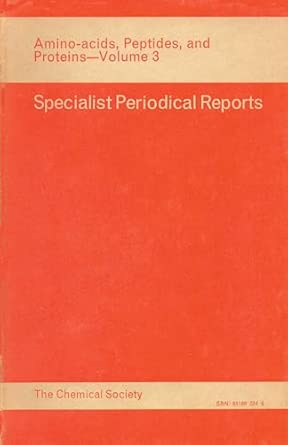
Amino Acids & Peptides: Volume 3 Edition. ed. Edition
Author(s): G T Young
- Publisher: CRC Press
- Publication Date: 30 Jun. 1990
- Edition: Edition. ed.
- Language: English
- Print length: 294 pages
- ISBN-10: 0851860249
- ISBN-13: 9780851860244
Book Description
Indispensable reference source for researchers in the pharmaceutical and allied industries, and at the biology/chemistry interface in academia.
Editorial Reviews
Excerpt. © Reprinted by permission. All rights reserved.
Amino-Acids, Peptides, and Proteins Volume 3
A Review of the Literature Published During 1970
By G. T. Young
The Royal Society of Chemistry
Copyright © 1971 The Chemical Society
All rights reserved.
ISBN: 978-0-85186-024-4
Contents
Chapter 1 Amino-acids By B. W. Bycroft,
Chapter 2 Structural Investigation of Peptides and Proteins,
Chapter 3 Peptide Synthesis By J. H. Jones,
Chapter 4 Peptides with Structural Features Not Typical of Proteins By J. S. Davies,
Chapter 5 Metal Derivatives of Amino-acids, Peptides, and Proteins By R. D. Gillard and S. H. Laurie,
Author Index, 359,
CHAPTER 1
Amino-acids
BY B. W. BYCROFT
Amino-acids continue to attract attention from all branches of chemistry and related disciplines. Unfortunately, this wide diversity of interest poses considerable problems in reviewing the year’s literature since only in a limited number of cases can any particular development be considered in depth. However, there can be no doubt that this year some of the most interesting advances have occurred within the field of asymmetric synthesis, and these have been considered worthy of more detailed coverage. The pattern already established for this chapter is maintained with a few minor exceptions, and the emphasis remains on a-amino-acids. Regrettably, it has only been possible to cover biochemical aspects when they relate directly to the chemistry.
1 Naturally Occurring Amino-acids
A. Introduction. — Amino-acids with novel structures continue to be isolated from natural sources both in the free state and from peptide and protein hydrolysates. Spectroscopic methods have played an important rôle in structure determination, in particular n.m.r. spectroscopy and mass spectrometry. However, it is interesting to note the increasing application of X-ray crystallographic analysis in cases where other spectroscopic methods have proved ambiguous (see Section 3). Those amino-acids whose structures have been confirmed by synthesis are presented in the list of newly synthesised amino-acids in Section 2.
The presence of amino-acids in marine sediments is attracting increasing attention. These acids are undoubtedly of natural origin since they are optically active, and the degree of racemisation observed with increasing age appears to offer an alternative method of dating.
B. New Natural Free Amino-acids. — A number of new plant amino-acids have been described. Further work on the amino-acids formed in the early stages of germination of pea seedlings has resulted in the isolation of the isoxazolinones (1) and (2). The structures are based on extensive spectroscopic data and degradative evidence. Treatment of (1) with mild base followed by acid hydrolysis affords αβ -diaminopropionic acid, whereas similar treatment of (2) gives D-glucose and glutamic acid. Both (1) and (2) are uncommonly sensitive to u.v. radiation and it has been suggested that they may play a role in some photobiological mechanism. It is also reported that they are present in the seedlings of several other leguminous plants. γ-Cyano-L-α-aminobutyric acid has been identified for the first time as a biological substance. It accumulates when inorganic cyanide is administered to young cultures of Chromobacterium violaceum. β-Methylene-L-norleucine (3) has been isolated from the carpophores of Amanita vaginata and is a further example of a dehydro-amino-acid produced by either a fungus or a micro-organism. N-Jasmonoyl- and N-dihydrojasmonoyl-isoleucine (stereochemistry at the amino-acid centre not defined) are produced by the fungus Gibberella fujikuroi and 2-N,6-N -di-(2,3-dihydroxybenzoyl)-L-lysine has been isolated from an iron-deficient culture of Azobacter vinelandii.
A number of new amino-acids have been detected in human urine. Both guanidino-dimethylarginine and –NN‘ -dimethylarginine were isolated in crystalline form; their structures were established by detailed spectroscopic analysis and chemical degradation to ornithine, and finally confirmed by synthesis. In addition, NεNε-dimethyl-lysine and N εNεN εtrimethyl-lysine were observed; although these had been previously obtained from certain protein hydrolysates, they had not been previously encountered in the free state.
β-Putreamine, a β-amino-acid, occurs in relatively large amounts in bovine brain tissue and the quaternary β-amino-acids anodendrine and allo-anodendrine are present in the plant Anodendron affine.
C. New Amino-acids from Peptide Hydrolysates. — Two new guanidino-amino-acids have been reported. Hydrolysis of the tuberculostatic anti-biotic tuberactinomycin affords tuberactidine (4) as well as viomycidine (6), whereas hydrolysis of a new streptothricin-type antibiotic yields N-methylstreptolidine (7). The relative and absolute configurations of stendomycidine have been established and are as shown (5). It is noteworthy that the above-mentioned amino-acids, as well as enduracididine (8), reported last year, are all derived from microbial peptides and are related both structurally and stereochemically to L-arginine. But, as yet, there is no well-authenticated report of the isolation of arginine itself from microbial peptide hydrolysate.
The antibiotics edeine A and B, produced by a strain of Bacillus brevis, give on hydrolysis 2,6-diamino-7 -hydroxyazelaic acid (9). The stereochemistry has not been fully denned but it is suggested that the two amino-groups have the same relative chirality as in meso-pimelic acid. Acid hydrolysis of cycloheptamycin yields L-β-hydroxynorvaline and N-methyl-allo-isoleucine, and L-β-hydroxyglutamic acid has been isolated from the hydrolysate of a peptide antibiotic complex.
Further work on the hydrolysates of diatom cell walls has resulted in the isolation of NεNεNε -trimethyl-δ-hydroxy-L-lysine (10). The structure has been determined by a detailed analysis of the spectral data, including 220 MHz 1H n.m.r. spectra, and subsequently confirmed by synthesis. Possible similarities between the structure and function of the cell-wall protein and collagen were noted. Sodium borohydride reduction of the intermolecular cross-links in collagen fibrils, followed by acid hydrolysis, affords Nε -(5–amino-5-carboxypentyl)-δ-hydroxylysine (11) and its corresponding six-membered lactone, as well as δ ε-dihydroxynorleucine. It is debatable whether these can be classified as true natural products, but this method has proved valuable in locating the sites of cross-linking in collagen and it was felt that the structures are of sufficient interest to warrant inclusion. The same argument applies also to the isolation, and characterisation by an X-ray analysis, of (12) from the hydrolysate of a fluorescent peptide produced by iron-deficient cultures of Azobacter vinelandii.
A number of β-amino-acids have been isolated for the first time from peptide hydrolysates: δ-hydroxy-β-lysine from tuberactinomycin; iso-serine and /J-tyrosine from edeine A and B; and β-amino-β-phenyl-propionic acid from a cyclic tetrapeptide produced by the lichen Roccella canariensis.
D. Occurrence of Known Amino-acids. — It has been decided to include in this section only those amino-acids which are rarely encountered or which exhibit interesting biological activity. The new basic amino-acids isolated from human urine have been described (see above); in fact the three possible Nε-methyl derivatives of lysine were obtained, as well as glucosyl-galactosyl- and galactosyl -5-hydroxylysines. The concentrations of the N-methyl derivatives of arginine and lysine were unchanged either by oral loading of these amino-acids or by a protein-free diet, and it was tentatively suggested that these compounds are derived from tissue protein. Nε-Tri-methyl-lysine has also been obtained from the hydrolysate of the cyto-chrome c derived from Saccharomyces cerevisiae. It has previously been observed in plant cytochromes but is absent in the cytochrome c produced by animal tissue. N
The West African legume Griffonia simplicifola, reputed to possess marked physiological activity, has been shown to contain relatively large amounts of 5-hydroxy-L-tryptophan in the free amino-acid pool. Nδ-Acetylornithine has been isolated from the seeds of the bush bean, Phaseolus vulgarise Acid hydrolysis of a peptide produced by the plant Canthium euryoides gives NN-dimethyl-L-phenylalanine and L-threo-β- phenylserine, whereas the antibiotic alamethicin, on hydrolysis, affords 2-amino-isobutyric acid.
2 Chemical Synthesis and Resolution of Amino-acids
A. Introduction. — The problem of asymmetric synthesis of α-amino-acids has received considerable attention, and important advances have been made both as regards optical efficiency and yield of material. The majority of the work has centred on a continuation and extension of asymmetric syntheses of α-amino-acids from their corresponding α-keto-acids, for which several methods have already been employed. These include: (a) hydrogenation of C=N double bonds using an optically active catalyst; (b) (c) reduction of Schiff bases derived from an α-keto-acid derivative and an optically active amine, and (c) reduction of Schiff bases obtained from an amine and an optically active α-keto-acid derivative. The earlier literature on hydrogenation using asymmetrically-modified catalysts has been reviewed and further work using Raney-nickel modified with histidine has been described. A detailed investigation on the course of the reaction is reported, but in general the optical efficiency in the process is relatively poor. An extensive study on the sodium borohydride reduction of the Schiff bases of α-keto-esters with optically active α-ethyl- and α-methyl-benzylamine has revealed that the optical purities of the resulting amino-acids are lower than those obtained by catalytic hydrogenation. The effect of both temperature and solvent on the catalytic hydrogenation of the above-mentioned Schiff bases has been studied. Low-temperature hydro genation of (13) and hydrolysis affords (S)(i.e. L)-alanine (optical purity 60%). The optical activity decreases sharply with a rise in the reaction temperature, becoming zero at about 17 °C. Then the configuration is inverted and the optical activity of the resulting D-alanine increases steadily until it reaches a maximum (optical purity 43%) at about 50 °C, finally decreasing at higher temperatures. It is suggested that at lower temperatures the preferred conformation of the substrate on the catalyst surface is as shown in (14) and that hydrogenation occurs from the least hindered side, generating an L-alanine derivative; at higher temperatures the conformer (15) predominates, which on reduction yields a D-alanine ester, and further increase in temperature results in complete conforma-tional mobility and the consequent fall in optical activity. Similar changes in conformer population are invoked to account for the increase in optical efficiency in solvents with a low dielectric constant. It is claimed that with polar solvents there is an increase in the concentration of the conformer (15).
The inherent problem of conformational mobility of the substrate in all the previously described asymmetric syntheses has been elegantly solved in a new important synthesis which is essentially a combination of methods (b) and (c), and is outlined in Scheme 1. The chiral reagents (16) and (17) have been synthesised and resolved, so that both enantiomers can be employed in the synthesis. Condensation of either (16) or (17) with an α-keto-ester affords the corresponding cyclic hydrazono-lactone (18), a chiral compound with limited conformational mobility. Reduction of (18) cannot be achieved under catalytic conditions but, with aluminium amalgam, (19) is formed in high yield. As expected, the addition of the hydrogen, to the cx-carbon atom occurs from the least hindered side, i.e. from a direction which is cis to the hydrogen at C-2 of the indoline. The stereo-chemical efficiency of the synthesis of (19) is 80 — 90% when (16) is employed but rises to 96 — 99% for (17). Reduction and hydrolysis of (19) in the manner indicated affords the optically pure amino-acid and regenerates the chiral reagent. From a practical viewpoint this synthesis makes possible the facile and economical synthesis of 100% optically pure amino-acids.
A previously reported synthesis of optically active alanine, employing a Strecker sequence from hydrogen cyanide and Schiff base between acetal-dehyde and a chiral amine, has been extended to other amino-acids, and the optical efficiency and material yield have been substantially improved. A new synthesis, involving the addition of a Grignard reagent to a Schiff base derived from an optically active amine and a glyoxylate ester, has been reported (Scheme 2). The optical efficiency is not high but it offers a new general route to amino-acids.
Interest continues on the origin of amino-acids. Further work describing the synthesis of amino-acids in simulated primitive environments and a speculative article on the origin of chiral compounds, with particular reference to amino-acids, have been published.
B. Protein and Other Naturally Occurring Amino-acids. — The methods described in the general introduction have, in many cases, been applied to the synthesis of protein amino-acids; in addition, further syntheses for D-alanine, DL-aspartic acid, and DL-glutamic acid have been described. An industrial preparation of L-glutamic acid, although performed by a well-established route (Scheme 3), is of considerable interest since it must presumably compete commercially with the naturally obtained material. The use of synthetic amino-acids in fortifying food materials is becoming increasingly important and has been reviewed.
Interest in Nε-methyl derivatives of lysine continues; a further synthesis of the trimethyl derivative has been reported, as well as a new synthesis of the mono- and dimethyl derivatives. The work on hydroxylation of phenylalanine to tyrosines under physiological conditions has been extended, and effective means of separation now appear to be available. The unusual amino-acid α-amino-β-phenylbutyric acid, obtained from the hydrolysate of a microbial peptide, has been synthesised and the relative configuration determined. Photocatalytic oxidation of glucose in the presence of a nitrate has been shown to give a variety of α-amino-acids.
C. C-Alkyl- and Substituted C-Alkyl-α -amino-acids. — The synthesis of the novel cyclohexane-amino-acids (20) and (21) has been achieved by the Strecker procedure from the corresponding ketones and, in the case of (21), the cis- and trans-isomers have been separated. The cis-isomer readily forms an anhydride, thus allowing a definitive assignment of relative stereochemistry. A novel general synthesis of perfluoroalkyl-α-amino-acids employs a perfluorocarboxylic acid anhydride as the starting material. The anhydride is converted into the sulphone (22) via an oxazolone intermediate and treated with a Grignard reagent to give (23), which on oxidation and hydrolysis yields the required amino-acid (24). L-ω -Fluoro-allo-isoleucine has been prepared and an improved synthesis of fluorinated valine and norvaline derivatives reported. Photochlorination of alanine affords a mixture of isomers, from which β-chloroalanine can be isolated.
The D and L forms of the acetylenic acid (25) are conveniently prepared from 1,4-dichlorobutyne and acetamidomalonate. It is suggested that (25) may be of value for the synthesis of lysine derivatives labelled in the 4- and 5-positions. Considerably enhanced yields of ornithino-alanine are obtained by condensing N-benzoyldehydroalanine with N-benzoylornithine and subsequent hydrolysis.
D. α-Amino-acids with Aliphatic Hydroxy-groups in the Side-chain. — The synthesis of β-hydroxy-amino-acids by the reaction of a suitably protected glycine derivative with an aldehyde is a well-established method, but two interesting modifications have been reported. Treatment of NN-bis -(trimethylsilyl)glycine ester (26) with base, followed by reaction of the resultant carbanion with an aldehyde, affords (27). Good yields are obtained if the aldehyde lacks α-hydrogen atoms, but enolisable aldehydes undergo aldol condensation under the basic conditions of the reaction. Similar observations had previously been made in the reaction between an aldehyde and copper bis glycinate. However, it is now claimed that, using the copper complex derived from the Schiff base of glycine and pyruvic acid, reaction occurs readily with mild bases and is applicable to a wide variety of aldehydes.
A number of O-glycosides of β-hydroxy-amino-acids have been prepared, and also several phosphoglycerides of threonine. Interest continues in L-homoserine and its derivatives and a facile enzymic synthesis of O-alkyl-homoserines from O-acetyl-homoserine in the presence of an alcohol has been described. An improved method for the synthesis of threo- and erythro-β-hydroxy-DL-aspartic acids from cis- and trans- epoxysuccinic acids has been claimed.
E. Aromatic and Heterocyclic α-Amino-acids. — Interest continues in substituted phenylalanines because of their potential biological activity. Detailed accounts of the synthesis of various L-cyclodopa (5,6-dihydroxy -indolin-2-carboxylic acid) derivatives by oxidative cyclisation of the corresponding L-3,4-dihydroxyphenylalanine have been published. The indane isostere of L-cyclodopa has been prepared, as well as L-6-hydroxydopa by hydrobromic demethylation of the corresponding tri-methoxyphenylalanine, and L-N-bis-(2-chloroethyl)dopa. Several new halogenated phenylalanines have been reported, and in this context it is of interest to note that an earlier claim that p -chlorophenylalanine methyl ester is an aphrodisiac has been discounted.
(Continues…)Excerpted from Amino-Acids, Peptides, and Proteins Volume 3 by G. T. Young. Copyright © 1971 The Chemical Society. Excerpted by permission of The Royal Society of Chemistry.
All rights reserved. No part of this excerpt may be reproduced or reprinted without permission in writing from the publisher.
Excerpts are provided by Dial-A-Book Inc. solely for the personal use of visitors to this web site.