Wow! eBook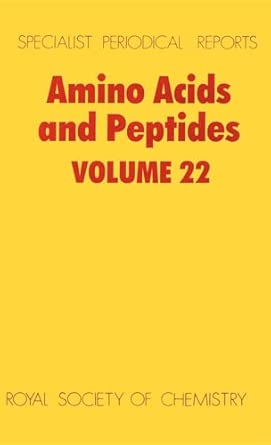
Amino Acids and Peptides: Volume 22
Author(s): J H Jones
- Publisher: Royal Society of Chemistry
- Publication Date: 1 Jan. 1991
- Edition: 1st
- Language: English
- Print length: 386 pages
- ISBN-10: 0851862047
- ISBN-13: 9780851862040
Book Description
Indispensable reference source for researchers in the pharmaceutical and allied industries, and at the biology/chemistry interface in academia.
Editorial Reviews
Excerpt. © Reprinted by permission. All rights reserved.
Amino Acids and Peptides Volume 22
A Review of the Literature Published during 1989
By J. H. Jones
The Royal Society of Chemistry
Copyright © 1991 The Royal Society of Chemistry
All rights reserved.
ISBN: 978-0-85186-204-0
Contents
Chapter 1 Amino Acids By G C Barrett, 1,
Chapter 2 Peptide Synthesis By D T Elmore, 83,
Chapter 3 Analogue and Conformational Studies on Peptide Hormones and Other Biologically Active Peptides By J S Davies, 145,
Chapter 4 Cyclic, Modified, and Conjugated Peptides By P M Hardy, 200,
Chapter 5 β-Lactam Antibiotic Chemistry By C H Frydrych, 294,
Chapter 6 Metal Complexes of Amino Acids and Peptides By R W Hay and K B Nolan, 343,
CHAPTER 1
Amino Acids
BY G. C. BARRETT
1. Introduction
The literature that is oriented towards chemistry and biochemistry of amino acids is covered in this Chapter, which has, as usual, been confined to their occurrence, chemistry and analysis. Routine literature covering the natural distribution of well-known amino acids is excluded.
Commentary on some papers is brief, so that adequate discussion can be offered for other papers where more significant synthetic and mechanistically-Interesting chemistry Is reported. Patent literature is almost wholly excluded but this is easily reached through Section 34 of Chemical Abstracts. The Chapter is arranged Into sections as used in all previous Volumes of this Specialist Periodical Report, and major Journals and Chemical Abstracts (to Volume 112, issue 11) have been scanned to discover the material to be reviewed.
2. Textbooks and Reviews
Several books and Conference Proceedings Volumes have appeared. Reviews cover N-hydroxyamino acids, distribution of D-amino acids, biosynthetic pathways in plants, and natural amino acids as enzyme inhibitors.
Recent IUPAC-IUB Joint Committee for Biochemical Nomenclature recommendations in a number of areas including amino acids, have appeared in Journals.
3. Naturally Occurring Amino Acids
3.1 Isolation of Amino Acids from Natural Sources. – This Section was introduced to this Chapter last year even though it would be thought of as a routine aspect of the literature. The generation of artefacts through extraction procedures and the ever-more-sensitive analytical methods for amino acids, clearly increase the scope for erroneous conclusions on the presence of amino acids in natural sources.
Ultrafiltration using a membrane impervious to molecules of size >2KDa allows amino acids and small peptides to be separated from proteins that have been partly degraded using poly(hydroxyethyl methacrylate)-immobilized carboxypeptidase. At the smallest scale level, amino acids can be isolated from proteins that have been separated by SDS-PAGE and electroblotting on to a poly(vinylidene fluoride) membrane, excised, and hydrolysed by gas-phase hydrochloric acid. At the other end of the scale, isocratic “moving-withdrawal” chromatography is advocated for separation of amino acids, and isolation of amino acids as their arenesulphonate salts has been studied. High recoveries of air-labile amino acids can be achieved from acid hydrolysates conducted in microcapillary tubes free from air. Development of a microwave acid hydrolysis method for proteins (e.g., requiring 6-8 min irradiation of a peptide attached to a Merrifield resin suspended in propanoic acid – conc HCl, using a domestic microwave oven) 4 has been reported.
Adsorption of glycine, aspartic acid and lysine to glass beads from solutions at three different pHs has been studied. Protonated lysine is adsorbed more strongly than the others from acidic solutions. A review of preparative scale ion-exchange chromatographic separation of amino acids has appeared.
3.2. Occurrence of Known Amino Acids. – Significant results sifted from the continuously expanding routine literature under this heading include a distinction between racemic, therefore contemporary, coded amino acids and other amino acids more recently acquired by dinosaur egg shells, and a note (in a useful review of the distribution, stereochemistry, and stable isotope composition of amino acids in fossils and modern mollusc shells), of the first observation of the occurrence of DL-glutamic acid in a Pleistocene-age Merceneria fossil shell.
Non-protein amino acids in meteorites, have been argued to have formed from protein amino acids after decarboxylation and deamination, rather than indicative of any particular alternative living system based on amino acids.
Non-protein amino acids from sources on this planet include (2S,3S) -3-hydroxyleucine, (2S,3R)-3-hydroxylysine, and Z-3-chlorodehydroalanine from HV-toxin M of the phytopathogenic fungus Helminthosporium victoriae. Analogous results from higher species include the presence of β-tyrosine and N-methyl-β-bromotryptophan in Jasplakinolide, a novel antifungal anthelminthic 19-membered ketide-depsipeptide from the marine sponge Jaspis, and β-D-aspartylglycine in the fish Aplysia kurodai. 4-Hydroxyisoleucine from fenugreek (Trigonella foenum-graecum) possesses (2S, 3R, 4S)-stereochemistry, not (2S,3R,4R) as previously reported. The (2S, 3S, 4R)-diasteroisomer occurs in the form of its lactone as a moiety of funebrine from Quararibea funebria.
Ovothiols A-C (1) are natural π-R-methyl-4-mercaptohistidines that are shown in the pre-1986 literature erroneously as τ-methyl isomers.
3.3 New Natural Amino Acids. – This heading covers derivatives and near-relatives, not only the amino acids themselves. The first example of a natural α-methoxy-α-amino acid derivative, megasporizine (2) from Penicillium megasporum NHL 2977, is a member of the dioxopiperazine family, in this case a modified cyclo(phenylalanyl-leucyl). While this is not a rare type of natural product, nevertheless the phenylalanine – leucine combination is most unusual. The β-hydroxy-L-α-amino acid derivative (obafluorln, 3) is a useful broad-spectrum antibiotic. A unique C20 β-amino acid “Adda” (2S, 3S, 8S, 9S)-3-amino-9-methoxy-2,6,8-trimethyl-10-phenyl-4, 6-decadienoic acid, is a moiety of the cyclic penta- and heptapeptide cyanobacteria hepatoxins, modularin and microcystin-LR, respectively.
3.4 New Amino Acids from Hydrolyzates.- “Dehydrobutyrine”, O-methylthreonine, and N-methylasparagine are not new, but are unusual company for 14-chloro-2-hydroxy-3-amino-4-methylpalmitic acid and another nine known amino acids in pawainaphycin C, a cardioactive cyclic peptide from the blue-green alga Anabaena BQ-l6. Marine organisms are also represented as sources of Dolastatin 15 (a depsipeptide from the marine mollusca Indian Ocean sea hare Dolabella auricularia), that contains the hitherto unknown phenylalanine biosynthetic product (4; “dolapyrrolidone”). Theonellamide F, a dodecapeptide from the marine sponge Theonella contains seven common amino acids and (2S, 3R)-3-hydroasparagine, (25,4R)-2-amino-4-hydroxyadipic acid, p-bromo-L-phenylalanine, (3S,4S,5E,7E)-3-amino-4-hydroxy-6-methyl-8 -(p-bromophenyl)-5, 7-octadienoic acid, and a bridging amino acid, τ-L-histidinoalanine, not previously encountered in proteins. A C-2 tryptophanyl – N-histidinyl linkage, with the tryptophanyl residue also linked through C-6 to the β-carbon of a substituted leucyl residue, is a notable feature of the cyclic octapeptide moroidin, from Laportea moroides, a bush prevalent in Eastern Australian rain forests.
4 Chemical Synthesis and Resolution
4.1 General Methods for the Synthesis of α-Amino Acids. – All standard general methods, some in new formats, are represented in the recent literature. Many of the general methods used in the area of asymmetric synthesis (next Section, 4.2) are also applicable in general synthetic routes to α-amino acids.
Reviews have appeared of aminocarbonylation, synthesis of hydroxylated amino acids from epoxy- and aziridino-pyranoses, and β-lactams as synthons for amino acids.
Alkylation of glycine derivatives and near relatives is as popular as ever, with Schiff bases providing most of the non-routine interest. Thus, γ-allenic α-amino acids are obtained by alkylation of Ph2C=NCHLiCO2Me with allenic phosphonates (EtO)2P(O)OCHR1R2CR3=C =CR4R5 in the presence of a palladium(II) catalyst. Acylation of Ph2C=NCH2CO2Et with an aroyl halide after deprotonation to the delocalized aza-allyl anion [MATHEMATICAL EXPRESSION NOT REPRODUCIBLE IN ASCII], gives N-aroylaziridinecarboxylates. Chiral N-benzyloxycarbonyl aziridines have been prepared from L-serine and used for the synthesis of optically-pure benzo-substituted tryptophans (5 -> 6), and a similar use (“amidoethylation”) of N-tosylaziridine t-butyl esters involving their ring-opening with organocuprates has been reported. The route to these aziridines is through Sharpless epoxidation of allyl alcohols to give optically-active glycidic esters, these being azidolyzed and treated with PPh3. Schiff bases “the other way round” such as Me3SIN=CHR1 CO2R2, prepared from the keto-acid and LiN(SiMe3)/ClSiMe3, and Me2C=CH (CH2)3N=CHCO2R, have been used in α-amino acid Synthesis through reduction in the former case (overall, animation of a keto-acid) and trans-selective cyclization to 3-propenylpipecolic acid esters (7) in the latter case.
Carbonylation of amines and amides is represented by reaction of CO with carbenium immonium ions generated from N-hydroxymethylamides and imides, to give N-acylglycines, the dehydration – carbonylation process being recognisable as an extension of the Koch-Haaf reaction.
N-Benzoyl-2-bromoglycine methyl ester is a well-known amino acid synthon, and undergoes substitution with alkylnitronate carbanions R1R2NO2C- to give corresponding β-nitroalkylglycines, suitable substrates for elimination to “dehydro-amino acids”. 2-Ethoxyglycine derivatives AcNHCH(OEt) CONHCH2Ph, prepared by the amidoalkylation reaction, undergo analogous substitution reactions. Other standard methods are represented in the azlactone synthesis for the synthesis of β-alkylaminoalaninamides (Scheme 1) and in the alkylation of methyl nitroacetate (Scheme 2) for the synthesis of β-methyltryptophan as a mixture of diastereoisomers. The (2RS, 3SR)-diastereoisomer crystallized out as the sole product as a result of epimerization in solution of the other diastereoisomer.
Stevens rearrangement of the carbene – tertiary amine adduct in Scheme 3 is an ingenious alternative approach to using a glycine derivative in α-amino acid synthesis.
Not too remote, structurally, from these glycine derivatives, is t-butyl N- (diphenylmethylene)oxamate, Ph2C=NCOCO2 But, prepared from t-butoxalyl chloride and diphenyl ketimine. It reacts with phosphorus ylides to give “dehydro-amino acid” derivatives Ph2C=NC(=CR1R2)CO2But, readily reducable to corresponding α-amino acid derivatives using sodium cyanoborohydride. α-Oximino-esters RC (=NOH)CO2R are readily reduced to corresponding α-amino acid derivatives using NaBH4 – titanium(III) chloride.
These are novel details for standard approaches to α-amino acids, generally under the headings of amination of a carboxylic acid derivative or carboxylation of an amine. An example of the latter route is electrocarboxylation of imines with sacrificial metal anodes in membrane-free cells (e. g. PhN=CHPh -> PhNHCHPhCO2H). The “amination” approach is more widely represented, further examples including a new twist to the recently established use of azodicarboxylate esters as nitrogen source leading to very high regioselectivity in amination of lithium dienolates or Sn-masked or Ge-masked dienolates (Scheme 4) and giving α- or γ-amino acid derivatives. A classical amino acid synthesis via α-azidoalkanoates can be completed by a one-pot conversion into the corresponding N-Boc-amino acid ester using H2/Pd-C/Boc2O. Amination of α-keto-acids and esters is another classical route, new versions being the use of benzotriazole (BtH) for promoting the reaction of an amide with glyoxylic acid or one of its esters [RCONH2 + OHCCO2Et + BtH -> RCONHCH (Bt) CO2Et -> RCONHCH (NH2)CONH2 with NH3. The transamination of phenylglycine with 2-oxoglutaric acid in the presence of N-dodecyl-pyridoxal chloride and of hexadecyltrimethylammonium chloride is the first example of mild non-enzymic transamination through the in vivo mechanism in the absence of metal ions.
Less commonly-used general methods include the Ugi “Four Component Condensation” method, found to give an unexpected cis/trans distribution of products in a particular case. Another route employing an isocyanide uses an aminocarbene – chromium(III) complex CCO) 5Cr-CPh=N*=CPhOCOPh + ButNC to give C-aminoketenimines ButN=C=CPhN=CPhOCOPh, which cyclize to imidazolidin-5-ones in solution, or which add water when treated with wet silica to give ButNHCOCPh(COPh)NHCOPh from which the corresponding amino acid can be obtained by hydrolysis.
A standard hydantoin synthesis has been applied to the synthesis of 2, 6-diaminopimelic acid, starting from piperidine-2, 5-dicarbonitrile, and reacting it with NH4OH/(NH4)2 CO3 at 100°C during 4 hours.
At the start of this section, well-established uses of glycine derivatives in general synthetic methods for other α-amino acids have been discussed. Of course, modifications to side-chains of other simple α-amino acids should also be discussed here, insofar as they offer general synthetic routes, though a dilemma results from the way this Chapter has been organized over the years. “Specific Reactions of Amino Acids” (Section 6.3) covers such chemistry, and readers seeking coverage of this topic should scan both these parts of this Chapter in each Volume. β-Iodo-L-alanine, from L-serine, yields the corresponding alkylzinc iodide through ultrasonically-activated reaction with zinc, and then can be elaborated into 2-amlno-4-oxoalkanoic acids with acyl chlorides. Radical cyclization of N-substituted iodo-L-alanine derivatives using Bu3SnH/AIBN provides a route to ring-fused prolines (Scheme 5).”
Creation of a carbanion α to the side-chain carbonyl group of β-methyl α-t-butyl N-benzyloxycarbonyl-L-aspartate and the N-trityl-L-glutamic acid analogue using 2.2 equivalents of lithium diethylamide (or lithium hexamethyldisilazide) at -78° can be followed by quenching with electrophiles, alkyl halides giving β-substituted aspartic acids and carbonyl compounds yielding γ-substituted glutamic acids.
4.2. Asymmetric Synthesis of α-Amino Acids. – There are some fascinating new approaches as well as equally satisfying studies that consolidate well-established methods. Several reviews and Williams book are available. The reviews include a broad survey with 222 references, some “Chemtracts” in which the work of Kunz and Pfrengle and of Williams is discussed, and reviews by Hegedus of his own work, the use of chromium – carbene complexes in amino acid synthesis (see vol.21, p,7).
Chirally-imprinted polymers are amazingly effective, all things considered, for some chiral recognition applications (see Section 7.5), and a crosslinked poly(styrene) imprinted through polymerization of the appropriate monomer mixture containing chiral additives, washed out from the polymer to create cavities containing salicylaldehyde and phenylboronic acid moieties, has been used in asymmetric synthesis of amino acids. The polymer-bound salicylaldehyde, converted into the salicylideneglycine Schiff base and complexed with nickel(II) ions and treated with acetaldehyde, gives L-threonine in slender enantiomeric excess, though 36% e.e. is obtained for a synthesis of L-DOPA on the same principle.
To the familiar crop of papers reporting homogeneously-catalyzed asymmetric hydrogenation of acetamidoacrylates, using rhodium – chiral phosphine catalysts – Rh(chiral tetrasulphonated diphosphine), cationic Rh(2S,4S-N-(t-butoxycarbonyl-4-[[bis(4′-methoxy-3′, 5′-dimethylphenyl)]phosphin]-2-([[bis](4′-methoxy-3′ 5′ -dimethylphenyl)] methyl] pyrrolidine)2 perchlorate [[equivalent to] Rh (NBD)2ClO4 for short], for example. In the latter report, very high efficiency is claimed, but the literature on the general topic is still well-populated with disappointingly low enantioselectivities. Molecular graphics – molecular orbital calculations might come to the rescue, following an assessment through this approach, that for the system employing [Rh(S,S-chlraphos)]+ X- as chiral homogeneous catalyst, 6 of the 8 possible modes of catalyzed H2 addition to 2-acetamidocinnamates generate impossibly large atom – atom interactions. A salutary warning arises in the observation that silica-bound chiral rhodium – phosphine complexes are capable of catalyzing 1H – 2H exchange during reaction of 2H2 with (Z)-2-acetamido cinnamates in methanol.
Catalytic reductive aminolysis of oxazol-5(4H)-ones also continues to disappoint in the same context, Ni – catalyzed reaction of the D-difluoromethoxybenzyl oxazolone (8 -> 9) with H2 in the presence of (S)-(-)-phenylethylamine giving less than 55% diastereoisomeric excess of the free acid, better than the 9 – 18% d. e. found for the same aminolysis product from hydrogenation of the corresponding azlactone and its in situ aminolysis by (S)-(-)-phenylethylamine. On the other hand, Pd-catalyzed asymmetric allylic amination by benzylamine, of allylic substrates (RCH=CHCHRX -> RCH=CHCHRNHCH2Ph) In the presence of the diphosphine (10) elaboration of the products into α-amino acids, gives better than 97% e. e.
(Continues…)Excerpted from Amino Acids and Peptides Volume 22 by J. H. Jones. Copyright © 1991 The Royal Society of Chemistry. Excerpted by permission of The Royal Society of Chemistry.
All rights reserved. No part of this excerpt may be reproduced or reprinted without permission in writing from the publisher.
Excerpts are provided by Dial-A-Book Inc. solely for the personal use of visitors to this web site.