Wow! eBook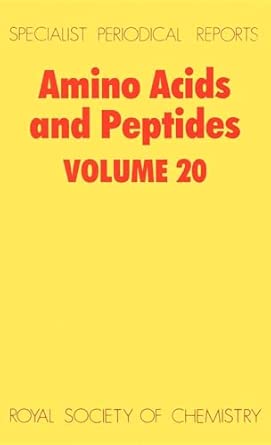
Amino Acids and Peptides: Volume 20 Edition. ed. Edition
Author(s): J H Jones
- Publisher: Royal Society of Chemistry
- Publication Date: 1 Jan. 1989
- Edition: Edition. ed.
- Language: English
- Print length: 350 pages
- ISBN-10: 0851861849
- ISBN-13: 9780851861845
Book Description
Indispensable reference source for researchers in the pharmaceutical and allied industries, and at the biology/chemistry interface in academia.
Editorial Reviews
From the Back Cover
Excerpt. © Reprinted by permission. All rights reserved.
Amino Acids and Peptides Volume 20
A Review of the Literature Published during 1987
By J. H. Jones
The Royal Society of Chemistry
Copyright © 1989 The Royal Society of Chemistry
All rights reserved.
ISBN: 978-0-85186-184-5
Contents
Chapter 1 Amino Acids By G. C. Barrett, 1,
Chapter 2 Peptide Synthesis By I. M. Eggleston, D. T. Elmore, and J. H. Jones, 65,
Chapter 3 Analogue and Conformational Studies on Peptide Hormones and Other Biologically Active Peptides By J. S. Davies, 128,
Chapter 4 Cyclic, Modified, and Conjugated Peptides By P. M. Hardy, 175,
Chapter 5 β-Lactam Antibiotic Chemistry By A. V. Stachulski, 249,
Chapter 6 Metal Complexes of Amino Acids and Peptides By R. W. Hay and K. B. Nolan, 297,
CHAPTER 1
Amino Acids
BY G. C. BARRETI
1 Introduction
The occurrence, chemistry and analysis of amino acids contained in the literature of 1987 are reviewed in this Chapter, which is arranged in the sections as used in all previous Volumes in this Specialist Periodical Report.
Access to the literature for creating this Chapter has been by way of Chemical Abstracts (to Volume 108, issue 9) and Biological Abstracts
2 Textbooks and Reviews
Uses of amino acids and simple derivatives in synthesis are surveyed in recent texts. Reviews of every conceivable amino acid with a sulphur functional group in the side chain comprise a complete Volume of Methods in Enzymology. A Symposium has covered roles of amino acids in various disorders. A similarly thorough treatment has been given to the biosynthesis of protein amino acids.
Other textbooks and reviews are located in the relevant sections of this Chapter.
3 Naturally Occurring Allina Acids
3.1 Occurrence of Known Amino Acids. – Amino acids in the Murchison meteorte show unusually high abundance of 2H, 16N, and 13C, giving further evidence for extraterrestrial origins for these amino acids
Amino acids and peptides in algae have been reviewed. Bacterial sources of less common amino acids as protein constituents (phycobiliproteins) include Mastigocladus laminosus and Calothrix ([??]-N-methyl asparagine) and Chromatium vinosum (Ng, Ng-dimethyl lysine). p-Aminophenylalanine occurs in Vigna, as a growth inhibitor of Escherichia coli.
Plant sources include tulip, with 4-methyleneglutamine identified as one constituent of its leaves. Trees of the Copaifera genus, whose leaves contain N-methyl trans-4-hydroxyproline in substantial amounts (up to 3% dry weight and representing 10% of the nitrogen content), are thought to be protected from bruchid beetle larval attack by this amino acid. The same amino acid occurs in Melaleuca, together with the corresponding betaine.
The free D-alanine content of bivalves is surprisingly high, frequently far exceeding that of its L-enantiomer. Several bivalve species also contain D -aspartic acid in concentrations approaching that of the L-isomer. 16 The absence of D-valine in these animals must have significance that has not yet been a source of speculation.
The accumulation of D-arginine in rat liver mitochondria has been reported. Another notable occurrence is of β-hydroxyasparagine
3.2 New Iatural Amino Acids.- The presence of L-2-amino-4-chloropent-4 -enoic acid in fruit bodies of Amanita pseudoporphyria Hongo. accounts for antibacterial properties of this fungus; Amanita abrupta contains (2S,4Z) -2-amino-5-chloro-6-hydroxy-4-hexenoic acid
Fruits of Rivina humilis contain the new betalain ( 2 ), a 5-hydroxy-norvaline derivative. Smaller ring moieties appear in cis-1-amino-3-hydroxymethyl -cyclobutane-1-carboxylic acid ( 3 ), found in Atelia herbert smithii Pittier (Sophoreae, Leguminoseae), and (2R, 3S)-oxetin ( 4 ), L-Ovothiol A and its N.N-dimethyl analogue (L-ovothiol B) have been proved to possess structure ( 5 ) by virtue of its synthesis from ( 12 ). The authors suggest that previously described marine 3-mercaptohistidines should be revised to the 1-methyl structures. The novel hydroxyornithine derivative proclavaminic acid ( 6 ) from the mycelium of the clavulanic acid-producing organism Streptomyces clayuligerys ATCC 27064 undergoes enzymatic cyclization in cell-free extracts to clavaminic acid ( 7 ).
A further example of the well populated class of natural N-carboxyalkyl amino acids is (2S,7S)-N[??]-(1-carboxyethyl)ornithine, from Streptococcus.
More complete information is now available on new amino acids from the red alga Chondria armata, previously noted in this Specialist Periodical Report (Vol. 19, p.2) to contain seven new amino acids. However, only domoilactone A (8; a correction of the structure given in Vol.19, p.2) and domiolactone B (epimer of A at the chiral centre carrying the hydroxy group) have been described so far.
3.3 New Amino Acids from Hydrolysates.- The earlier section (3.1) included reports on the occurrence of known amino acids as noteworthy protein constituents. This section develops the same topic but with new and therefore even more noteworthy analogues.
Bovine ligament elastin contains a cross-linking amino acid related to isodesmosine, insofar as it is a pyridinium compound, but it also carries a C=C bond in an extra side chain. It has been christened “pentasine”, as it is derived from the condensation of five lysine residues.
Fifteen years’ work leads to the structure assigned (without stereochemical details) to dolastatin 10 ( 9 ). It is a “pentapeptide” from the sea hare Dolabella auricularia and is the most potent antineoplastic compound known, containing four amino acids not previously known in Nature. A corrected abstract has been published for an unusual peptide from a strain of Streytomyces AM-2504 that contains a β-hydroxydopa derivative (mild hydrolysis of AM-2504 gives (10) and an amino acid of relative molecular mass 141).
The vapour-phase hydrolysis regime for peptides and proteins , employing 7M hydrochloric acid containing 10% trifluoroacetic acid at 150° during 22 – 45 minutes, will be of considerable interest.
4 Chemical Synthesis and Resolution of Amino Acids
4.1 General Methods.- A broad review of amino acid synthesis 37 and a more limited coverage of contributions to synthesis of unusual natural amino acids have appeared. Formation of N-acylamino acids by the amidocarbonylation of aldehydes (CO/amide/homogeneous mixed – metal catalyst systems) has been extensively reviewed.
This section is divided into applications, either of well established or of lesser-known general methods. Later sections include several examples of variations of standard general methods. In the former category, the Bucherer-Bergs synthesis has been used for the synthesis of α -(5-hydroxy-2-pyridyl) glycine starting from (5-benzyloxy) pyridine-2-carboxaldehyde, though with the unexpected intermediacy of the oxazole ( 11 ), rather than the usual hydantoin. Treatment of ( 11 ) with 2M sodium hydroxide at 120° during 8 hours gave the required product. Other hydantoin-based syntheses include carboxylation of α-aminonitriles (via carbamate, oxazolidinone, and α-isocyanato-acid amide).
The Strecker synthesis has been applied to the preparation of α-hydroxymethyl -α-(3,4-disubstituted phenyl)glycines. The acetamidomalonate synthesis continues to be widely used in all its variations, e.g. for 3-(3-pyridyl)- and 3-(3-benzo[b] thienyl)-D-alanines (including enzymic resolution), and for 3-(2-carboxy-4-pyridyl)- and 3-(6-carboxy-3-pyridyl) alanines .
Alkylation of glycine derivat!ves has also become widely used in its many variants. The predominance of the route based on alkylation of glycine Schiff bases continues, to which novel routes occasionally arise (e.g. to t-butyl N-(t-butyloxycarbonyl) iminoacetate from BocNHCHBrCO2tBu, this being alkylated with either a Grignard reagent, or an enamine, or morpholinostyrene) . 6-Fluorodopa has been prepared from veratric acid (via the derived benzylic bromide) and Ph2C=NCH2CO2Et. Similar alkylations of N,N-dibenzylglycine esters, methyl nitro-acetate, and reduction of α-diazo-acetoacetates RCOC
Tin enolates of thiolesters undergo diastereoselective addition to N-furfuryl mines (Scheme 1). Another example of a novel route that might develop into a useful general method involves photochemical addition of N3CO2Et to silylenols R1R2C=C(OR3)OSiMe3, giving N-(ethoxycarbonyl) amino acid esters in 45 – 75% yields.
4.2 Asymetric Synthesis.- Some of the general methods in the amino acid field offer useful enantiospecific synthesis opportunities in the α-amino acid area. The later Section 4.17 deals both with general methods and asymmetric synthesis of β- and higher homologous amino acids. The requirement for enantiomerically pure α-amino acids in biological and synthetic studies has sustained the development of stereoselective synthetic methods, frequently feeding back improvements into established general methods.
The “bis-lactim ether” method, introduced by Schöllkopf and his co-workers, continues to be used profitably for asymmetric synthesis of α-amino acids. Typically, L-Ovothiol A ( 5 ) and its N,N-dimethyl analogue (L-ovothiol B) have been prepared by this method, from ( 12 ). The method involves alkylation of the chiral carbanion of ( 12 ), commonly using an alkyl halide as electrophile [as in a synthesis of enantiomers of phosphinothricin, MeP(O)(OH)CH2 CH2CH2NH3+)CO2]. However, Michael additions
The bis-lactim ether method is a “hidden” form of Schiff base alkylation, a widely used approach with a longer history. This is represented in the recent literature with alkylations of glycine chiral Schiff bases, giving praline homologues through alkylation with I(CH2)nHal, or α-alkyl-α-amino acids using the D–galactodi-aldehyde imines( 13 ) with from 23 to >95% asymmetric induction. The “Evans – Sjoegren” ketene derived from the glycyl chloride ( 14 ) gives β-lactams by cycloaddition to benzylidene-amino acids. On alkaline hydrolysis and hydrogenolysis
Alkylation of the imine ( 16 ) from 3-hydroxymethylenecamphor and ethyl glycinate with alkyl chlorides after carbanion formation with lithium di-isopropylamide gives only low to moderate enantiomer excesses; better diastereoselectivity is seen for sarcosine analogues.
The Schiff base from β-D-galactopyranosylamine is a source of D-amino acids through diastereoselectivity of Strecker reactions based on it. Aldehydes react with the tetra-O-pivaloyl derivative catalyzed by Me3SiCN and ZnCl2 or SnCl4 to give diastereoisomer mixtures favouring the R-epimer by 7-13:1.
Introduction of the nitrogen function diastereoselecti vely is a feature of well established aminolysis procedures . Serine β-lactone prepared from protected serines by the Mitsunobu method reacts with organometallic reagents, R2CuLi or R2Cu(CN)Li2, to give optically pure β-hydroxyamino acids resulting from alkylation of the original serine methylene group. Lesser enantioselectivity is found for the lactone derived from N-benzylserine; conversely, optical purity better than 99.4% is achieved through copper(I)-catalyzed Grignard alkylation. Reductive aminolysis of oxazolinones with (S)-(-)-phenylethylamine and H2/PdCl2 gives corresponding (S)-amino acid derivatives. Azidolysis of halogenoalkylboronates of (S)-pinanediol is followed by generation of the carboxy group in the target L-amino acids by a novel method involving insertion of a chloramethylene group through reaction with LiCHCl2 (Scheme 2).
Chiral bis-aziridines obtained from D-mannital can undergo nucleaphilic ring-opening in one of two ways; it has been found that the pathway leading to (S) – amino acids is fallowed ((17) -> (18)] when R2CuLi is used.
Alkylatian of chiral oxazolidinones or imidazolinones has been developed further from its initial exploration as a route to α-amino-β-hydroxy acids. The hydroxy group originates in alkylation by a carbonyl compound – i.e. a diastereaselective aldol condensation in its original form – and complete stereaselectivity leading to the anti-relationship of the hydroxy and amino groups calls for a longer route (Scheme 3). This variation has been used in alternative approaches to the synthesis of unusual constituents of the peptide Echinocandin D (aldolization of the starting material in Scheme 4 with (R)-2-methyl-4-hexenal and tin (II) triflate). [Both these amino acids were synthesized by Ohfune in 1986 (Vol. 19, p. 10).] Chiral N-acyloxazolidinones, after conversion into dibutylboron enolates, undergo successive diastereoselective bromination (N-bromosuccinimide) and azidolysis, offering a general asymmetric synthesis (e. e. better than 98%) suitable for multifunctional amino acids (Scheme 5) and involving recovery of the chiral auxiliary.
There is a regular supply of papers describing asymmetric hydrogenation of acetamidocinnamic acid <82-93% enantiomeric excess using chiral Rh or Re complexes as homogeneous catalysts) and its close relatives. Regular hydrogenation systems lead to rather low enantiomeric excesses when operating on unsaturated amino acid (S)-phenylethylamides [5-cyano-2-(hydroxyimino) valeric acid gives the D-lysine derivative in 6-12% diastereoisomeric excess with H2/Pt] or on 2-trifluoromethyl -4-alkylidene oxazolinones (H2/ Pt/(S)-phenylethylamine).
A brief reference to enzyme-catalyzed syntheses of L-amino acids is usually located in this Chapter in the later section covering protein amino acids, but unusual enzymic methods are found a place here. The availability of relatively large quantities of cloned E. coli. aspartate transaminase for mediating the conversion of α-keto-acids into corresponding α-amino acids offers a practical route to a wide range of aliphatic and aromatic slde chains. The essential role of large relative amounts of enzyme in these asymmetric syntheses and use of aspartic or glutamic acids as nitrogen source are notable aspects of this unselective application of an enzyme. Dimethyl meso-N-benzylpyrrolidine-2, 5-dicarboxylate gives N-benzyl-D-proline methyl ester through selective hydrolysis catalyzed by pig liver esterase, followed by radical decarboxylation of the N-hydroxypyridine-2-thione ester.
4.3 Synthesis of Protein Amino Acids and Other Naturally Occurring α-Amino Acids.- The protein amino acids feature incidentally in exploration and development of new synthetic methods (see preceding sections). Many of the reactions are covered under Section 6.3 ‘Specific reactions of amino acids’ with side-chain modifications, and of ten amount to the synthesis of one protein amino acid from another. Having drawn attention to these other locations, the main interest as far as this Sect ion is concerned lies in developments in enzymatic and bacterial methods applicable to large-scale production of protein amino acids. However, limitations of space permit only representative citations of these papers (readers are directed interalia to Section 16 ‘Fermentation and Bio-industrial Chemistry’ in Chemical Abstracts for more complete access to this literature) . Biosynthetic studies for protein amino acids are otherwise excluded.
(Continues…)Excerpted from Amino Acids and Peptides Volume 20 by J. H. Jones. Copyright © 1989 The Royal Society of Chemistry. Excerpted by permission of The Royal Society of Chemistry.
All rights reserved. No part of this excerpt may be reproduced or reprinted without permission in writing from the publisher.
Excerpts are provided by Dial-A-Book Inc. solely for the personal use of visitors to this web site.