Wow! eBook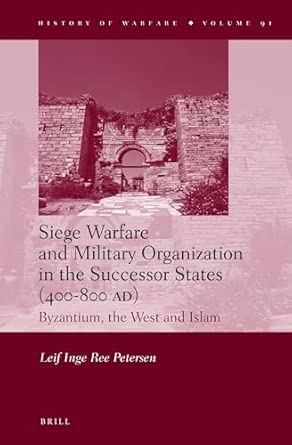
Siege Warfare and Military Organization in the Successor States (400-800 Ad): Byzantium, the West and Islam: 91 New Edition
Author(s): Leif Inge Ree Petersen (Author)
- Publisher: Brill
- Publication Date: 1 Aug. 2013
- Edition: New
- Language: English
- Print length: 852 pages
- ISBN-10: 9004251995
- ISBN-13: 9789004251991
Book Description
The result was a common post-Roman military culture suitable for more restrained economic circumstances but still able to maintain, defend and attack city walls with skills rivalling those of their Roman forebears.
Editorial Reviews
Review
Roger Collins, Journal of Military History, vol. 78
“…The volume is a major achievement and the author deploys his arguments with a wealth of supporting detail. The “Corpus Obsidionum” will prove a very valuable resource.”
Denis Sullivan,
“This exhaustive study, based on the most recent research, will lead scholars to look again at evidence that they thought they knew well. Many scholars have assumed that between the dissolution of the Roman Empire in the West and the Carolingian Empire sieges were insignificant in warfare, because the “successor states” that followed the Roman Empire in the West lacked the military technology, organization, economy, and population to wage warfare on the same scale and with the same efficiency as the Roman Empire had done. Leif Inge Ree Petersen sets out to show that siege warfare did not die out in the West with the fall of the Western Empire and the loss of Roman technology… Petersen sets out a carefully structured case, founded on analysis of a very wide range of primary evidence from both Christian and Islamic writers, as well as critical scrutiny of modern secondary studies…. This is not only a history of warfare in what is still popularly called the “Dark Ages,” but also a history of governments and administrative structures. As such, it will prove useful to scholars of later periods… Readers may consider that Petersen paints too rosy a picture of continuity. Nevertheless, the evidence he sets out is persuasive and suggests that we can no longer assume that the successor states were a decline from the Roman Empire, a “Dark Age” of barbarism.”
Helen Nicholson,