Wow! eBook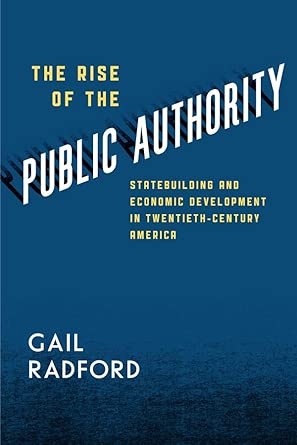
The Rise of the Public Authority – Statebuilding and Economic Development in Twentieth–Century America
Author(s): Gail Radford (Author)
- Publisher: University of Chicago Press
- Publication Date: 13 Sept. 2013
- Language: English
- Print length: 232 pages
- ISBN-10: 022603769X
- ISBN-13: 9780226037691
Book Description
Editorial Reviews
Review
About the Author
Excerpt. © Reprinted by permission. All rights reserved.
The Rise of the Public Authority
Statebuilding and Economic Development in Twentieth-Century America
By GAIL RADFORD
THE UNIVERSITY OF CHICAGO PRESS
Copyright © 2013 The University of Chicago
All rights reserved.
ISBN: 978-0-226-03769-1
Contents
Acknowledgments……………………………………………………viiIntroduction………………………………………………………1ONE / The Campaign for a Federal Fleet Corporation…………………….17TWO / The Creation of the Federal Land Banks………………………….41THREE / Municipalities Struggle to Meet New Needs……………………..71FOUR / The Truncated Career of Autonomous Federal Agencies……………..89FIVE / The Federal Government Promotes Public Authorities………………117SIX / Public Authorities since the Second World War……………………135EPILOGUE / The Future of Public Authorities…………………………..155APPENDIX / Federal Corporate Agencies………………………………..167Notes…………………………………………………………….175Index…………………………………………………………….213
Excerpt
CHAPTER 1
The Campaign for aFederal Fleet Corporation
Critics of America’s vast, uncoordinated sphere of government-created butdemocratically remote agencies, commonly known as public authorities,often assume that these mechanisms mirror the intentions of the politicalleaders who initially proposed them. However, the history of the EmergencyFleet Corporation, one of the first public authority–type agenciesin the United States, illustrates how these mechanisms only partially reflected,and in some ways contradicted, the aims of those who first advocatedtheir use.
William Gibbs McAdoo
It was William Gibbs McAdoo, secretary of the treasury under WoodrowWilson, who in 1914 came up with the idea for a merchant marine thatwould be run by a corporation owned and controlled by the government.His aim was to give the federal government a tool by which to shape internationaltrade. It may seem surprising that a nationally acclaimed businesshero who had never held public office before taking over the TreasuryDepartment would champion governmental activism. Yet even during hisdays in the private sector, McAdoo never embraced the prevailing economicattitudes of his time. He was, in the words of Walter Lippmann, “anoutsider who knows the inside wires.” This was the case in part becauseMcAdoo, like Wilson himself and others in the president’s inner circle, wasa transplanted Southerner who had made his mark in the North. His gruelingclimb from obscurity before achieving financial security in his fortiesseems to have checked any temptation to idealize the benevolence of unrestrainedmarket forces. Indeed, during one particularly low point in hispersonal fortunes, he began writing a book on poverty, which he describedas “the most serious indictment of our vaunted civilization.”
Trained as a lawyer, McAdoo essentially functioned as an entrepreneurbefore entering public life. Throughout his career, he was continually drawnto technologically innovative and financially complicated, even risky, projectsto expand and rationalize transportation networks. After his attemptto electrify the Knoxville, Tennessee, street railway system ended in failure,leaving him nearly bankrupt and “very much mortified,” McAdoo movedhis family to New York City. He arrived without any real connections andjust in time for the severe depression of the 1890s. Nevertheless, by the turnof the century, he had built up a solid practice based on selling corporatesecurities and reorganizing financially shaky railroads. Shortly thereafter,he established a company that tunneled under the Hudson River, providingthe first rail links (now PATH tunnels) between Manhattan Island andNew Jersey. Impressive as this achievement was, McAdoo saw it as only thefirst step toward the comprehensive, integrated transportation network forthe entire metropolitan region that he dreamed of creating. He was ultimatelyfrustrated in his hopes to achieve this larger vision, but the openingof the Hudson Tubes in 1908 and the accolades he received for his managementof the Hudson and Manhattan Railroad Company transformedhim into a respected public figure and propelled him onto the nationalpolitical stage. The press hailed him as “probably the most popular citizenof New York,” and groups around the country invited him to address themon his vision of business-government relations.
According to one biographer, the humanitarian strain in McAdoo’sthinking placed him “outside the broad spectrum of business thought.”Whether or not this is entirely accurate, given the popularity of “welfarecapitalist” ideas in the early twentieth century, the future cabinet secretarydid have quite liberal ideas. Despite being on a first name basis with manyof the biggest names in American business—men such as Elbert “Judge”Gary, who headed U.S. Steel, and J. P. Morgan, the financier, put hundredsof thousands of dollars of venture capital into McAdoo’s projects—the futuretreasury secretary was openly critical of standard corporate practices ofthe day. He ran his own firm as something of a counterexample. The company’sslogan, “the public be pleased” (an obvious reference to WilliamHenry Vanderbilt’s notorious “the public be damned” comment), turnedout to be more than a clever public relations gambit (see figure 1.1). Ata time of widespread hostility toward urban rail companies for poor service,the Hudson and Manhattan acquired a reputation for clean, moderncars, convenient schedules, and courteous staff. Few riders bothered to usethe complaint forms that the company distributed as one of its customer-friendlypolicies.
Cordial labor relations were also the rule at the Hudson and Manhattan.The way the company introduced women ticket sellers in 1909 suggestssome of the reasons. McAdoo explained later that the idea came fromone of his managers who suggested women would increase customer satisfaction,since they were “quick and courteous.” The manager also recommendedfemale workers on the basis of economy, but McAdoo refused topay his new female employees at a lower rate than men doing the same job.As predicted, riders responded positively to the innovation. In addition, hisdecision to pay women comparable wages boosted McAdoo’s reputationafter it was publicized by female teachers in New York City as part of theircampaign to equalize their salaries with those of their male counterparts.
McAdoo also embraced change when it came to government interventioninto the economy. Invited in 1910 to address the Harvard BusinessSchool, he told his audience: “I believe in the Commission idea.” Regulatorycommissions were necessary and beneficial, he said, always assumingthat everyone understood that business was “essential to the public welfare”and had to show a profit to survive. Moreover, McAdoo believed thegovernment had a role in labor relations. He told the same Harvard audiencethat he applauded the movement then under way in which some corporationswere voluntarily beginning to offer employee pensions, and helooked forward to the time when what he called “wise legislation” wouldcompel all business concerns to provide disability and accident benefits.
One could summarize McAdoo’s views on political economy by sayingthat despite his success as an entrepreneur, he was never in thrall to themystique of business. While certainly no socialist, his strongest commitmentwas to a stable and expanding economy that met ordinary people’sneeds, rather than the sanctity of private property. During his years in Wilson’scabinet, he continually inveighed against the idea that business alonecould manage the economy, and he even challenged the assumption thatthe profit motive guaranteed that businessmen would run their own companiesin the most rational manner. In addition, he openly belittled theconcept that government should be managed like a business. “Can we affordto say that the Government shall never do anything for the generalwelfare unless each agency can earn a profit?” he asked the IndianapolisChamber of Commerce in 1915. It was clearly a rhetorical question, as heimmediately launched into a story about how the Treasury Department(which then included the Public Health Service) had helped San Franciscoexterminate rats after an outbreak of the bubonic plague was detected inthe city. “We spent hundreds of thousands of dollars for the exterminationof the rats and the plague. We shall never see that money again, butwe saved San Francisco. Would you have had the Government leave thepeople of San Francisco in peril until it could be assured of a profit ondead rats?”
The Crisis in American Shipping
The outbreak of hostilities in Europe during the summer of 1914 presentedMcAdoo and other members of the Wilson administration with an immediatecrisis regarding international trade, but the underlying problempredated the war. America’s commercial shipping industry had been inthe doldrums for decades. In the aftermath of the Civil War, American-registeredvessels carried 30 percent (by weight) of American commerce. Bythe turn of the century, the proportion had dropped to under 10 percent,which was where things stood at the time of Wilson’s inauguration. Britishships were moving approximately 60 percent of American cargo, withGerman and Austrian ships responsible for another 15 percent. Wilson’ssecretary of commerce, William Redfield, likened the country to “a departmentstore without a delivery system.”
Redfield was hardly the first political leader to decry the country’s dependenceon foreign carriers. The Republican Party’s national platform of1900 had warned that a “European war would seriously cripple our expandingforeign commerce.” Congress took the situation seriously butwas unable to develop a policy response. Efforts to explain the source ofthe problem, let alone reach agreement on how to rectify it, exposed someof the deepest fault lines in American politics. Republicans sided with industryfigures who emphasized the high prices of U.S.-built ships (drawingparticular attention to labor costs) that American shipping companies werelegally required to use. They called for federal aid for these companies tolevel the playing field with foreign competitors, whom, they charged, werebeing subsidized by their governments. Democrats, beginning to form analliance with unions, opposed to protectionism, and still bitter over thefederal largesse they believed Republicans had squandered on the railroadsduring the post–Civil War era, discounted industry claims. They blamedpoor management and proposed that commercial shippers be allowed tobuy vessels produced anywhere.
According to business historians, both sides had a case. The higher costsfor American ships and labor did put American shipping companies at adisadvantage, and some nations were in fact offering financial support totheir own merchant marines. Meanwhile, American tariff walls raised steelprices 40–75 percent above what shipbuilders in Britain and Germanypaid. Another important factor, although it received little attention in Congress,was the backwardness of the shipbuilding industry. Foreign firmswere making cost-cutting innovations typical of modern large-scale enterprisethat not even the best capitalized U.S. firms attempted. For example,modern steel ships were being put together in American shipyards usingthe same craft processes as had been used to build their wooden predecessors,without recourse to new technologies, such as pneumatic tools andlarge-scale cranes, which would have vastly simplified assembly. Whateverthe sources of the lackluster performance of American commercial shipping,however, no public intervention of any kind seemed possible giventhe stalemate in Congress. Republicans regularly introduced bills for directaid to shipping firms and these were just as regularly defeated by Democrats.Meanwhile, Democratic proposals that foreign-built ships be allowedto register under the U.S. flag were voted down by Republicans.
War broke the deadlock. Fear of the British navy sent German and Austriancargo ships scurrying for safe ports once the conflict started in earlyAugust 1914. Simultaneously, Great Britain withdrew carriers from normalcommercial service in order to move troops and munitions. With the shortfallin ocean transport, a bumper wheat crop started piling up on docksalong the Atlantic and Gulf Coast seaboards. By the end of the month,Galveston and New Orleans were so clogged that railroads stopped incomingshipments. Soon, the largest cotton crop in American history wouldbe ready for harvest. With cotton still king of the South’s economy, panicgripped the region. The prospect of not being able to sell abroad was devastating,since overseas customers accounted for 60 percent of the market.Prices plunged to half the level of the previous year (and well below the costof production). The administration was under enormous pressure to act.Core Democratic constituencies, export-oriented farmers of the South andWest, faced ruin. Indeed, the country’s entire financial structure—linkedas it was to international trade—was threatened. The New York Stock Exchangeclosed at the end of July, not to open again until December.
The Plan for a Federal Fleet and Its Reception
McAdoo, the most forceful member of the cabinet—and well situated byhaving recently become the president’s son-in-law—took the initiative. Inmid-August he came up with a plan for a government-owned fleet of merchantships. Wilson signed on enthusiastically, predicting with relish thatthe proposal was sure to “arouse the hostility of every reactionary in theUnited States.” The first step was to convince skeptical Democratic Partyleaders. At a private White House briefing, McAdoo portrayed the tradeparalysis as so critical that it required “heroic treatment.” By emphasizingthe immediate emergency, he was trying to motivate the lawmakers to act.In reality, however, he and Wilson had long-range goals that transcendedthe moment. Both aspired to expand American international trade beyondprewar levels by developing new markets. A federal fleet controlled by theexecutive would be a key tool by which to achieve this objective.Both Wilson and McAdoo had long been committed to trade expansion.
Wilson’s convictions regarding the moral and material advantages thatwould accrue to the world at large through the extension of American traderelationships are well known. On the campaign trail in 1912, he described”a great merchant marine” as “absolutely indispensable.” Like Wilson,McAdoo’s southern roots sensitized him to trade questions. The South’seconomy had always rested on export trade. Now, as the treasury secretarysaw it, the economy of the entire nation was moving in the same direction.At one point in the campaign for a federal fleet, McAdoo told AmericanFederation of Labor (AFL) president Samuel Gompers that acquiring “ourshare” of world markets was essential, because the country was producingmore than it could consume in manufactured products as well as agriculturalstaples. Enlarging international commerce was the key, McAdoo believed,to avoiding “extremes of prosperity and business depression.” Inother words, McAdoo saw trade expansion as a macroeconomic stabilizer.
Given such views, the long-coveted markets of Latin America, previouslydominated by the British, must have looked particularly alluring inAugust of 1914. This was the month the Panama Canal opened. So perhapsit was not by coincidence that the day after the first ship sailed through thecanal, McAdoo awoke at dawn and jotted his initial ideas for a fleet corporationon a notepad next to his bed. That same day he sent Wilson the draftof a bill that would authorize a federally owned fleet, explaining that thedisruption of normal trading relationships in the Southern Hemisphere offeredAmericans an “unusual opportunity.” But he emphasized that “withoutships we can do nothing.” The president agreed. With his trademarkmixture of moralism and appeal to material advantage, Wilson conceptualizedit as both “our duty and opportunity” to supply the South Americansnow that their normal European trade partners were otherwise occupied.
With Wilson giving strong support, congressional Democrats introducedthe bill McAdoo had drafted. The proposed legislation called fora shipping board to oversee a corporation authorized “to purchase, construct,equip, maintain, and operate merchant vessels in the foreign tradeof the United States.” The board, to be composed of the secretary of thetreasury, the postmaster general, and the secretary of commerce, would setpolicy. Full-time directors would handle day-to-day operations. The corporationwould be initially capitalized at $10 million, with the governmentas majority, or if necessary, sole stockholder. If more funds were needed,the corporation would be able to use the proceeds from the sale of up to$30 million in federal bonds that had previously been authorized to constructthe Panama Canal. Representative Joshua Alexander (D-MO), chairof the Committee on the Merchant Marine and Fisheries, introduced themeasure in the House. In the upper chamber, Senator James P. Clarke(D-AK), head of the Senate Commerce Committee, presented it.
McAdoo, Wilson, and the Democratic congressional leadership expectedopposition, but they were taken aback by the ferocity of the response. Theeastern media was apoplectic. The New York Sun called the plan an “economicand political monstrosity.” To the New York Times, it was simply”preposterous.” McAdoo later recalled how “a swarm of lobbyists, representingshipping concerns, descended on Washington.” The infestationwas no doubt related to windfall profits that the industry was suddenlyenjoying—in some cases shipping rates leaped over a 1,000 percent. J. P.Morgan, who controlled the International Mercantile Marine Corporation,called on McAdoo at the Treasury to warn that “the government’s entranceinto the [shipping] field would be a menace.” McAdoo was unimpressed,commenting later that the only menace was to the “absurdly high rates”the shipping companies were then enjoying.
(Continues…)Excerpted from The Rise of the Public Authority by GAIL RADFORD. Copyright © 2013 by The University of Chicago. Excerpted by permission of THE UNIVERSITY OF CHICAGO PRESS.
All rights reserved. No part of this excerpt may be reproduced or reprinted without permission in writing from the publisher.
Excerpts are provided by Dial-A-Book Inc. solely for the personal use of visitors to this web site.