 Wow! eBook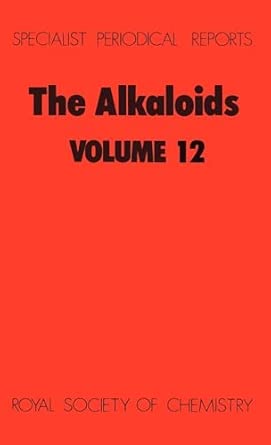
Alkaloids: Volume 12
Author(s): M F Grundon
- Publisher: Royal Society of Chemistry
- Publication Date: 1 Jan. 1982
- Language: English
- Print length: 330 pages
- ISBN-10: 0851863574
- ISBN-13: 9780851863573
Book Description
Indispensable reference source for researchers in the pharmaceutical and allied industries, and at the biology/chemistry interface in academia.
Editorial Reviews
Excerpt. © Reprinted by permission. All rights reserved.
The Alkaloids Volume 12
A Review of the Literature Published between July 1980 and June 1981
By M. F. Grundon
The Royal Society of Chemistry
Copyright © 1982 The Royal Society of Chemistry
All rights reserved.
ISBN: 978-0-85186-357-3
Contents
Chapter 1 Bio synthesis By R. B. Herbert, 1,
Chapter 2 Pyrrolidine, Piperidine, and Pyridine Alkaloids By A. R. Pinder, 35,
Chapter 3 Tropane Alkaloids By G. Fodor and R. Dharanipragada, 45,
Chapter 4 Pyrrolizidine Alkaloids By D. J. Robins, 54,
Chapter 5 Indolizidine Alkaloids By J. A. Lamberton, 69,
Chapter 6 Ouinolizidine Alkaloids By M. F. Grundon, 73,
Chapter 7 Ouinoline, Ouinazoline, and Acridone Alkaloids By M. F. Grundon, 84,
Chapter 8 β-Phenylethylamines and the lsoquinoline Alkaloids By K. W. Bentley, 94,
Chapter 9 Aporphinoid Alkaloids By M. Shamma and H. Guinaudeau, 135,
Chapter 10 Amaryllidaceae Alkaloids By M. F. Grundon, 151,
Chapter 11 Erythrina and Related Alkaloids By A. S. Chawla and A. H. Jackson, 155,
Chapter 12 Indole Alkaloids By J. E. Saxton, 163,
Chapter 13 Diterpenoid Alkaloids By S. W. Pelletier and S. W. Page, 248,
Chapter 14 Steroidal Alkaloids By D. M. Harrison, 275,
Chapter 15 Miscellaneous Alkaloids By J. R. Lewis, 291,
Errata, 302,
Author Index, 303,
CHAPTER 1
Biosynthesis
BY R. B. HERBERT
The established practice of including references to earlier Reports in this series for background information is continued. Two comprehensive reviews are also cited. An authoritative account of the biosynthesis of fungal metabolites has been published,3 as has an introductory text which includes a survey of the biosynthesis of alkaloids and nitrogenous microbial metabolites.
1 Pyrrolidine and Piperidine Alkaloids
Simple Pyrrolidine Alkaloids. — lt is well established that ornithine (1) is a key precursor in the biosynthesis of pyrrolidine alkaloids. Notably, the amino-acid (1) is utilized for the biosynthesis of nicotine (5) via the symmetrical intermediate putrescine (3), whereas the biosynthesis of tropane alkaloids, e.g. scopolamine (6), avoids any symmetrical intermediate1 (cf Vol. 11. p. 1).
The first intermediate beyond ornithine in the biosynthesis of tropane alkaloids has been deduced to be δ-N-methylornithine (2). Recently, (2) was identified as a natural constituent for the first time in a plant, namely Atropa belladonna, which produces tropane bases. The (2) was labelled by radioactive ornithine (I), but, unfortunately, the alkaloids were not, so correlation between the formation of (2) and the biosynthesis of alkaloids has not yet been achieved.
The biosynthetic pathway to both nicotine (5) and the tropane alkaloids includes N-methylputrescine (4) as a probable intermediate. New results obtained for nicotine (5) and scopolamine (6) with [1-13C, 14C;methylamino-15N]-N-methyl putrescine [(4); labels as shown] nicely confirm this. The specific incorporation of both stable isotopes was closely similar to that of the 14C label in both alkaloids, indicating intact incorporation of the precursor. The labelling patterns deduced are illustrated ([??] = 13C, * = 15N), and they are in accord with earlier results that were obtained with 14C-labelled precursors. [2-14C]Ornithine labels C-1′ of the tropane nucleus [as (6)]. The assignment of C-5′ in (6), rather than C-1′, as the site that is labelled by the N-methyll [13C]putrescine is in accord with this; the n.m.r. assignment was not of itself completely unambiguous.
The labelling of the alkaloids was apparent from a small doublet in their 13C n.m.r. spectra, flanking a central natural-abundance 13C singlet for the relevant carbon atom. This technique of using the two contiguous stable isotopes, i.e. 13C and 15N, which give rise to 13C n.m.r. doublets that are separate from natural-abundance singlets and which are detectable at much higher dilution than would be the case for a single 13C label, is ingenious and notable. It has found previous application in experiments with two adjacent 13C labels (cf. Vol. 11, pp. 1 and 19).
The tiglic acid moieties that are found in some tropane alkaloids, e.g. (8), derive from isoleucine via 2-methylbutanoic acid (cf Vol. 5, p. 12; Vol. 6, p. 11; Vol. 9, p. 3). Since 2-hydroxy-and 3-hydroxy-derivatives of the latter are not involved in biosynthesis, the conversion of 2-methylbutanoic acid (possibly via its CoA ester) into tiglic acid must be a dehydrogenation reaction. Incorporation of (2RS,3S,4S)-[2-14C;4-3H,lisoleucine (7) into the tigloyl moieties of (8) in Datura innoxia with almost complete retention of tritium, and of (2S,4R)-[4-3H1]isoleucine into the tigloyl moiety of meteloidine (9) in D. meteloides with almost complete loss of tritium, shows that the dehydrogenation is achieved by an antiperiplanar elimination within (2S)-2-methylbutanoic acid, involving the loss of the 4-pro-R-isoleucine proton [see (10)].
An apparently similar, antiperiplanar elimination with loss of the isoleucine 4-pro-S proton, to generate a double-bond of opposite geometry in alkaloidal necic acid fragments, has been observed (cf. Vol. 11, p. 2).
The structure of cocaine (11) suggests a biogenesis from ornithine and one that is closely similar to that of the tropane alkaloids, e.g. scopolamine (6), which was discussed above. Until recently, however, the only significant incorporation of labelled precursors to be obtained was with [3-14C]phenylalanine: it specifically labelled the carboxy-group of the benzoyl moiety of cocaine. Eventually, a change of feeding technique to one where a solution of the precursor was painted on the leaves of Erythroxylon coca resulted in a significant incorporation of DL-[5-14C]ornithine [as (1)] into cocaine (11). Further, the radioactivity that was present in the cocaine (11) was shown to be located specifically at one, or both, bridgehead carbon atoms, indicating a normal direct biosynthesis from ornithine.
Radioactive cuscohygrine (12) was also isolated in this experiment. Results obtained using other plants had shown that the biosynthesis of tropane alkaloids and of cuscohygrine (12) was related: both were formed via hygrine (13) (cf. Vol. 1, p. 9). The formation of tropane alkaloids from ornithine without intervention of a symmetrical intermediate (see above) implies that cuscohygrine is formed similarly. The cuscohygrine that formed from [5-14C]ornithine in E. coca was specifically labelled, but, surprisingly, one quarter of the radioactivity was deduced to be located at each of C-2, C-2′, C-5 and C-5′, indicating formation from ornithine via a symmetrical intermediate, presumably putrescine (3). Biosynthesis of cusco-hygrine in E. coca appears to be different in detail then from that in other plants that have so far been examined. Obviously, this needs further examination, and it will be most interesting to see, in addition, whether cocaine is formed through a symmetrical intermediate too, resulting in labelling of both bridgehead carbon atoms.
Phenanthroindolizidine Alkaloids. — The phenanthroindolizidine alkaloids, e.g. tylophorine (14) and tylophorinine (15), are assembled in Tylophora asthmatica from fragments derived from ornithine, phenylalanine, and tyrosine (cf Vol. 8, p. 6; Vol. 9, p. 5). The last amino-acid is the source of ring B plus C-9 and C-10. It has now been shown that dopa is a better precursor than tyrosine for this fragment. Label from [2-14C]dopa was specifically incorporated into C-10 of (14) and (15).
The diphenylhexahydroindolizine (16) has been identified as a key intermediate in the biosynthesis of tylophorine (14), tylophorinine (15), and tylophorinidine in T. asthmatica. In support, material bearing a 14C label at C-5 was found to be a specific precursor for (14) and (15); it was clearly the best precursor of eight diphenylhexahydroindolizines tested. From the combined results it is clear that earlier diphenylhexahydroindolizines have a hydroxylation and methylation pattern on ring A corresponding to that in (16). The result with [2-14C]dopa indicates that ring B is dioxygenated when the first indolizine is formed. However, (19) is an intact alkaloid precursor, and is nearly as well incorporated as (16).
Tetra-oxygenated precursors corresponding to (16), but with varying extents of methylation, and differing in methylation pattern, have been examined as precursors for (14) and (15). Unfortunately, unlike (16), they were all less well incorporated than dopa. However, the results do allow tentative identification of (17) and (18) as possible intermediates, lying earlier than (16) on the biosynthetic pathway to (14) and (15). Interestingly, (20), which cannot give tylophorinine (14) by phenol oxidative coupling without alteration of its methylation pattern to that of (16), was incorporated into both (14) and (15) at a similar level to that of (17) and (18).
Pyrrolizidine Alkaloids. — Retronecine (23), the most common base portion found in the pyrrolizidine alkaloids, has been shown to derive from two molecules of ornithine (1) via putrescine (3) by the use of 14C-labelled precursors (cf. Vol. 10, p. 13). Unequivocal evidence on the manner of incorporation of putrescine comes from experiments in Senecio isatideus with 13C-labelled samples of putrescine.
First, [1,4-13C2]putrescine [as (3)] was found to label C-5, C-9, C-3, and C-8 of (23) and to label each atom to a nearly equal extent. Secondly, [2,3-13C2]putrescine [as (3)] gave retronecine (23), the proton-decoupled 13C n.m.r. spectrum of which displayed doublets (superimposed on natural-abundance singlets) for signals corresponding to C-1 and C-2 (J = 71 Hz) and for those corresponding to C-6 and C-7 (J = 34 Hz); the enrichment levels for all the doublets were similar. The derivation of retronecine (23) from the intact carbon skeletons of two putrescine units is, therefore, quite clear, and the pattern for their utilization in biosynthesis is shown in Scheme 1.
The nearly equal enrichment of all four 13C-labelling sites suggests that putrescine is biotransformed into retronecine (23) via a symmetrical intermediate such as (22) and/or homospermidine (21). This possibility has been explored in experiments with [l-amino-15N;1-13C]putrescine in S. vulgaris and S. isatideus. In both sets of experiments, the 13C n.m.r. signals for C-3 and C-5 of retronecine (23) showed doublets of approximately equal intensity, arising from 13C-15N coupling superimposed on a singlet for each carbon, made up of natural-abundance 13C enriched by 13C label adjacent to 14N. This is entirely consistent with the biosynthesis of retronecine (23) occurring by way of at least one symmetrical intermediate such as homospermidine (21). The intermediacy of (21) in the bio-synthesis of retronecine was confirmed by showing that (21; *= 14C label) was a specific precursor for retronecine (23) (labelling sites deduced to be C-9 and C-8) and that (21) was present in S. isatideus plants, being labelled by the retronecine precursor ornithine.
Lysine. — Lysine is a common precursor of piperidine alkaloids. Of the two enantiomers of this amino-acid, the L-isomer is the more direct precursor, in plants, for piperidine alkaloids, e.g. anabasine, whereas D-lysine is more directly implicated in the biosynthesis of pipecolic acid (24) (cf. Vol. 7, p. 7). It has now been shown that a pathway exists in the plant Nicotiana glauca, and also in the micro-organism Neurospora crassa, which transforms D-lysine into L-lysine by way of L-pipecolic acid (24).
Quinolizidine Alkaloids. — Important new information (cf. Vol. 11, p. 4) has been obtained on the biosynthesis of quinolizidine alkaloids such as lupanine (27) in experiments with enzyme preparations from Lupinus polyphyllus cell suspension cultures and with chloroplasts. These alkaloids are formed from three molecules of lysine by way of cadaverine (25), and the enzymic evidence is that conversion of cadaverine into these alkaloids occurs without release of inter-mediates until 17-oxosparteine (26) is generated; the enzyme is a transaminase and not a diamine oxidase.
The enzyme, i.e. lysine decarboxylase, that is required for the conversion of lysine into cadaverine, and thus the first step of alkaloid biosynthesis, has been isolated from chloroplasts of L. polyphyllus. Like the majority of amino-acid decarboxy-lases, this enzyme is dependent on pyridoxal 5′-phosphate. Its activity was found not to be affected by the presence or absence of quinolizidine alkaloids. Control of the enzyme by simple product feedback inhibition therefore seems unlikely. The operational parameters of this enzyme resemble those of the 17-oxosparteine synthase. Co-operation between the two enzymes would explain why cadaverine is almost undetectable in vivo.
Essentially only lupanine (27) is accumulated in cell suspension cultures of Lupinus polyphyllus, Sarothamnus scoparius, and Baptista australis, whereas the intact plants accumulate other alkaloids. It is reasonable to assume that the cultures will accumulate alkaloids early rather than late in a biosynthetic pathway. Thus lupanine (27) is identified as a likely intermediate in the biosynthesis of the other alkaloids of these plants. In the case of B. australis, these alkaloids are of the pyridone type, e.g. anagyrine (28) and cytisine (29). Earlier results with 14CO2 had indicated that lupanine (27) is an intermediate in the biosynthesis of pyridone alkaloids, e.g. (28) and (29), in Thermopsis rhombifolia and T. caroliniana (cf. Vol. 3, p. 30), and this is supported by these new results. In addition, 14C-labelled lupanine was found to be incorporated, inter alia, into (28) and (29).
Biosynthesis of piperidine alkaloids from lysine/cadaverine commonly occurs via Δ1-piperideine (31). Three molecules are utilized for the construction of lupanine (27), and an attractive biosynthetic route involving the all-trans-isomer of isotripiperideine has been hypothesized (cf. Vol. 8, p. 3).
The enzymic evidence alluded to above (cf. Vol. 11, p. 4) indicates that Δ1-piperideine (31) may not be a normal intermediate in lupanine biosynthesis, but may be utilized via (30).
The quinolizidine alkaloid matrine (32), like lupanine (27), is biosynthesized from three molecules of lysine by way of cadaverine. Δ1-[6-14C)Piperideine [as (31)) was incorporated into matrine (32); 10% of the radioactivity was found to be located at C-15 and the remainder was distributed over C-2 and C-10.34 The incorporation of Δ1-[6-14C]piperideine [as (31)] into matrine has been re-examined in two plant species, Sophora tetraptera and S. microphylla, with similar but more detailed results: It was deduced that C-2, C-10, and C-15 were labelled, showing that three units of Δ1-piperideine (31) are used specifically for the elaboration of matrine (32). In the matrine obtained from each of the two Sophora species, C-2 and C-10 showed the same molar specific activity whereas C-15 showed a different, lower, molar specific activity. This means that two units of Δ1-piperideine (the two with the same molar specific activity: [??]) combine first, this being followed by combination with the third ([??]) after dilution with unlabelled material in the plant (see Scheme 2).
One third of the label from Δ1-[6-14C]piperideine that was found in the matrine (32) was located elsewhere than at C-2, C-10, and C-15. A plausible explanation for the partial randomization that was observed is that reversible transamination converted the Δ1-[6-14C]piperideine [as (31)], via its ring-opened form (30), into cadaverine (25). Subsequent re-conversion into (31) gave material that was labelled at C-6 and also at C-2.
The model scheme developed for the biosynthesis of lupanine from Δ1-piperideine and isotripiperideineJJ has been adapted for the biosynthesis of matrine (32). At the moment, the two hypothetical pathways for the biosynthesis of quinolizidine alkaloids are manifestly different (cf. Vol. 11, p. 4 and Vol. 8, p. 3): one uses Δ1-piperideine (31) as an intermediate; the other does not. Where the points of fundamental agreement between the two models lie, and which model is a more accurate picture of what is really happening, are questions that remain to be answered.
In accord with a general body of evidence on the biosynthesis of alkaloids as against that of pipecolic acid (see above), L-lysine has been shown to be the preferred precursor for lupanine (27) and D-lysine the preferred precursor for L-pipecolic acid (24) in Lupinus angustifolia. A high retention of tritium, present at C-4 and C-5 in the lysine, on formation of (27) is to be noted.
2 Isoquinoline Alkaloids
Papaver Alkaloids. — Biosynthesis of morphine (36) occurs, in Papaver somniferum, through reticuline (33) by way of thebaine (35). The sequence from (35) to (36) involves, inter alia, two O-demethylations, with that at the methoxy-group at C-6 occurring first. Confirmation that the other methoxy-group is not demethylaied first in this Papaver species obtains from the failure to detect oripavine (37), which is found in other Papaver species, as a natural constituent of P. somniferum. The experiment involved attempted isolation of radioactive (37), using inactive alkaloid as carrier, following a feeding experiment with radioactive reticuline (33).
(Continues…)Excerpted from The Alkaloids Volume 12 by M. F. Grundon. Copyright © 1982 The Royal Society of Chemistry. Excerpted by permission of The Royal Society of Chemistry.
All rights reserved. No part of this excerpt may be reproduced or reprinted without permission in writing from the publisher.
Excerpts are provided by Dial-A-Book Inc. solely for the personal use of visitors to this web site.


