Wow! eBook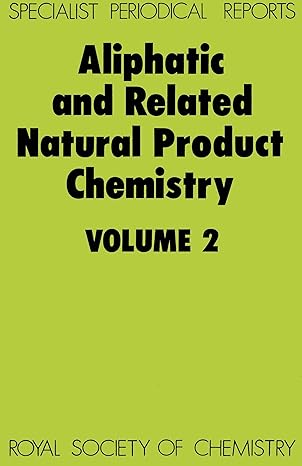
Aliphatic and Related Natural Product Chemistry: Volume 2
Author(s): Frank D Gunstone
- Publisher: Royal Society of Chemistry
- Publication Date: 1 Jun. 1981
- Language: English
- Print length: 278 pages
- ISBN-10: 9780851866529
- ISBN-13: 0851866522
Book Description
Indispensable reference source for researchers in the pharmaceutical and allied industries, and at the biology/chemistry interface in academia.
Editorial Reviews
Excerpt. © Reprinted by permission. All rights reserved.
Aliphatic and Related Natural Product Chemistry Volume 2
A Review of the Literature Published During 1978 and 1979
By F. D. Gunstone
The Royal Society of Chemistry
Copyright © 1981 The Royal Society of Chemistry
All rights reserved.
ISBN: 978-0-85186-652-9
Contents
Chapter 1 Natural Acetylenic and Olefinic Compounds, excluding Marine Natural Products By C. M. Scrimgeour, 1,
Chapter 2 Acyclic Terpenoids By D. H. Grayson, 20,
Chapter 3 Insect Pheromones and Related Behaviour-modifying Chemicals By R. Baker and J. W. S. Bradshaw, 46,
Chapter 4 Olefinic Microbial Metabolites, including Macrocyclic Compounds By R. C. F. Jones, 76,
Chapter 5 Prostaglandins By P. R. Marsham, 125,
Chapter 6 Fatty Acids and Glycerides By F. D. Gunstone, 194,
Chapter 7 Polar Lipids By A. K. Lough, 224,
Author Index, 251,
CHAPTER 1
Natural Acetylenic and Olefinic Compounds, excluding Marine Natural Products
C. M. SCRIMGEOUR
1 Introduction
This report covers the same topics as does the corresponding chapter in the first volume of this series. The bulk of it is concerned with polyacetylenic and other acetylenic aliphatic natural products while the remainder deals with olefinic compounds not obviously included in the other chapters. The literature coverage is for 1978–9 plus a few earlier reports not previously included.
2 Natural Acetylenic Compounds
Introduction. – This two-year spell has again been one of consolidation rather than dramatic progress. A number of new compounds, mainly related to previously known structures, have been reported. A number of new sources of known compounds have also been reported. Many of these reports concern the physiological role or chemotaxonomic application of acetylenic compounds. Four general reviews about polyacetylenes have appeared, covering the work of the past decade or more. While Bohlmann’s output has continued to focus on terpenoid compounds, he still remains the most prolific contributor to this field.
New Polyacetylenic Compounds. — The majority of new compounds are found in species within the family Compositae. A C18 enediynene (1) and the related dihydro-compound (2) were isolated from the roots of various South African species of the genera Athanasia and Pentzia. These acids are of interest as possible intermediates in the biosynthesis of polyacetylenes from crepenynic acid. The linoleyl ester of (1) was also identified. In his continuing study of South African members of the Compositae, Bohlmann identified a related pair of C18 compounds (3) and (4) from a number of species of Senecio. The two C18 compounds (1) and (2) have also been reported, occurring as their methyl esters in Athanasia tridens, along with the new C17 olefin derivative (5). Bohlman has suggested that (5) is biosynthesized by loss of carbon dioxide and water from the β-hydroxy C18 compound (6). Clibadium cf. glomeratum has also yielded a new C17 compound (7). Further C17 compounds are related to dehydrofalcarinone; (8) and (9) were identified in various South African species of Nidorella, while the South American Diotis maritima yielded the dihydro-derivative (10), related to (8). One new C16 compound has been identified. The aldehyde (11) was found in Siegesbekia jorullensis.
A number of C13 and C14 compounds have also been reported from various members of the Compositae. Bohlmann identified four new thiophen derivatives (12)–(15) from Cullumia setosa, along with other known thiophens. A polyacetylene has been isolated for the first time from Brickellia laciniata. This is a new C14 compound, with a novel pattern of unsaturation (16), and it occurs as a mixture of stereoisomers. The stereochemistry has not yet been determined. A study of compounds that are capable of stimulating the germination of safflower rust (Puccinia carthami) and which are produced by germinating safflower (Carthamus tinctorius) revealed a number of polyacetylenic hydrocarbons. A number of these are C13 compounds that are new to this well-studied species, and (17)–(19) are new compounds. A careful re-examination of the polar fraction of the aerial parts of Centaurea ruthenica revealed over twenty new compounds. Most of these are C13 compounds, along with some C10 and C14 compounds, all of them present in trace amounts. Complete separation of the components was not always possible, but the structures (20)–(48) were unravelled from spectroscopic evidence. The new compounds help to extend the biosynthetic schemes for these compounds.
Bohlmann has also discovered a number of C12 compounds among members of the family Compositae. The sulphur-containing compound (49) occurs in Chrysanthemum coronarium, along with a number of known, related cornpounds. Emilia coccinea and E. sagittata afforded a number of C12 compounds (50)–(54), which are suggested as the biosynthetic precursors of the better known C11 compounds. Two representatives (55) and (56) of a new type of chloro-aromatic thiophen compound occur in Helichrysum tenuifolium and H. panduratum, along with the related, non-aromatized compound (57). A chloro-enol ether (58) has been proposed as the biosynthetic precursor of these compounds, as shown in Scheme 1.
A number of C11 acetylenes (59)–(67) occur in Cineraria species, and the chemotaxonomy of the genus Cineraria is discussed by Bohlmann with reference to these and related compounds. Several sources of new C10 compounds have been found. These compounds are derivatives of matricaria ester, with which they often co-occur. The lactme (68) was isolated from Solidago altissima, and the seasonal variation of its concentration and those of matricaria ester and dehydromatricaria ester was observed. Chrysothamnus parryi gave four new derivatives of matricaria ester, i.e. (69)–(75). A number of known compounds were isolated from Artemisia absinthium, along with a new thiophen derivative of dehydromatricaria ester (76). Two C10 furano-acetylenes (77) and (78) were identified in Felicia filifolia.
A number of compounds were isolated from the roots of Pituranthus tortuosus (Umbelliferae), and three of these are new compounds. The structures of (79) and (80) were determined by spectroscopic and chemical-modification methods. A third compound was not fully characterized, but was shown to contain the part structure (81).
The fungus Peniophora resinosa yielded the new compound (82) in its (+)-form, along with related known compounds. Cultures of the fungus Polyporus anthracophilus produced a number of C10 polyacetylenes, among which one new isomer (83) was detected. An interesting collection of long-chain polyacetylenic and acetylenic compounds has been reported from a sponge of the genus Siphonchalina. These compounds, (84)–(89), are marine natural products, but sufficiently similar to some non-marine compounds to be mentioned here. Unlike the compounds found in Reniera fulva, (88) and (89) only contain terminal hydroxyl groups, leaving unresolved the problem of chirality raised in the previous review.
Other Acetylenic Compounds. – Six long-chain monoacetylenic compounds (90)–(95) have been found in the Amazonian Laurel, Licaria mahuba. The stereochemistry of the γ-lactone was determined by spectroscopic (mainly 1H n.m.r.) methods and from information about the circular dichroism of these and related compounds. Compounds (90) and (91) are unstable, and had to be studied within a few days of isolation. These compounds co-occur with the related olefinic and saturated compounds. A further acetylenic isocoumarin, 8-hydroxycapillarin (96), has been isolated from Artemisia dracunculus.
Known Polyacetylenic Compounds. – Known compounds often co-occur with the new compounds described above, and these are not further discussed. There are, however, a number of reports of known compounds from new plant sources. Many of these reports stem from chemotaxonomic studies of the complex genera of the Compositae. Table 1 lists the plant sources studied, along with the main types of acetylenic compounds found therein, but excludes sources mentioned in the foregoing and following sections.
Structure Determination. – The structures of the majority of the new and known compounds were deduced by the conventional spectroscopic methods, coupled (on occasions) with chemical transformations. High-field (270 MHz) proton magnetic resonance spectroscopic studies and the use of lanthanide shift reagents are becoming routine, and allow considerable information to be obtained from mixtures which cannot be separated. Bohlmann has reported the 13C n.m.r. spectra of two synthetic compounds. These compounds were 13C-labelled, and this allowed the assignment of the acetylenic carbons (see Table 2). The potential of this highly structure-sensitive method is, however, still limited by the larger samples required compared with 1H n.m.r.
Synthesis. – The syntheses of two C10 alcohols from Polyporus anthracophilus, of a C10 methyl ether found in both Lentinus lepideus and Leucopaxillus giganteus, and of ([+ or -])-helenyolic acid all used conventional Chodkiewicz coupling.
A useful route to pure (Z) and (E) C5, C6, and C7 alk-3-en-1-ynes has been reported. The mixture of isomers prepared by the usual synthetic routes is separated by spinning-band distillation of the trimethylsilyl derivatives. These derivatives, formed from the alkyne, n-butyl-lithium, and trimethylsilyl chloride, increase both the stability of the terminal alkyne and the difference in boiling point of the two isomers. The parent hydrocarbon is regenerated by treatment with silver nitrate or potassium fluoride.
Bohlmann confirmed the structure of three furano-polyacetylenes from Alphonsea ventricosa by synthesis. The route is a general one to α-substituted furans, and involves the reaction of a nitrile with allylmagnesium chloride and treatment of the resultant keto-olefin with osmium tetroxide and sodium hydrogen sulphite. Alternatively, treatment of the osmate ester with base gives the diol (Scheme 2).
A modified synthesis of 1,4-enynes (Scheme 3) and a stereospecific synthesis of terminal (E)-enynes (Scheme 4) have possible applications in the synthesis of polyacetylenic natural products.
Biosynthesis. — Many of the new compounds described above have been proposed as further intermediates in the generally accepted schemes of biosynthesis, and some reports include postulated biosynthetic routes to novel compounds. However, there have only been two reports of labelling studies during the past two years.
The biosynthesis of wyerone (97) by the broad bean (Vicia faba) has been clarified by a study using material infected with Botrytis cinerea. Wyerone is only produced in response to infection, and previous work, using healthy tissue, produced understandably inconclusive results. This new study showed significant incorporation of [1-14C]acetate, [2-14C]malonate, and [n,9,10-3H]-oleate into wyerone, increasing in that order. This strongly suggests that wyerone is derived from oleate, presumably via crepenynate, but leaves the problem of the subsequent double-bond rearrangement unresolved.
The role of matricaria esters as intermediates in the biosynthesis of several metabolites of Polyporus anthracophilus has been established by tracer studies. When a mixture of (E,E)-[1-14 C]- and (2E,8Z)-[1-14C]-matricaria esters, (98) and (99), was fed to a culture of the fungus, specific incorporation into (E,E)- and (Z,Z)-matricariol, (100) and (101), and the dimethyl ester (102) was observed. These results show that the fungus has the ability to reduce the ester function to an alcohol and also to isomerize an (E) 2,3 double-bond to the (Z) configuration. The production of (102) shows the further ability to oxidize the terminal methyl group, presumably with the hydroxy-matricaria esters (103) and (104) as intermediates.
Chemotaxonomy and Physiological Properties. – Many of the reports listed in Table 1 include applications of the distribution of polyacetylenic compounds to the complex problem of the taxonomy of members of the Compositae. This topic has been reviewed at some length, and one report on the systematics of the genus Anacyclus includes a discussion of the existing data on polyacetylene distribution.
The role of polyacetylenes as phytoalexins (plant defence substances) has received some attention. The role of polyacetylenes in resistance to fungal infections of safflower and broad bean has been reviewed. A study of germinating lentils (Lens culinaris) that were infected with Botrytis cinerea has shown that wyerone (97) and the related epoxide and dihydro-compound are produced as phytoalexins. This suggests that the genus Lens is more closely related to Vicia than it is to Pisum or Lathyrus, which do not produce furano-acetylenes. Both falcarindiol (105) and falcarinol (106), isolated from the roots of ground elder (Aegopodium podagraria), were found to inhibit the germination of fungal spores, but the diol was much more effective in this respect. Dehydromatricaria ester and lactone have been shown to inhibit the germination of millet seeds. There has been a further account of the nematocidal properties of C13 trienetriynes from Carthamus tinctorius. The action of polyacetylenes as insecticides, nematocides, and antibiotics and their action against vertebrates has been reviewed. This review includes a report of the phototoxicity of some thiophen compounds, and this topic is described further in a report of the photosensitizing behaviour of α-terthienyl and 5-(but-3-en-1-ynyl)-2,2′-bithienyl, isolated from Tagetes species.
3 Natural Olefinic Compounds
Introduction. – This part of the review describes those long-chain olefinic compounds which do not obviously fall within any other class of compounds. A few of these compounds are related to acetylenic natural products, both in source and probable biosynthesis, while the remainder have only an aliphatic chain of some length in common.
Olefins Related to Acetylenes. – A new tetrahydrofuran derivative (107) from Helichrysum aureo-nitens is likely to be related to the acetylenic compounds found in other species of that genus. The structure was determined by high-field 1H n.m.r. (270 MHz) of both (107) and its acetate, in conjunction with solvent shift effects. The known C15 hydrocarbon (108) has now been found in Ligularia macrophylla. Olefinic compounds from Licaria mahuba were mentioned when describing the acetylenic compounds from that species.
Other Olefinic Compounds. – Two novel β-triketones (109) and (110) have been isolated from the larval mandibular glands of Anagasta kuehniella and other lepidoptera, and this is the first report of such compounds from insects. The compounds, which are optically active, were examined by spectroscopic techniques. The 1H n.m.r. data suggest that both compounds are fully enolized in deuteriochloroform solution. The antibiotic and behavioural effects of (109) and (110) are being studied.
The stereochemistry of the antibiotic thermozymocidin has been revised to the all-Z form rather than the previously suggested all-E form. The chiral lactone (111) was prepared by a stereospecific synthesis and shown to be identical with that obtained from the open-chain natural product. Three aliphatic alkaloids, (112)–(114), that have C12 chains have been identified from spectroscopic data in extracts of Dicarpellum pronyensis. The insecticidal properties of the known isobutylamide (115) from Piper nigrum have been studied.
A new metabolite of sorbic acid (116) has been found in cultures of the fungus Mucor sp. A-73. The structure was determined spectroscopically, in conjunction with periodate cleavage. The absolute configuration (2S,3R) was established by stereospecific synthesis of the corresponding saturated compound. Two new short-chain compounds (117) and (118) occur as aroma constituents of the purple passionfruit (Passiflora edulis). Both structures were confirmed by synthesis.
CHAPTER 2
Acyclic Terpenoids
D. H. GRAYSON
1 Introduction
This report surveys the principal developments in acyclic terpene chemistry for the years 1978 and 1979, its format paralleling that of the same Chapter in Volume 1 of this series. Some relevant reviews which have appeared during this period include monographs on the enzymic reactions which lead to mono- and sesqui-terpenes in plants, on the synthesis and natural occurrence of acyclic diterpene alcohols, and on general aspects of acyclic terpenoids, with a special section on the tagetones. For the synthetically inclined, there are articles on selective transformations using organo-aluminium reagents, on the use of sulphones as aids to terpene synthesis, on the synthesis of polyenes via phosphonium ylides, and on cyclization reactions of acyclic terpenoids. Another review (in Japanese) discusses biomimetic cyclizations. An account has been given of the development of a computer program for the recognition of regular acyclic isoprenoid structures.
(Continues…)Excerpted from Aliphatic and Related Natural Product Chemistry Volume 2 by F. D. Gunstone. Copyright © 1981 The Royal Society of Chemistry. Excerpted by permission of The Royal Society of Chemistry.
All rights reserved. No part of this excerpt may be reproduced or reprinted without permission in writing from the publisher.
Excerpts are provided by Dial-A-Book Inc. solely for the personal use of visitors to this web site.