 Wow! eBook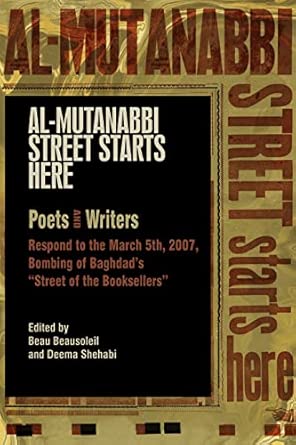
Al-Mutanabbi Street Starts Here: Poets and Writers Respond to the March 5th, 2007, Bombing of Baghdad's Street of the Booksellers
Author(s): Beau Beausoleil (Author)
- Publisher: PM PRESS
- Publication Date: 12 July 2012
- Language: English
- Print length: 256 pages
- ISBN-10: 1604865903
- ISBN-13: 9781604865905
Book Description
Editorial Reviews
Review
“This anthology celebrates the exquisite relationship between the book and the reader, humanity and culture, writing and life and love. It is a tribute to a street that grows into a large and archetypal symbol and spatial metaphor for books.”
–Muhsin al-Musawi, professor of Arabic and Comparative Studies at Columbia University and editor of the Journal of Arabic Literature
“The collection of materials in this anthology is astounding and harrowing. Beausoleil and Shehabi have put together a book that will be adored by lovers of poetry, essays, journalism, and testimony. It will also be required reading for anyone interested in social justice.”
–Steven Salaita, associate professor of English, Virginia Tech University
“Al-Mutanabbi Street Starts Here has brought together a stellar group of authors to write about a time and place: the destruction of Baghdad’s famed al-Mutanabbi Street, when on March 5, 2007, the cultural spaces of bookstores, libraries, and cafes frequented for centuries by the Iraqi literary community were bombed. This is a wonderful and exceptionally moving anthology and a compelling collection of poetic and historical merit.”
–Susan Slyomovics, professor of anthropology and Near Eastern languages, UCLA
“Propaganda reigns when there are no natural alliances of self-defense, when image-makers — poets, novelists, journalists, filmmakers, photographers, and artists–have no personal relationships with their counterparts across zones of conflict. Al-Mutanabbi Street Starts Here steps directly into this vacuum, holding the mirror of resistance directly to our acquiescent eyes, reminding us that before the invasion of Iraq there were sanctions, that before the sanctions there was Saddam Hussein, part of an elaborate web of U.S. supported and inspired totalitarianism that has kept the peoples of the Middle East in a stranglehold for a good part of the 20th century. This extraordinary collection asks us to account for our lack of resistance, and to begin learning just what it might mean to resist.”
–Ammiel Alcalay, chair of Classical, Middle Eastern and Asian Languages and Cultures at Queens College
About the Author
Beau Beausoleil is a poet and bookseller in San Francisco, California. His latest book is Concealed in Language. He is the founder of the Al-Mutanabbi Street Coalition.
Deema Shehabi is the author of Thirteen Departures from the Moon. Her work has appeared in various journals and anthologies including Inclined to Speak: Contemporary Arab-American Poetry, The Kenyon Review, Drunken Boat, Literary Imagination, The Poetry of Arab Women, Poetry Review (London), and Wasafiri. Her work has been nominated for the Pushcart prize four times, and she served as Vice-President for RAWI, the Radius of Arab-American Writers, Inc.
Excerpt. © Reprinted by permission. All rights reserved.
Al-Mutanabbi Street Starts Here
By Beau Beausoleil, Deema K. Shehabi
PM Press
Copyright © 2012 PM Press
All rights reserved.
ISBN: 978-1-60486-590-5
Contents
Introduction BeauBeausoleil,
Preface Muhsin al-Musawi,
I. THE RIVER TURNED BLACK WITH INK,
The Bookseller’s Story, Ending Much Too Soon Anthony Shadid,
A Man in Love with Knowledge Mousa al-Naseri,
For al-Mutanabbi Street Naomi Shihab Nye,
The Last Word Deena Metzger,
The Grief of Birds Sam Hamod,
Al-Mutanabbi Street Lutfiya al-Dulaimi,
Occident to Orient Zaid Shlah,
Ways to Count the Dead Persis M. Karim,
Al-Mutanabbi Street Ayub Nuri,
Qasida, My Father Spoke at Funerals, Ways to Raise the Dead Marian Haddad,
Girls in Red on Page One Sarah Browning,
Al-Mutanabbi Street Eileen Grace OMalley Callahan,
Abridged Qasida for al-Mutanabbi Street Roger Sedarat,
Al-Mutanabbi Street Elline Lipkin,
Fragment, in Praise of the Book MeenaAlexander,
An Ordinary Bookseller Esther Kamkar,
What Prayer Robert Perry,
Marianne Moore in Baghdad Gloria Collins,
The al-Mutanabbi Street Bombing Brian Turner,
In Perpetuity GloriaFrym,
Against the Weather (for al-Mutanabbi Street) Owen Hill,
Dead Trees Yassin “The Narcicyst” Alsalman,
Elegy for al-Mutanabbi Street Jose Luis Gutierrez,
The Letter Has Arrived Sargon Boulus,
Al-Mutanabbi Street Peter Money,
Voices Surround & Fade: The Hooded One Peter Money,
A Letter to al-Mutanabbi Sinan Antoon,
Escape from al-Mutanabbi Street Muhammad al-Hamrani,
into the lizard’s eyes Lilvia Soto,
After Rumi Janet Sternburg,
To Salah al-Hamdani, November, 2008 Sam Hamill,
Thirty Days after Thirty Years Salah al-Hamdani,
Excerptfrom Blue Gail Sher,
A half-burned page on al-Mutanabbi Street Dunya Mikhail,
My Days Lack Happiness and I Want You Irada al-Jabbouri,
Remnants Dilara Cirit,
Ashes Niamh macFhionnlaoich,
The Color She Wears Erica Goss,
No Man’s Land Daisy Zamora,
On al-Mutanabbi Street George Evans,
The Friend Steve Dickison,
The River Turned Black with Ink Maysoon Pachachi,
II. KNOWLEDGE IS LIGHT,
Matter and Spirit on al-Mutanabbi Street Summer Brenner,
Untitled Jen Hofer,
Untitled Rijin Sahakian,
Rain Song Badr Shakir al-Sayyab,
The Poet Jane Hirshfield,
“Close to God” Jack Marshall,
A Book in the Hand Susan Moon,
Revolutionary Letter #77 Awkward Song on the Eve of War Diane di Prima,
Al-Mutanabbi Street Evelyn So,
Ethics of Care: The Retreat of al-Mutanabbi Nahrain al-Mousawi,
A Secret Question Ko Un,
The Road to al-Mutanabbi Street Joe Lamb,
Untitled Katrina Rodabaugh 120,
For I Am a Stranger Badr Shakir al-Sayyab,
Untitled Mohammed Hayawi,
Excerpt from Five Hymns to Pain Nazik al-Malaika,
Al-Mutanabbi Street RayaAsee,
Attention Saadi Youssef,
Destinies Gazar Hantoosh,
A Book of Remedies MarkAbley,
On the Booksellers’ Street of Baghdad Majid Naficy,
Crossroads Lewis Buzbee,
Untitled Ibn al-Utri,
Remembering al-Mutanabbi Thomas Christensen,
On Ashurbanipal’s Library Amy Gerstler,
III. GATHERING THE SILENCES,
In the Valley of Love Genny Lim,
Night in Hamdan Saadi Youssef,
Burning Judith Lyn Sutton,
Luis and Celso on al-Mutanabbi Street JoshKun,
Lullaby Dana Teen Lomax,
I Recall al-Sayyab Mahmoud Darwish,
Country of Large Rivers EtelAdnan,
The Murderer Bushra al-Bustani,
GHAZAL: Dar al-Harb Marilyn Hacker,
A Home on al-Mutanabbi Street Richard Harrison,
Proof of Kindness Fady Joudah,
Hearing of Alia Muhammed Baker’s Stroke Philip Metres,
Prayer for the Living Hayan Charara,
Interpenetrate Annie Finch,
The Contract KazimAli,
Curves in the Dark Deema K. Shehabi,
The Booksellers of Pansodan Kenneth Wong,
The Proper Purgation ElmazAbinader,
In the Country of the Dead HabibTengour,
Adolescence of Burnt Hands Khaled Mattawa,
From Tales of a Severed Head Rachida Madani,
Untitled Amina Said,
What Every Driver Must Know AliseAlousi,
Explosion Sita Carboni,
Letter to My Childhood Friend, the Baghdad Car Bomber Fran Bourassa,
Chrysalis JabezW. Churchill,
Al-Mutanabbi Street: Foot Notes after the Fire Daniela Bouneva Elza,
Poppies Are Not (Enough) Daniela Bouneva Elza,
Psalms and Ashes Linda Norton,
Black and Red Fred Norman,
Nazik al-Malaika Fred Norman,
Al-Mutanabbi Bonnie Nish,
random Bonnie Nish,
The Twisted Janet Rodney,
Tonight No Poetry Will Serve Adrienne Rich,
The Blues Sat Down on al-Mutanabbi Street Cornelius Eady,
March 9, 2007 Al-Mutanabbi Street, Baghdad Julie Bruck,
The Secret Carpentry Kwame Dawes,
Blackouts Ralph Angel,
Moth B.H. Fairchild,
Baghdad Callsby Terese Svoboda,
They Didn’t Ask: What’s After Death Mahmoud Darwish,
The Airport of Language Amir el-Chidiac,
Rocks Aram Saroyan,
April Stork Saadi Youssef,
Solos on the Oud (#3) Saadi Youssef,
See Them Coming Sholeh Wolpe,
Love Song Sholeh Wolpe,
Until the Glaciers Melt Sholeh Wolpe,
Tonight Nathalie Handal,
One (for al-Mutanabbi Street) Beau Beausoleil,
The Timeless Legacy of al-Mutanabbi Street Azar Nafisi,
The Sudden Cessation of Electricity Dima Hilal,
Market Forces Runon Tony Kranz,
Freedom to Walk Jordan Elgrably,
Untitled devorah major,
Words Suzy Malcolm,
The Last Supper Ibrahim Nasrallah,
The Celebration Ibrahim Nasrallah,
A Special Invitation Ibrahim Nasrallah,
Circle of Prey Rick London,
Its First Smell Sarah Menefee,
Automatize Roberto Harrison,
Verses for Everyday Use Fadhil al-Azzawi,
Paper Elegy Amaranth Borsuk,
311 and Counting Lamees al-Ethari,
A Very Short Letter Shayma al-Saqr,
The Street of the Poet Jim Natal,
Contributors,
Acknowledgments,
CHAPTER 1
The Bookseller’s Story, Ending Much Too Soon
Anthony Shadid
Washington Post,Monday, March 12, 2007
It was a summer day in 2003, when Iraq was still filled with the half-truths of occupation and liberation, before its nihilistic descent into carnage. Mohammed Hayawi, a bald bear of a man, stood in his shop, the Renaissance Bookstore, along Baghdad’s storied al -Mutanabbi Street.
On shelves eight rows high rested books by communist poets and martyred clerics, translations of Shakespeare, predictions by Lebanese astrologers, a 44-volume tome by a revered ayatollah and a tract by the austere medieval thinker Ibn Taimiyyah. Dusty stacks spilled across the cream-colored tile floor, swept but stained with age. In those cramped quarters, Hayawi tried to cool himself with a fan, as perspiration poured down his jowly face and soaked his blue shirt.
We had met before the American invasion, and nearly a year later, he almost immediately recognized me.
“Abu Laila,” he said, using the Arabic nickname taken from the name of a person’s child.
He then delivered a line he would repeat almost every time we saw each other over the next few years. “I challenge anyone, Abu Laila, to say what has happened, what’s happening now, and what will happen in the future.” And, over a thin-waisted cup of tea, scalding even on this hot day, he shook his head.
A car bomb detonated last week on al-Mutanabbi Street, leaving a scene that has grown familiar in Baghdad, a collage of chaotic images, disturbing in their brutality, grotesque in their repetition. At least 26 people were killed. Hayawi the bookseller was one of them.
Unlike the U.S. soldiers who die in this conflict, the names of most Iraqi victims will never be published, consigned to the anonymity that death in the Iraqi capital brings these days. Hayawi was neither a politician nor a warlord. Few beyond al-Mutanabbi Street even knew his name. Yet his quiet life deserves more than a footnote, if for no other reason than to remember a man who embraced what Baghdad was and tried to make sense of a country that doesn’t make sense anymore. Gone with him are small moments of life, gentle simply by virtue of being ordinary, now lost in the rubble strewn along a street that will never be the same.
After his death, I thought back to our conversation on that summer day. As he often did, Hayawi paused after an especially vigorous point and dragged on his cigarette. He ran his hand over his sweaty cheeks. “Does this look like the face of 39 years?” he said, grinning. He then knitted his brow, turning grimmer. “We don’t want to hear explosions, we don’t want to hear about more attacks, we want to be at peace,” he told me. He always had dark bags under his limpid eyes, whether or not he had slept. “An Iraqi wants to put his head on his pillow and feel relaxed.”
Independent Thinker
Hayawi had worked at the bookstore all his life. His father, Abdel-Rahman, opened it in 1954, and after he died in 1993 his five sons inherited the business, keeping a portrait of the patriarch, in a Russian-style winter hat, hanging on the wood-paneled wall. Over the years, Hayawi and his older brothers would branch out. They owned other shops on al-Mutanabbi — Legal Bookstore and Nibras Bookstore down the street — along with a business that sold Korans across town.
His family was Sunni Muslim, but Hayawi played down its importance to his sense of self, and he lived with his wife and young son, Ahmed Akram, in a predominantly Shiite neighborhood. He took pride in his independence, in being someone who celebrated the gray areas, a reflection of the best of what the intellectual entrepot of al-Mutanabbi Street was supposed to represent.
We first met as I wandered into his shop before the invasion, when S addam Hussein was still in power in 2002. As usual, he was unshaven, and even then, he seized the opportunity to talk. “Iraq’s invasion of Kuwait was wrong,” he told me quite boldly — a blasphemous idea at the time.
But years later, he was unable to understand the American obsession with Iraq and Saddam. “Why the crisis after crisis?” he asked. “For weapons of mass destruction? We don’t have any. If we did,” he declared, “we would have fired them at Israel. A war simply for Saddam?”
After the invasion and the government’s fall, Hayawi described himself much as other Iraqis did in that first uncertain year: as neither for Saddam nor happy with the Americans. He was angry, of course — at the chaos, the insecurity, the lack of electricity.
“The American promises to Iraq are like trying to hold water in your hand,” he told me in one conversation. “It spills through your fingers.”
But he was never strident; he was filled with a thoughtfulness and reflection that survival in Iraq rarely permits these days.
Hayawi resented the occupation but voted in the elections the United States backed. He was a devout Muslim, but feared the rise of religion in politics. In his bookstore, once-banned titles by Shiite clerics, imported from Iran, vied with books by radical Sunni clerics, among them Muhammad Abdel-Wahab, the eighteenth century godfather of Saudi Arabia’s brand of Islam. Profit may have inspired his eclectic mix, but Hayawi also seemed to be making a statement: al-Mutanabbi Street, his Baghdad and his Iraq would respect their diversity.
He was always a proud man. Every so often, Hayawi would repeat this story: he was driving to Syria on business in his yellow Caprice and was stopped at a U.S. checkpoint, manned by two Humvees, outside the Euphrates River town of Ramadi, in Western Iraq. Through a translator, one of the American officers, clad in camouflage and dusty from a desert wind, began to ask him routine questions.
“‘What are you doing here?’ the soldier asked.”
“I said, ‘What are YOU doing here? You’re my guest. What are you doing in Iraq?'”
“He laughed and he patted my shoulder,” Hayawi recalled.
Bookstore Retreat
The doorway of the Renaissance Bookstore was a border, in a way. Outside were the sirens of ambulances and police cars. Gunfire was common. Horns blared in two lanes of traffic, one more than al-Mutanabbi had been built for. Inside Hayawi went about business as he had every day since he inherited the shop from his father.
The last time I saw him, in 2005, he was sitting behind his desk, sipping a cup of tea that cost 10 cents, a pack of Gauloise cigarettes next to it.
As he did every morning, hour after hour, Hajji Sadiq, the money changer, ambled into the bookstore.
“What’s the rate?” Hayawi bellowed.
“I won’t tell you unless you’re going to buy,” Hajji Sadiq answered.
Hayawi waved to friends passing along the street outside. An elderly woman stood at the door, asking for alms. Vendors entered offering everything from books to beach towels.
The day went on, in the rhythm of a life that now no longer exists. Two Kurdish booksellers came in, bringing a gift of honey from Sulaimaniya in the North. They greeted Hayawi in Kurdish, then the conversation continued in Arabic. Hajji Sadiq returned, quoting an exchange rate that had barely changed. The electricity cut off, with no one seeming to notice. Customers from Balad in the North told of the situation there, as did visitors from Basra in the South.
By afternoon, the electricity came on and a water pipe was brought out. Sweet-smelling apple-flavored tobacco smoldered.
“Life goes on,” Hayawi told me that day. “We are in the middle of a war, and we still smoke the water pipe.”
Literary Loss
Al-Mutanabbi Street always seemed to tell a story of Iraq.
Its maze of bookshops and stationery stores, housed in elegant Ottoman architecture, was named for one of the Arab world’s greatest poets, a 10th-century sage whose haughtiness was matched only by his skill. The street was anchored by the Shahbandar Cafe, where antique water pipes were stacked in rows three deep. On the walls inside were pictures of Iraq’s history: portraits of the bare-chested 1936 wrestling team, King Faisal’s court after World War I and the funeral of King Ghazi in 1939.
In its heyday, this street embodied a generation-old saying: Cairo writes, Beirut publishes, Baghdad reads. But under the U.N. sanctions that followed Iraq’s invasion of Kuwait in 1990, isolating it from the world, its stores were lined with magazines 20 years old, obsolete textbooks and dust-covered religious tomes that seemed more for show than for sale. It became a dreary flea market for used books, as vendors sold off their private collections in an attempt to get by, and Hayawi and his brothers eked out a living by selling religious texts, works of history for university curricula, and course work in English, what he called a passport.
In the months after the invasion, al-Mutanabbi Street revived into an intellectual free-for-all. There were titles by Mohammed Baqir al-Sadr, a brilliant theologian killed, as the story goes, when Saddam’s executioners drove nails into his forehead. Shiite iconography — of living ayatollahs and 7th-century saints marching to their deaths — was everywhere. Nearby were new issues of FHM and Maxim, their covers adorned with scantily clad women. On rickety stands were compact discs of Osama bin Laden’s messages selling for the equivalent of 50 cents. Down the street were pamphlets of the venerable Communist Party. As one of the booksellers once said, quoting a line of poetry by al-Mutanabbi, “With so much noise, you need ten fingers to plug your ears.”
Al-Mutanabbi Street today tells another story.
When the Mongols sacked Baghdad in 1258, it was said that the Tigris River ran red one day, black another. The red came from the blood of nameless victims, massacred by ferocious horsemen. The black came from the ink of countless books from libraries and universities. Last Monday, the bomb on al-Mutanabbi Street detonated at 11:40 a.m. The pavement was smeared with blood. Fires that ensued sent up columns of dark smoke, fed by the plethora of paper.
A colleague told me that near Hayawi’s shop, a little ways from the now-gutted Shahbandar Cafe, a black banner hangs today. In the graceful slope of yellow Arabic script, it mourns the loss of Hayawi and his nephew, “who were assassinated by the cowardly bombing.”
CHAPTER 2
A Man in Love with Knowledge
Mousa al-Naseri
My name is Mousa al-Naseri. I was born in Baghdad in 1964. From 2001 to 2007, I worked as a sales representative for an Iraqi wholesale merchant of stationery items and imported office supplies. Most of my work was on al-Mutanabbi Street, but I also had customers on other historic streets such as Souq al-Sarrai. The nature of my work was walking down the streets, presenting the inventory of imported stationery goods and office supplies to the owners of the bookstores and stationery shops. Every day, I walked down the alleyways and the streets for hours checking on the supplies and taking orders from my regular customers. I carried with me, besides my selling skills, two big plastic suitcases filled with samples of the inventory. What I couldn’t carry with me, because of its weight or size, I wrote on a long, detailed list.
On a regular workday, I started my day showing my goods to the shop owners on historic al-Rasheed Street, where the beautiful statue of the famous Iraqi poet, Abdul-Ghannai Maarouf al-Rusafi, stands. Then, I walked straight down to al-Mutanabbi Street. The stationery shops are spread out along the two sides of the street, which I estimate to be around 300-400 meters long. Sometimes, after finishing those long strenuous trips, I took a short rest at the old and famed al-Shabandar coffee shop, and I would sip a cup of real Baghdadi tea, istifcan chai. The al-Shabandar was always filled with the essence of poetry and intellectual discourse. I often found myself listening to a discussion of literature or politics while enjoying my tea. I would then rush back to my work, spending another two or more hours offering my goods to the rest of my customers on Souq al-Sarrai. After finishing Souq al-Sarrai, al-Rasheed Street, and al-Mutanabbi Street, earlier in the day, I headed back to the office. On the way back, I passed by al-Shabandar coffee shop again; continuing, I would head towards a few more shops that sit near al-qushla, another beautiful historic building where I do more work with the shop owners. This stop concludes the strenuous part of my long day. However, the last part of my work is to go back to the warehouse where I started the morning, to put together the orders I collected during the day. I make sure these orders go out to the customers that same day. Finally, my workday is done, only to start the whole journey again the next morning!
(Continues…)Excerpted from Al-Mutanabbi Street Starts Here by Beau Beausoleil, Deema K. Shehabi. Copyright © 2012 PM Press. Excerpted by permission of PM Press.
All rights reserved. No part of this excerpt may be reproduced or reprinted without permission in writing from the publisher.
Excerpts are provided by Dial-A-Book Inc. solely for the personal use of visitors to this web site.


