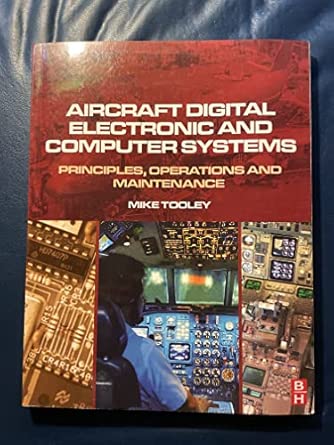
Butterworth-Heinemann s Aircraft Engineering Principles and Practice Series provides students, apprentices and practicing aerospace professionals with the definitive resources to advance your aircraft engineering maintenance studies and career.
This book provides an introduction to the principles of aircraft digital and electronic systems/communications and navigation systems. It is written for anyone pursuing a career in aircraft maintenance engineering or a related aerospace engineering discipline, and in particular will be suitable for those studying for licensed aircraft maintenance engineer status. The book systematically outlines modules 5 / 11 and 13 Part-66 of the EASA syllabus. It is ideal for anyone studying as part of a EASA and FAR-147 approved course in aerospace engineering.
The perfect blend of academic and practical information for aircraft engineering maintenance
Delivers the essential principles and knowledge needed by Aircraft Certifying Mechanics, Technicians and Engineers for Part-66 qualification
Coverage includes X Y Z
Comprehensive and accessible, with self-test questions, exercises and multiple choice questions to enhance learning for both independent and tutor-assisted study
All the necessary mathematical, electrical and electronic principles are examined clearly and in-depth, meeting the requirements of Part-66 modules, Aerospace Engineering City and Guilds modules, EDEXCEL National Units, elements of EDEXCEL Higher National Units, and a Foundation Degree in aircraft maintenance engineering or a related discipline.
OTHER BOOKS IN THE SERIES
Aircraft Engineering Principles (modules 1, 2, 4, 4 and 8 of Part-66) 075065015X
Aircraft Maintenance Practice (due May 2007) (modules XYZ)
Aircraft Digital and Electronic Systems (module 5)
Aircraft Communications and Navigation Systems (modules 11 and 13)
From the Back Cover
(DRAFT) Butterworth-Heinemann s Aircraft Engineering Principles and Practice Series provides students, apprentices and practicing aerospace professionals with the definitive resources to advance your aircraft engineering maintenance studies and career.
Delivers the essential principles and knowledge base required by licensed aircraft engineers
following EASA Part-66 qualification routes. The book provides systematic coverage of Module 5 as well as essential underpinning knowledge for Modules 11 and 13 of the EASA Part-66 syllabus. The book is also valuable for those following BTEC awards in aerospace engineering as well as air force personnel and Airframe and Propulsion (A&P)Mechanics in the US.
Comprehensive and accessible, with self-test questions, exercises and multiple choice questions to enhance learning for both independent and tutor-assisted study
Accompanied by on-line resources and an online image bank for use in lecture presentations and
in teaching materials.
The Aircraft Engineering Principles and Practice Series provides students, apprentices and practicing aerospace professionals with the definitive resources to advance their aircraft engineering maintenance studies and career.
This book provides an introduction to the principles of communications and navigation systems. It is written for anyone pursuing a career in aircraft maintenance engineering or a related aerospace engineering discipline, and in particular will be suitable for those studying for licensed aircraft maintenance engineer status as part of an EASA or FAR-147 approved course or taking City and
Guilds aeronautical engineering courses, EDEXCEL National Units, EDEXCEL Higher National
Units or a Degree in aircraft engineering.
About the Author
Mike Tooley is a technical author and consultant. He was formerly Vice Principal at Brooklands College in Surrey, England, where he was responsible for the delivery of learning to over 10,000 Further and Higher Education students increasingly by flexible, open and on-line distance learning. Mike is the well-known author of several popular engineering and related text books, including widely adopted course texts for BTEC, GCE A-level and GCSE qualifications in Engineering. Mike’s hobbies include astronomy, amateur radio, aviation, computing and electronic circuit design and construction.
 Wow! eBook