Wow! eBook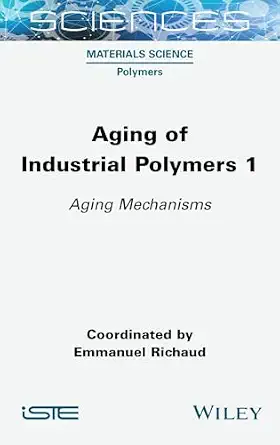
Aging of Industrial Polymers 1: Aging Mechanisms
Author(s): Emmanuel Richaud
- Publisher: Wiley-ISTE
- Publication Date: November 12, 2025
- Edition: 1st
- Language: English
- Print length: 336 pages
- ISBN-10: 1789451892
- ISBN-13: 9781789451894
Book Description
As a result, users need to consider the maximum duration of use during which these materials will retain acceptable levels of properties. This questioning is even more crucial as it responds to societal requirements linked to limiting end-of-life waste flows and preserving the resources necessary for their production.
Editorial Reviews
From the Back Cover
Preface ix
Chapter 1. Historical Abel-Gontcharoff Polynomials 1
1.1. Abel identity 1
1.2. Abel polynomials and expansions 2
1.3. Gontcharoff contribution 4
1.4. Increased recognition 8
1.5. A first meeting problem 10
1.6. A final epidemic outcome 13
1.7. A goodness-of-fit test 16
1.8. Extension to pseudopolynomials 19
Chapter 2. Abel-Gontcharoff Pseudopolynomials 21
2.1. General framework: D, E, F,Δ 21
2.2. Copies Ε and standard families 24
2.3. An integration operator Iu 30
2.4. A-G pseudopolynomials Gn( |U) 32
2.5. Expansions of A–G type 37
2.6. A shift operator Sa 42
2.7. A multiplication operator Mλ 46
2.8. Shift invariance property 48
Chapter 3. General Theory and Explicit Results 55
3.1. Return to the shift invariance 55
3.2. The higher dimensional case 66
3.3. Calculation formulas for ¯Gn( |U) 71
3.4. Geometric or affine form for U 80
3.5. Extension to special sequences ui = {ui,j} 87
3.6. When D is the set of integers 93
Chapter 4. Further Results and Properties 97
4.1. A related basic family E(b) 97
4.2. Upper and lower bounds for Gn( |U) 102
4.3. Short visit to the A–G type series 111
4.4. Bilinear forms and biorthogonality 116
4.5. An alternative generalization 119
Chapter 5. Multi-index A–G Pseudopolynomials 129
5.1. Key definitions and expansions 129
5.2. Explicit formulas for Gn1,n2( |U) 132
5.3. Multivariate case Gn1,n2( |U(1), U(2)) 136
5.4. Integral multivariate representation 146
5.5. Special case of A–G polynomials 149
Chapter 6. Randomizing A-G Pseudopolynomials 153
6.1. How to integrate stochasticity? 153
6.2. With ui partial sums of i.i.d. variables 155
6.3. Multivariate additive extension 165
6.4. With ui partial products of i.i.d. variables 170
6.5. Multivariate multiplicative extension 173
6.6. Additive case for exponential functions 176
Chapter 7. First Meeting Level with a Lower Boundary 183
7.1. Return to a classical Poisson process 183
7.2. For a compound Poisson process 186
7.3. Related first passage problems 190
7.4. With the number of Poisson jumps 193
7.5. For a linear birth process with immigration 196
7.6. Extension allowing multiple births 201
7.7. For a nonlinear birth process 204
Chapter 8. Less Standard First Meeting Models 211
8.1. Compound Poisson process with a renewal process 211
8.2. Linear birth process with a renewal process 214
8.3. Nonlinear death process with a birth process 217
8.4. Binomial process with a lower boundary 221
8.5. For a compound binomial process 224
8.6. Compound binomial process with a renewal process 226
Chapter 9. Martingales and A–G Pseudopolynomials 229
9.1. Motivation via damage-type models 229
9.2. Unified treatment by A–G pseudopolynomials 232
9.3. Reed–Frost multipopulation epidemic 235
9.4. Nonlinear death process 237
9.5. Combined general and fatal epidemics 241
9.6. Time-dependent bivariate death process 246
Chapter 10. Towards a Non-homogeneous Theory 255
10.1. A non-stationary compound Poisson process 255
10.2. A compound Poisson random field 265
References 277
Index 281
About the Author
Emmanuel Richaud is Professor in Arts et Métiers Sciences and Technologies, and Researcher in the Process and Engineering in Mechanics and Materials lab (PIMM), France. His research focuses on predicting the service life of polymer materials and composites.