 Wow! eBook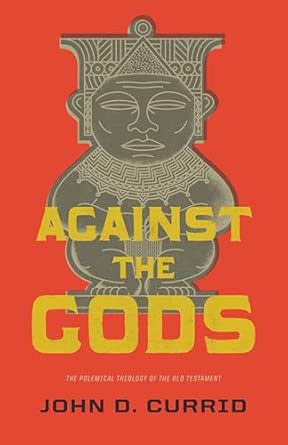
Against the Gods: The Polemical Theology of the Old Testament
Author(s): John D. Currid (Author)
- Publisher: Crossway
- Publication Date: 31 Aug. 2013
- Language: English
- Print length: 160 pages
- ISBN-10: 1433531836
- ISBN-13: 9781433531835
Book Description
Did the Old Testament writers borrow ideas from their pagan neighbors? And if they did, was it done uncritically? A respected Old Testament scholar and archaeologist engages with this controversial question by carefully comparing the biblical text to other ancient Near Eastern documents. Well-researched and thoughtfully nuanced, Currid aims to outline the precise relationship between the biblical worldview and that of Israel’s neighbors.
Editorial Reviews
Review
Review
“A clearly written account of a centrally important issue―the influence (or not) of ancient Near Eastern thought upon Old Testament writers. John Currid’s books and commentaries have proven invaluable, and in this additional volume, his thorough research, theological acumen, and nuanced argumentation makes it an essential requirement for ministers, theological students, and serious students of Scripture. This is an invaluable aid in furthering our understanding of the Old Testament and a loud affirmation of the Bible’s utter trustworthiness and inerrancy. A marvelous book.”
―Derek W. H. Thomas, Chancellor’s Professor of Systematic and Pastoral Theology, Reformed Theological Seminary; Teaching Fellow, Ligonier Ministries
“This is a splendid introduction to the use that the Old Testament makes of the religious ideas of Israel’s ancient neighbors. Currid compares the biblical accounts of creation and the flood with the versions from neighboring cultures and shows how the Bible puts down and rejects the theological ideas of Babylon, Egypt, the Hittites, and the Canaanites. This process, which Currid terms ‘polemical theology’, serves to demonstrate the unique sovereignty of the God of Israel. This is a very positive approach to the issues raised by the extrabiblical parallels and is greatly preferable to seeing the parallels as showing the Bible as simply borrowed pagan ideas and myths.”
―Gordon Wenham, Emeritus Professor of Old Testament, University of Gloucestershire, United Kingdom
“In this vital work John Currid presents an enormously useful approach to understanding the relationship of the Old Testament to the literature and thought of Israel’s ancient Near Eastern neighbors. This book is certainly a must read for any Old Testament scholar, yet it also provides a relevant and readable introduction for every student of Scripture.”
―David W. Chapman, Professor of New Testament and Archaeology, Covenant Theological Seminary; author, Ancient Jewish and Christian Perceptions of Crucifixion
“A rising influential voice in Old Testament studies is asserting that the biblical worldview, while monotheistic, often parallels and at times pirates with minimal discrimination the pre-enlightened religious ideas and rituals of ancient Israel’s neighbors. In contrast, John Currid persuasively demonstrates in Against the Gods that the Bible’s tendency is not to appropriate but to dispute and repudiate pagan myths, ideas, identities, and customs. This important introduction to Old Testament polemical theology provides a balanced corrective to many current comparative studies.”
―Jason S. DeRouchie, Research Professor of Old Testament and Biblical Theology, Midwestern Baptist Theological Seminary and Spurgeon College
“If you’re like me, you need to know a lot more about biblical backgrounds and how to think about them. John Currid’s Against the Gods is a great place to start.”
―James M. Hamilton Jr., Professor of Biblical Theology, The Southern Baptist Theological Seminary; author, God’s Glory in Salvation through Judgment
About the Author
John D. Currid (PhD, University of Chicago) is the Carl W. McMurray Professor of Old Testament at Reformed Theological Seminary. He is currently an adjunct faculty member at the Jerusalem Center for Biblical Studies in Jerusalem, Israel, and serves as project director of the Bethsaida Excavations Project in Israel (1995-present). He lectures and preaches worldwide.
Excerpt. © Reprinted by permission. All rights reserved.
Against the Gods
Polemical Theology of the Old Testament
By John D. Currid
Good News Publishers
Copyright © 2013 John D. Currid
All rights reserved.
ISBN: 978-1-4335-3183-5
Contents
Prologue,
1 A Brief History of Ancient Near Eastern Studies,
2 The Nature of Polemical Thought and Writing,
3 Genesis 1 and Other Ancient Near Eastern Creation Accounts,
4 Ancient Near Eastern Flood Accounts and the Noahic Deluge of Genesis 6–9,
5 Joseph, the Tale of the Two Brothers, and the “Spurned Seductress” Motif,
6 The Birth of the Deliverer,
7 The Flights of Sinuhe and Moses,
8 Who Is “I Am that I Am”? Exodus 3 and the Egyptian Book of the Heavenly Cow,
9 The Rod of Moses,
10 The Parting of the Waters of the Red Sea,
11 Canaanite Motifs,
CHAPTER 1
A Brief History of Ancient Near Eastern Studies
Ancient Near Eastern study today is a highly developed discipline that includes much modern technology, with computer analysis and data organization as dominating forces. Obviously,s this has not always been the case because at its inception in the beginning of the nineteenth century no such tools were available. As we will see, the first researchers in the discipline were those who discovered unknown languages and those who deciphered them. In reality, the serious examination and study of the cultures of the ancient Near East are relatively recent phenomena. The field of study is barely two hundred years old. Presently, the discipline is thriving, becoming specialized, and the amount of information is exploding. How did such a development occur in a mere two-hundred-year period? How did the discipline evolve into what it is today? This chapter will attempt to do two things: first, it will provide a cursory outline of the history of ancient Near Eastern studies and, second, it will briefly consider the relationship of that field to the field of biblical studies.
The Beginnings of Research in the Ancient Near East (1798–1872)
Prior to 1798, the world’s knowledge of the history of the ancient Near East was principally derived from the Bible and from some early Greek writers who preserved some aspects of it in their own histories. One of the more important of these historians was Herodotus, who lived in the fifth century BC. He introduced his history with a famous statement:
I, Herodotus of Halicarnassus, am here setting forth my history, that time may not draw the color from what man has brought into being, nor those great and wonderful deeds, manifested by both Greeks and barbarians, fail of their report, and, together with all this, the reason why they fought one another.
One of Herodotus’s primary goals in writing a history was to give explanation and understanding to the hostilities between the Greeks and the Persians that occurred in the first half of the fifth century BC. Part of his work included some information about the histories of Egypt, Babylon, Assyria, Phoenicia, and other areas of the ancient Near East. Much of his testimony came from oral tradition that was provided by contemporary natives of the fifth century BC, such as the priests of Egypt. The trustworthiness of Herodotus’s history is a matter of raging debate: to some he is “the father of history,” and to others he is “the father of lies.” No matter, the evidence of the history of the ancient Near East prior to the nineteenth century was paltry.
Archaeology was of little help before the nineteenth century in providing evidence for our understanding of the ancient Near East. The field of archaeology was in existence before that century; modern fieldwork had begun with organized digs at Herculaneum, located on the Bay of Naples, in AD 1738:
Tunnels dug at Herculaneum led to the recovery of magnificent statuary now housed in the Naples Museum. Karl Weber drew some very accurate architectural plans during these early excavations. The digs were eventually suspended at Herculaneum because of the great problem of having to chop through meters of volcanic residue that covered the site.
Excavations at Pompeii soon followed, beginning in 1748. The first buildings to be excavated included “the smaller theatre (or Odeon, 1764), the Temple of Isis (1764), the so-called Gladiator’s barracks (1767), and the Villa of Diomedes outside the Herculaneum Gate (1771).”
Systematic archaeological work in the Near East, however, did not begin until the turn into the nineteenth century. The first great stride in the field was in Egyptian research. In 1798 Napoleon invaded Egypt. He brought with him a scientific expedition of scholars, architects, and draftsmen whose primary purpose was to survey the ancient monuments of Egypt. The account of their findings was published in a series of tomes, from 1809–1829, titled Description de l’Egypte. This exploration was important because Egypt was the first ancient land of the Near East rediscovered in modern times: it opened up the eyes of the West to a vast ancient civilization. When Napoleon’s army gathered at the base of the pyramids to engage the Mameluke army in battle (July 21, 1798), Napoleon said to his troops, “Soldiers! From atop these pyramids, fifty centuries look down upon you!” This message was not merely encouragement for the French expeditionary force; it was intended for all Europe.
In regard to the future of Egyptian archaeology, Napoleon’s expedition made a most important discovery: the Valley of the Kings. From the Eighteenth–Twentieth Dynasties, which is the New Kingdom period of Egyptian history (c. 1550–1070 BC), the Egyptian rulers at Thebes built for themselves royal tombs on the west side of the Nile River. The Valley of the Kings contains more than sixty tombs, although not all of them belong to royalty. This area, of course, became a central spot for excavation work beginning in the middle of the nineteenth century and continuing today. The most famous discovery here was the tomb of Pharaoh Tutankhamen by the archaeologist Howard Carter in 1922.
The reality is that no real advances could be made until the hieroglyphic language was deciphered, which leads us to consider the most significant find of the Napoleonic excursion: the Rosetta Stone (1799):
It proved to be invaluable because it was the key to unlocking ancient Egyptian hieroglyphics, a picture script unutilized for over fourteen hundred years. Dating to the time of King Ptolemy V (204–180 BC), the Rosetta Stone is inscribed in three scripts: demotic, Greek, and hieroglyphs. The Greek proved to be a translation of the ancient Egyptian language on the stone.
The English physician Thomas Young (1819) and the French philologist Jean-François Champollion (1822) performed linguistic work on the stone, and they were able to decipher the hieroglyphic language. The cracking of the language was an important step. As Andrews comments, it “marked the beginning of the scientific reading of hieroglyphs and the first step toward formulation of a system of ancient Egyptian grammar, the basis of modern Egyptology.” Thus, this early find by the Napoleonic expedition proved to be one of the greatest discoveries ever as it opened up the world of ancient Egypt.
The decipherment of hieroglyphs not only led to the discovery of ancient Egypt as a highly civilized culture worthy of investigation; it was also seen as important for the study of the Old Testament. For example, the work of Champollion soon bore fruit with the translation of a monumental triumphal relief on the Bubastite Portal of the main temple of Amon at Karnak. The relief provides striking verification of the biblical account of Shishak’s invasion of Judah and Israel in the tenth century BC (see 1 Kings 14:25–26 and 2 Chron. 12:2–4).
Archaeological work also began in Mesopotamia in the first half of the nineteenth century. Georges Roux comments:
But in 1843 Paul Emile Botta, Italian-born French consul in Mosul, started at Khorsabad the first archaeological excavations in Iraq, discovered the Assyrians and opened a new era. Almost at once (1845) an Englishman, Sir Henry Layard, followed his example at Nimrud and Nineveh, and soon a number of tells were excavated.
Based on these excavations, scholars began to reconstruct the history of Mesopotamia, including the lands of Assyria and Babylonia. In this early period of discovery, Mesopotamia yielded many more monuments and inscriptions relevant to the history of the Old Testament than did Egypt. For instance, the annals of Sargon II were found at this time, and the king called himself “the conqueror of Samaria and of the entire country of Israel.” In these same annals, Sargon II says that he deported 27,290 upper-class citizens from Israel and replaced them with peoples from other nations. He made Israel an Assyrian province, placed a governor over it, and exacted heavy tribute from the inhabitants. Thus Israel, the northern kingdom, met its end and ceased to exist. The annals of Sargon II provide helpful information about this important period.
For the scholarship of this time, there was a general sense of innocent discovery. Certainly the researchers recognized some problems with harmonization of ancient Near Eastern history and biblical history, but there does not appear to have been a dominant hermeneutic of suspicion in the academy. When, for example, the influential Society of Biblical Archaeology was founded in 1870, one of the founding members, Samuel Birch of the British Museum, made the following remarks to the first official meeting of the society:
It is true that these results have not been obtained without difficulties. There has been some conflict between Assyrian and Jewish history, and although Assyrian scholars, dealing with the special subject of Assyria, naturally lean with favour to the information monuments of Nineveh afford, it is by no means sure that the Assyrians, especially in speaking of foreign nations, may not have recorded errors. As the research advances, the difficulty of reconciling the chronology of the Assyrians and the Jews will melt away before the additional monuments that may be acquired. There is nothing to alarm the exegetical critic in the slight discrepancies that always present themselves in the world’s history when the same fact is differently recorded by the actors in some national struggle.
Although Birch may be accused of naivete, in reality the most that can be said about him with certainty is that he was not prescient. For indeed, right around the corner — in fact, in an article just about to be published in the journal of Birch’s own society — George Smith announced that he had discovered an Assyrian account of the flood. Everything was about to change.
The Period of Suspicion Begins (1873–1905)
Although we will deal with the ancient Near Eastern flood accounts in chapter 4 of this work, it is important to mention the discovery of the Assyrian flood story because it is a watershed event in the history of ancient Near Eastern studies. Smith began his report with the following statement:
A short time back I discovered among the Assyrian tablets in the British Museum, an account of the flood; which, under the advice of our President, I now bring before the Society.
After translating and commenting on the Assyrian text of the flood, Smith concluded the following:
In conclusion I would remark that this account of the Deluge opens to us a new field of inquiry in the early part of Bible history. The question has often been asked, “What is the origin of the accounts of the antediluvians, with their long lives so many times greater than the longest span of human life? Where was Paradise, the abode of the first parents of mankind? From whence comes the story of the flood, of the ark, of the birds?” Various conflicting answers have been given to these important questions, while evidence on these subjects before the Greek period has been entirely wanting. The cuneiform inscriptions are now shedding a new light on these questions, and supplying material which future scholars will have to work out.
This publication received immediate scholarly response, and as Alexander Heidel points out, “it created a tremendous enthusiasm throughout Europe and gave a great impetus to the study of cuneiform inscriptions in general.”
Many scholars of the time concluded that the Hebrew account of the flood was directly dependent on the earlier Mesopotamian texts. It is true that the Mesopotamian flood stories predate the Old Testament by centuries. So from a simple chronological consideration, these scholars inferred that the biblical flood account evolved from the Mesopotamian story. Friedrich Delitzsch is a prime example of that mind-set because he “drew sharp attention to the Babylonian ingredient in Genesis, and went on to conclude that the Bible was guilty of crass plagiarism.” S. R. Driver, when considering ancient Near Eastern creation accounts, argued “that we have in the first chapter of Genesis the Hebrew version of an originally Babylonian legend respecting the beginning of all things.”
Scholars of the later nineteenth–early twentieth centuries did not believe that the Hebrew writers merely borrowed Mesopotamian myths, leaving it at that. No, indeed; there was a second step, and that was that the biblical authors had stripped the Mesopotamian accounts of pagan elements. In other words, they had gone to great lengths to sanitize and “Yahwize” the myths. Friedrich Delitzsch, for instance, said, “the priestly scholar who composed Gen. chap. i endeavoured, of course, to remove all possible mythological features of this creation story.” Driver concluded that “no archaeologist questions that the Biblical cosmogony, however altered and stripped of its original polytheism is, in its main outlines, derived from Babylonia.”
Although they believed that the biblical accounts of creation and the flood were stripped of their original polytheism and of many other pagan elements, many of these early scholars believed that some remnants of those elements remained in the text. A classic example is the contention that the word tehom (“deep”) in Genesis 1:2 is a remnant of Mesopotamian myth. Supposedly it relates to Tiamat, the goddess of the deep sea who was a foe of the creator-god Marduk. In the Mesopotamian account, Marduk had to vanquish Tiamat in order to bring about creation. Delitzsch commented,
The priestly author that wrote the first chapter of Genesis took infinite pains to eliminate all mythological features from his story of the creation of the world. But since his story begins with the gloomy, watery chaos which bears precisely the same name as Tiamat, namely Tehom, … it will be seen that there is a very close relationship between the Biblical and the Babylonian story of the creation of the world.
This connection between the two accounts has become accepted as fact in much literature of the twentieth–twenty-first centuries, and has almost reached the status of a sacred cow in some quarters.
New Horizons (1906–1940)
Discovery of other cultures of the ancient Near East and their literatures came more slowly than in the cases of Egypt and Mesopotamia. Canaanite culture, for example, was known primarily from the Bible prior to the discovery of the Ugaritic texts at Ras Shamra beginning with the excavations there in 1929 and following. The parallels between the Old Testament and the literature of Ras Shamra are ubiquitous. I will not consider them at this point because the final chapter of this book is a study of the relationship between Ugarit and Israel.
An important year in ancient Near Eastern studies was 1906, when excavations began at the Hittite city of Bogazkoy (Hattusa). There archaeologists discovered thousands of inscriptions in several languages that make it possible for historians to piece together the basic history and culture of the Hittites. Hugo Winkler, the chief archaeologist, uncovered the royal Hittite archives, in which approximately 10,000 clay tablets were found. Some of these were written in the Akkadian language, but most were in Hittite. Within ten years of its discovery, the Hittite language had been deciphered. The Oriental Institute of the University of Chicago started the Chicago Hittite Dictionary (CHD) project in 1975, and it has made great strides in formulating a complete dictionary of the Hittite language.
One factor that played a considerable role in nineteenth-century ancient Near Eastern studies was the desire of the investigators “of making discoveries that would throw light on biblical history.” That was no longer the case in the twentieth century, as researchers began studying cultures of the ancient Near East on their own merits and for their own sakes. The German excavations at Bogazkoy are an example of this latter trend. This shift does not mean, however, that the remains found at Bogazkoy did not shed light on the Old Testament, only that it was not a primary purpose of the investigation. For example, George Mendenhall did some groundbreaking work by demonstrating the striking parallels between the covenant forms in the Old Testament and the covenant-treaties found in the Hittite archives at Bogazkoy from the fifteenth–thirteenth centuries BC.
During this period, ancient Near Eastern studies were given a continuous supply of new literature as archaeologists uncovered major cuneiform archives. One of these came from the site of Nuzi, which was excavated between 1925 and 1933. Nuzi was a Hurrian administrative center located in modern northern Iraq, and the excavations revealed thousands of tablets dealing with the administration of the city. These documents covered a wide range of topics, including politics, religion, and law. Although not a goal of the excavations, the literature found at Nuzi does enlighten our understanding of biblical history. The Nuzi documents describe customs of the Hurrians that were similar to the practices of the early Hebrews such as Abraham, Isaac, and Jacob. In particular, they give a picture of inheritance rights, marriage practices, and adoption customs that parallel those in use during the patriarchal period of Israel’s history.
(Continues…)Excerpted from Against the Gods by John D. Currid. Copyright © 2013 John D. Currid. Excerpted by permission of Good News Publishers.
All rights reserved. No part of this excerpt may be reproduced or reprinted without permission in writing from the publisher.
Excerpts are provided by Dial-A-Book Inc. solely for the personal use of visitors to this web site.


