Wow! eBook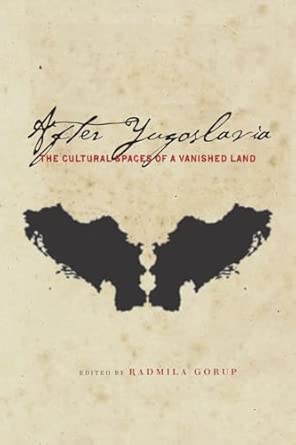
After Yugoslavia: The Cultural Spaces of a Vanished Land
Author(s): Radmila Gorup
- Publisher: Stanford University Press
- Publication Date: 12 Jun. 2013
- Edition: 1st
- Language: English
- Print length: 368 pages
- ISBN-10: 0804784027
- ISBN-13: 9780804784023
Book Description
The book brings together many of the best known commentators and scholars who write about former Yugoslavia. The essays focus on the post-Yugoslav cultural transition and try to answer questions about what has been gained and what has been lost since the dissolution of the common country. Most of the contributions can be seen as current attempts to make sense of the past and help cultures in transition, as well as to report on them.
The volume is a mixture of personal essays and scholarly articles and that combination of genres makes the book both moving and informative. Its importance is unique. While many studies dwell on the causes of the demise of Yugoslavia, this collection touches upon these causes but goes beyond them to identify Yugoslavia’s legacy in a comprehensive way. It brings topics and writers, usually treated separately, into fruitful dialog with one another.
Editorial Reviews
Review
“This volume is an important corrective to the literature that stresses the supposed cultural incompatibilities and tensions in the Balkans . . . Highly recommended.”―R. M. Hayden,
CHOICE“This collection brings together a remarkable roster of writers and scholars to consider the past, present, and future of the diverse yet closely interconnected cultural spaces that the dissolution of Yugoslavia left behind. There have been many attempts to explain the causes and character of Yugoslavia’s demise, but so far few have identified―let alone analyzed or interpreted―Yugoslavia’s legacy in such comprehensive, nuanced, and stimulating terms.”―Wendy Bracewell, University College London
From the Author
About the Author
Excerpt. © Reprinted by permission. All rights reserved.
After Yugoslavia
The Cultural Spaces of a Vanished Land
By Radmila Gorup
Stanford University Press
Copyright © 2013 Board of Trustees of the Leland Stanford Junior University
All rights reserved.
ISBN: 978-0-8047-8402-3
Contents
Contributors………………………………………………………xiAcknowledgments……………………………………………………xviiNotes on the Pronunciation of Proper Names and Words Given in Original
Spelling………………………………………………………….xixIntroduction Marijeta Bozovic………………………………………1Part I My Yugoslavia: Personal Essays………………………………..1 My Yugoslavia Maria Todorova……………………………………..232 Yugoslavia: A Defeated Argument? Vesna Goldsworthy………………….38Part II Histories and Common Culture…………………………………3 The Past as Future: Post-Yugoslav Space in the Early Twenty-First
Century Dejan Djokic………………………………………………554 What Common Yugoslav Culture Was, and How Everybody Benefited from It
Zoran Milutinovic………………………………………………….755 Discord la Concors: Central Europe in Post-Yugoslav Discourses Vladimir
Zoric…………………………………………………………….88Part III Legacies of Yugoslavia: Cultural Returns……………………..6 “Something Has Survived …”: Ambivalence in the Discourse About
Socialist Yugoslavia in Present-Day Slovenia Mitja Velikonja…………..1157 Vibrant Commonalities and the Yugoslav Legacy: A Few Remarks Gordana P.
Crnkovic………………………………………………………….1238 Zenit Rising: Return to a Balkan Avant-Garde Marijeta Bozovic………..135Part IV The Story of a Language……………………………………..9 Post-Yugoslav Emergence and the Creation of Difference Tomislav Z.
Longinovic………………………………………………………..14910 What Happened to Serbo-Croatian? Ranko Bugarski……………………16011 Language Imprisoned by Identities; or, Why Language Should Be Defended
Milorad Pupovac……………………………………………………169Part V Post-Film…………………………………………………..12 The Vibrant Cinemas in the Post-Yugoslav Space Andrew Horton………..18513 Marking the Trail: Balkan Women Filmmakers and the Transnational
Imaginary Meta Mazaj………………………………………………200Part VI The New National Literatures…………………………………14 Traumatic Experiences: War Literature in Bosnia and Herzegovina Since
the 1990s Davor Beganovit………………………………………….21915 Culture of Memory or Cultural Amnesia: The Uses of the Past in the
Contemporary Croatian Novel Andrea Zlatar-Violic……………………..22816 Cheesecakes and Bestsellers: Contemporary Serbian Literature and the
Scandal of Transition Tatjana Rosic…………………………………24117 Slovene Literature Since 1990 Alojzija Zupan Sosic…………………26518 The Palimpsests of Nostalgia Venko Andonovski……………………..273Part VII Return to the Provinces…………………………………….19 The Spirit of the Kakanian Province Dubravka Ugresil……………….289Notes…………………………………………………………….307Index…………………………………………………………….331
Excerpt
CHAPTER 1
My Yugoslavia
Maria Todorova
“My Yugoslavia” is my way of sharing with the ones for whom Yugoslaviawas an existential reality, their home for good or for bad, how a viewfrom the outside was shaped. While it is an external view, it is not necessarilyforeign: I would dare to say it is the view of an intimate stranger (or, lesspoetically, of a neighbor). This is not a research essay that pretends to addnew knowledge or novel analysis. What it does do is illustrate my scholarlyand personal engagements with Yugoslavia; it is a kind of Bildungs essay.
When I was a little girl, of the four borders of my country my favoritewas the one on the right side of the map: the eastern border, the BlackSea, where we went every summer on vacation. But I knew that on the leftside of the map there was a country called Yugoslavia, and I was positivelydisposed to it, because from there came the chocolates called Kra, whichtetkica Bozena would bring ever so often. She was a close family friend,born in Zagreb; she had moved to Sarajevo during the Second World Warbecause she could not stand the Germans, and there she met and marrieda Bulgarian. We grew up with her daughter, who now lives in Canada withher Bulgarian husband. But that was pretty much all. Like most Balkanpeople at the time (and I think this pattern is very gradually beginning tobe broken only in the past two decades), I was least of all interested in myneighbors. I had started school in Austria, then spent time in Germany,and later attended an English school; this is where my cultural interestslay. The one exception was Greece. I had been weaned, like many of mycontemporaries, on Greek mythology, and I came from a mixed Greek-Bulgarianbackground, so sometime in high school I started learningGreek. My interest in the country almost vanished, however, when I begandating Bulgarian boys, and my Greek grandmother told me solemnly thatI should never forget that I was a “daughter of Pericles.” I don’t remembermyself ever understanding the appeal of nationalism, but if ever there wasa potential for my developing some national pride, this was the dire endof it. On top of it came my interest in the Ottoman empire, and when Ientered university, I began studying Ottoman Turkish. My interests thusgravitated in a southeastern direction. When I first visited Istanbul, I instantlyfell in love with the city. I was aware that the people I was meetingthere, who were all wonderfully educated and cultivated, were not youraverage Turks, but this gave me enough ammunition to fight all the profoundanti-Turkish prejudices at home.
When the first Congress of Balkan Studies was convened, in Sofia in1966, I was still in high school. Coming from a historian’s household, I hadalready encountered such silver-haired scholars, who came to our housefrom all over the world. I would regularly fall in love with one or moreof them. Two in particular held my fancy for many years, both of themin their seventies: One, Anatolii Filipovich Miller, a prominent RussianOttomanist, who sported a watch that had been given him by Atatürk,was like my third grandfather. The other one, an Albanian, I saw in amore romantic light: Alex Buda, a historian and president of the AlbanianAcademy of Sciences, who had studied in Vienna in his youth and couldrecite Goethe by heart. As a result, Albania was for me the epitome of realintellectuals, and the few contacts I had later with Albanian academicsonly confirmed this belief. This is significant, as it inadvertently influencedmy first impressions of Serbian academics. At one of my earliest scholarlyconferences, when I was a kind of debutante, nervous at presenting mywork and at having left behind a husband with two tiny children for afew days, my colleague at the panel was a young Serbian academic. I hadclashed with him in the corridors, when he enlightened me with regardto my naïveté about Albanians, all of whom he believed were savage andbackward. Of course, my measure of Albania was Alex Buda. But it becameworse when, unsatisfied with my continuing naïveté, he asked mehow my husband and children were faring without their mother? Whatwere they eating? Canned food? No, I replied, I had actually preparedcooked meals that I had put in boxes in the deep freezer with a differentmenu for every day. That was already a crime. I heard a lecture about organicand freshly prepared food, and how he refused to eat anything butwhat his mother prepared for him from the farmer’s market. We parted,both of us firm in our negative impressions. For him, I was a naïve person(part of the postwar feminization of scholarship), and a failure as a mother,and my verdict of him was no less generous: he was a racist and a macho.To me this meant “Oriental.” So, I nested Orientalism in Serbia (avant lalettre) many years before I came to know Milica Bakic-Hayden, and manyyears before she had conceived of her felicitous and evocative concept. Inmy Balkan map, Turkey was Western (because of the handful of fascinatingintellectuals there), and Yugoslavia was Eastern. Even one of my earliestpositive encounters with Yugoslavia was mediated through Turkey. I musthave been nineteen, when, browsing in an antiquarian bookshop in Istanbul,I stumbled upon Milovan Dilas’s Conversations with Stalin (Stalinlekonusmalar, 1964), in Turkish, and bought it. It did not much improve myTurkish, but it certainly whetted my appetite to learn more about Tito andwhy a broader Balkan federation had not materialized.
My subsequent encounters with Serbian colleagues did not entirelydisabuse me of my first negative impression until quite later, although Iexcluded women from my harsh judgment. And even there, the beginningwas thorny. Olga Zirojevic, the great Ottomanist, whose book Carigradskidrum od Beograda do Budima u XVIi XVII veku (The Constantinople Roadfrom Belgrade to Buda in the Sixteenth and Seventeenth Centuries, 1976)I had long admired, approached me after one of my comments at a conferenceand told me that I was vrlo vredna. I was deeply mortified. Theliteral translation of vrlo vredna in Bulgarian is “exceedingly harmful”—ina word, a huge pest. Luckily, Olga saw me blush and gasp for air, and themisunderstanding was dispersed with lots of laughter, but it taught menever to arrogantly assume that I knew a language simply because it wasthe closest to my own. So when I did my next purchase of Yugoslav books, Imade sure that it was in the original. But it was still mediated: I bought IvoAndric’s Na Drini cuprija (The Bridge on the Drina) in the foreign-languagebookshop in Moscow. My real-life introduction to inflation I also owe toanother remarkable Serbian historian: the Ottomanist Bojanka DesanicLukac.We were in Hungary for a conference in the 1980s, and we had topay our registration fee “in currency”—three dollars, no national equivalent.So Bojanka opened her large purse and started rummaging through apile of banknotes, which turned out to be dinars, until at the very bottomof her purse she fished out the three precious green banknotes, exclaiming:”Ovo su pare [Here is the money].”
Nor were my impressions of Yugoslav males, especially Serbian ones,entirely negative. One of the finest (of the very few fine Bulgarian featuremovies) of the 1960s was a film adaptation of a novella by the great Bulgarianwriter Emilian Stanev, Kradetsit napraskovi (The Peach Thief). Thestory—set in the First World War—is about a POW camp in Tirnovo, inwhich a Serbian officer and the wife of the Bulgarian chief-of-garrison fallin love with each other. At the end, when the camp has to be relocated,he decides to say a last farewell, sneaking into the garden of his belovedtrying to bring her peaches. He is shot by the guards as a mere peach thief.It was a wonderful role—of the sophisticated, disillusioned, peace-loving,internationalist, and cosmopolitan Serb, contrasted with the priggish, disciplined,and boring Bulgarian military husband. The beautiful NevenaKokanova was in the leading female role, and the Serbian officer wasplayed by Rade Markovic, who for a brief time became the dream of manyBulgarian women. Maybe because this, my first encounter with Serbs, wasartsy, my first real-life one was very disappointing. It felt like a betrayal.I have to say, though, and this is my way of paying homage to one of thesweetest human beings I have ever encountered, that when I was alreadyin the United State and came to know closely the late and much missedMita Ðordevic, his warm and soft nature reminded me of the peach thief.
All of this is the stuff out of which stereotypes are made. Why am Itelling these unimportant stories without any seeming connection or purpose?Because they all shaped a perception or, rather, a stereotype, andbecause this is how stereotypes are formed. They revolve around true occurrences,but it is the blanket generalization that elevates them to a seeminglycoherent and, most often, dangerously sweeping and oversimplifiedpicture. Later, I learned that such stereotypes are shared. In the mid-1990s,when I was writing Imagining the Balkans at the Woodrow Wilson Centerin Washington, D.C., the journalist Liljana Smajlovic, a cofellow, told methat at one point she had lived in Algeria, where her mother, a doctor, wasposted for a period of time. When rambunctious Yugoslavs would go tothe beach with wine and beer, and were accosted there by the local police,they maintained that they were Bulgarians. Recently, I read Vesna Goldsworthy’swonderfully moving memoir Chernobyl Strawberries, in whichshe describes going to a bookstore near St. Paul’s Cathedral in London.I remember this very same bookstore from before 1989: it gave out freebooks to Eastern Europeans—mostly forbidden literature, but also usefuldictionaries, textbooks, and guides—and all you had to do was sign up ina pro forma book with your name and provenance, without being obligedto provide an identity. Vesna, upon picking up her volume of Solzhenitsyn(I believe), signed up as Bulgarian, just to be on the safe side. But this wasnot necessarily malicious. It displayed a certain kind of “cultural intimacy,”to use Michael Herzfeld’s notion, where you partake in the dirty linen ofyour group or a group you consider sufficiently close or well known.
Yugoslavia was the last Balkan country (outside of Albania, where Ihave never been) that I visited while still living in the Balkans. As a child,I had actually passed through it once with my family en route to Hungary,but I did not remember anything. But Yugoslavia was a favorite choice formany Bulgarians. The language was similar, there were often open bordermeetings (even in the days of the Cold War), and then there was Macedonia,the bleeding Bulgarian irredenta until the Second World War. Toconclude my section on personal reminiscences, I recall how recently Ialmost lost a good Serbian friend with my potentially hurtful comments.Countering the bitter complaint about the fate of the Kosovo monasteriesand what was the sacred symbolic center of Serbian national consciousness,I pointed out (obviously tactlessly): “You’ll get over it. The Bulgariansgot over Macedonia, but most importantly the Greeks got over Constantinople,and Constantinople is worth a couple of hundred Serbian monasteriesand Macedonia on top, and even I would not be able to get over thecity.” We are, however, still friends.
It was mostly because of Macedonia that I was demonstrably not interestedin Yugoslavia, since for many Bulgarians, and certainly for most ofmy historian colleagues, Macedonia was an obsession. I was sick of it anddid not want to have anything to do with it (in fact, Macedonia is the onlyone of the former Yugoslav republics that I have not been to). But apartfrom Macedonia (and that primarily in unofficial conversations), universitycourses actually gave me a fairly solid grounding in the history of the neighboringSouth Slavs. As undergraduates conforming to a curriculum stillowing a lot to the Humboldtian system we were drilled with an inordinateamount of ancient and medieval history. Apart from Bulgarian medievalhistory, I have passed exams in ancient Greece and Rome, Byzantine, Serbianmedieval history, Russian medieval history, and Western Europeanmedieval history. All these courses were remarkably devoid of any nationalistzeal. The same was true, more or less, for the modern period, but itdepended on the instructor. I happened to be exposed to professors of bothkinds. For example, the professor who gave the lecture course on modernBalkan history went against every cliché that would have been instilled inschool. Explaining the Treaty of San Stefano, for example, the cornerstoneof the idea of the modern Bulgarian state, he did not necessarily challengethe idea that it resurrected a Bulgarian state in its ethnic boundaries, sinceit actually did follow the borders of the Bulgarian Exarchate recognized bythe Sublime Porte. However, the professor accompanied this with a mapshowing that this new Bulgaria of 1878 was larger than the territories ofthe new kingdoms of Serbia and Greece combined. Here was a wonderfulillustration not only of clashing perspectives but of the conflict betweenthe principles of balance of power and self-determination. On the otherhand, his young assistant, who was writing a dissertation on the Cominternpolicy toward Macedonia, was of the opinion that Yugoslavia was an “artificialformation” that would inevitably disintegrate. I thought this was sillyat the time and I still think so, even as he seems to have been vindicatedby the latest developments. What is natural as opposed to artificial in theworld of politics, after all?
One of the most valuable graduate seminars I had at the Universityof Sofia was a seminar devoted to the history of the discipline. It was notexhaustive and there was little written on this subject at the time, but itprovided a sound framework that remained intact over the years, to befilled in with detail and nuance. It is here that I first learned about JovanCvijic and his major work La Péninsule balkanique (1918). This grand regionalsurvey was a paradigmatic work of geopolitical theory, drawing onthe conjunction of geomorphologic and geophysical analysis with humangeography and migrations, which bestowed a central political and strategicrole to “Greater Serbia” as ordained by geography and in the bestinterests of the West. Thus history was subordinated to a geopolitical andethno-cultural framework and the regional narrative was meant to buttressYugoslav nation building, where common racial characteristics overwrotedivergent historical and religious experiences.
While the turn of the twentieth century was generally characterized bythe radicalization of national discourses, it also saw the rise of nonnationalhistorical comparative methodologies, primarily among linguists, literaryscholars, and ethnographers. Historiography, to the extent that it venturedbeyond the national framework, later followed suit. The interwar periodsaw the institutionalization of Southeastern European studies in the wholeregion, and in this respect what was happening in Yugoslavia was crucial. In1934, a Balkan Institute was founded in Belgrade under the auspices of theKing of Yugoslavia. Alongside its research program, it had a regional geopoliticalagenda envisaged on the basis of Balkan solidarity. “Our patriotism,if it wants to be real, should be a Balkan patriotism,” was the programmaticpronouncement of the founders of the Belgrade Balkan Institute.Two scholars were pivotal in defining the new discipline of Balkanology:the linguists Petar Skok, a Croat, and the Serb Milan Budimir. As editorsof the Belgrade-based Revue internationale des études balkaniques, of whichonly three volumes were published between 1934 and 1938, they aimed atdemonstrating the commonality of Balkan societies through the comparativemethod of the nineteenth century. They related the new discipline toByzantinology, Egyptology, or to classical philology which studies togetherand in a comparative way Greek and Roman antiquity.
In their first editorial, a sui generis Balkanological manifesto, Skokand Budimir observed that Balkan studies “divided into national compartments,such as were constituted after the fall of the Ottoman Empire,researched, in fact, solely the parts of an organic whole.” Thus, “state particularismhas been duplicated with a scientific particularism.” They lamentedthat at present no scholar studies the common Balkan reality and pleadedthat “the time has come to contemplate the coordinating of national academicBalkan studies, to give them cohesion, and, above all, to orient themtowards the study of a Balkan organism that had constituted one wholesince the most distanced times of classical and pre-classical antiquity. Thisis the principal goal of the science that we have called Balkanology and towhich our journal is devoted.”
(Continues…)Excerpted from After Yugoslavia by Radmila Gorup. Copyright © 2013 by Board of Trustees of the Leland Stanford Junior University. Excerpted by permission of STANFORD UNIVERSITY PRESS.
All rights reserved. No part of this excerpt may be reproduced or reprinted without permission in writing from the publisher.
Excerpts are provided by Dial-A-Book Inc. solely for the personal use of visitors to this web site.