 Wow! eBook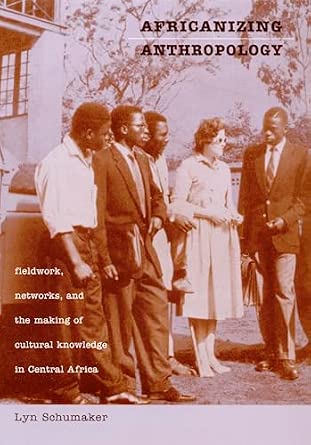
Africanizing Anthropology: Fieldwork, Networks, and the Making of Cultural Knowledge in Central Africa
Author(s): Lyn Schumaker (Author)
- Publisher: Duke University Press
- Publication Date: 12 July 2001
- Edition: Illustrated
- Language: English
- Print length: 277 pages
- ISBN-10: 0822326787
- ISBN-13: 9780822326786
Book Description
Schumaker shows how local conditions and local ideas about culture and history, as well as previous experience of outsiders’ interest, shape local people’s responses to anthropological fieldwork and help them, in turn, to influence the construction of knowledge about their societies and lives. Bringing to the fore a wide range of actors-missionaries, administrators, settlers, the families of anthropologists-Schumaker emphasizes the daily practices of researchers, demonstrating how these are as centrally implicated in the making of anthropological knowlege as the discipline’s methods. Selecting a prominent group of anthropologists-The Manchester School-she reveals how they achieved the advances in theory and method that made them famous in the 1950s and 1960s.
This book makes important contributions to anthropology, African history, and the history of science.
Editorial Reviews
Review
–George W. Stocking Jr. “American Historical Review”
“Lyn Schumaker’s splendid history provides a balanced and sensitive account of the growth of a particular form of the discipline.”–Peter Fry “TLS”
“Schumaker’s work, which takes a completely different approach to the study of anthropology, is by far the most revealing account I have ever read, not only of the Rhodes-Livingstone Institute but of anthropology in Africa. Both highly innovative and extremely convincing, it sets new standards for Southern African intellectual history.”–Terence Ranger, University of Zimbabwe
From the Back Cover
About the Author
Lyn Schumaker is Wellcome Research Lecturer at the Wellcome Unit for the History of Medicine, University of Manchester.
Excerpt. © Reprinted by permission. All rights reserved.
Africanizing Anthropology – CL
By Lyn Schumaker
Duke University Press
Copyright © 2001 Lyn Schumaker
All right reserved.
ISBN: 9780822326786
Chapter One
“The Water Follows the Stream”
Historical Ethnography, History of Anthropology, and Indigenous Anthropologists
Matshakaza Blackson Lukhero grew up in Feni, the Ngoni paramount chief’s village in eastern Northern Rhodesia (now Zambia). While still a child in 1935, he saw the British anthropologist Margaret Read, while she was doing a short period of fieldwork in Northern Rhodesia to supplement her main work on the Ngoni of Nyasaland (now Malawi). She wore leather riding breeches, he recalled, and, because she did not speak the local language and stayed such a short time in Feni, she was “not close to the people.” Read was his first anthropologist.
Recruited for war service in 1941 when only fifteen, Lukhero served in Kenya in the Seventh Northern Rhodesia Field Ambulance Corps, trained in first aid by Desmond Clark, archeologist and first curator of the Rhodes-Livingstone Museum. Clark couldn’t pronounce “Matshakaza” and so he nicknamed the young African “Matchbox,” a name that didn’t survive Lukhero’s war service. Back in Feni in 1946, Lukhero became an interpreter for a newly arrived anthropologist, Max Marwick, a Colonial Social Science Research (CSSRC) fellow attached to the Rhodes-Livingstone Institute (RLI). Marwick soon left the Ngoni to do fieldwork on the Chewa people. J. A. Barnes, an RLI research officer, then arrived in the Ngoni area and hired Lukhero as interpreter and research assistant for the duration of his fieldwork. With only a few breaks after that, Lukhero continued to work for the RLI and its anthropologists or former anthropologists in rural and urban fieldwork until 1966, a career as research assistant that spanned twenty years and included research in three countries.
From the later 1960s through the 1970s Lukhero worked for the copper mines on aptitude testing in the newly independent Zambia, taking up anthropology again in the 1980s when he became involved with the revival of the Ngoni Nc’wala traditional ceremony and wrote a book on it. When I met him in 1991, he was doing fieldwork for a second book on Ngoni chiefly succession. He answered my questions about the RLI fieldwork in which he had participated, as well as assisting my own interviews with people who had been Barnes’s informants and attempting to train me in what he called “the RLI way” of fieldwork. It was during my second interview with him that I asked about the names local people gave to anthropologists and their assistants. According to Lukhero, people usually referred to Barnes as “one who learned (or studied) people’s traditions.” Lukhero himself they gave the nickname “Manzi okhonkha mkolo-the water follows the stream.” “I am following Barnes’s footsteps,” he explained.
Lukhero did not say what he thought of this nickname. It suggests a dependency and loyalty-of African assistant to white anthropologist-that we are not comfortable acknowledging today. At the same time it describes, as well as contradicts, Lukhero’s account of his work for Barnes and later research for his own books. In his description, “following” amounted to his leading Barnes to the people, introducing him, interpreting for him, teaching him the language, discussing local traditions, and afterward talking to people about their reactions to the anthropologist and assuring them Barnes was not a spy.
On the other hand, Lukhero also sometimes followed Barnes as they worked in the field together, learning (and helping to develop) “the RLI way” of doing research. Later, he continued asking questions and collecting material for the anthropologist after Barnes had left the field. And in subsequent years Lukhero followed the RLI way after his own fashion, using its style of titling for one of his books, claiming professional anthropological skills as a way of legitimating his part in the revival of the Nc’wala ceremony, and, especially, using the word “fieldwork” for his activities, something indigenous anthropologists do not generally do.
In the following chapters I treat Lukhero’s nickname as suggestive in ways that its original speakers may not have intended, working with its different possibilities as a kind of thought experiment: how does the water follow the stream, or the research assistant the anthropologist? Indeed, does the water follow the stream-isn’t it the water that makes the stream, or the assistant who shapes the anthropologist’s knowledge? And how much does Africa itself-the land that the water flows through-determine the course of the stream, the anthropology that results? Here is a research agenda for telling the history of the RLI as a story of the coproduction of cultural knowledge. In other words, how did Africans and the African context shape the work of anthropologists there?
From History of Anthropology to Historical Ethnography
The Rhodes-Livingstone Institute, founded in 1937 in Northern Rhodesia, was the first social science research institute in Africa. Until that country gained its independence as Zambia in 1964, the RLI carried out a coordinated research program involving several teams of anthropologists and their African assistants. The Institute also coordinated research in Nyasaland and Southern Rhodesia-the other two countries of what was to become, between 1953 and 1963, the British Central African Federation. From 1949 when its second director, Max Gluckman, became chair of the University of Manchester’s new department of sociology and social anthropology, the RLI acted as the locus of fieldwork for an evolving school of anthropology, later known as the Manchester School. The Manchester School became a major force in British social anthropology in the 1950s and 1960s and exerted a strong influence outside the British scene, as well.
This book is not a history of anthropology in the usual sense. Such a history of the Manchester School would focus on its place in the story of British functionalism, as in Kuper’s Anthropology and Anthropologists (1983), or on its innovations in theory and method, as in Werbner’s article, “The Manchester School in South-Central Africa” (1984). This book does not focus on the intellectual genealogy of theories or the intellectual connections of famous anthropologists that such a history would entail. Instead, this history focuses on the cultural and social factors in the particular historical situation of the Manchester School that were as important as the intellectual factors. It attempts to discover people, ideas, and practices that, though important at the time, have left no recognized disciplinary descendants. And it reveals the influences on anthropology that came from nonscientific activities that shared a location with it, whether in the fieldwork site, at the institute headquarters, or in the daily domestic life of the anthropologists in Northern Rhodesia. Thus, this history explores in detail the often acknowledged but rarely analyzed role played by colonial settler culture and mission and administrative practices in shaping the work of anthropologists.
This book places anthropology and anthropologists in multiple contexts-social, cultural, political, historical, and material-and discusses the forces that have mutually shaped both anthropology and the world around it. Social histories of this kind can provide a richer understanding of the processes involved in doing anthropology, useful to anthropologists as well as historians. The social context dealt with in this kind of history can be construed very broadly, as in Stocking’s Victorian Anthropology (1987) and Kuklick’s The Savage Within (1991), or more narrowly and with greater focus on the discipline’s more immediate academic context and social and intellectual networks, as in Stocking’s After Tylor (1995) and Vincent’s Anthropology and Politics (1990). Here I deal with the multiple contexts of anthropology, but center these on Africa, where the fieldwork of the Manchester School began.
The field often appears as an important context in social histories of anthropology. Rarely, however, have scholars taken the fieldsite as the central context for a social history of anthropology, as this book will do. Such an approach requires a different type of chronology of events relevant to the evolution of the Manchester School as an anthropological research school and, indeed, requires an altogether different construction of its identity. Use of the name “Manchester School” focuses attention on the British metropolitan character of a group of anthropologists famous for specific advances in theory and method.
Instead, this study takes the RLI as its focus-a very different and more Africa-centered phenomenon. Although it has resonances of institutional and colonial history, the name “Rhodes-Livingstone Institute” captures many of the local social and cultural factors and the nonanthropological personnel and perspectives that would be neglected in a metropolitan-centered history. The comments of Zambians on this name today reveal a rich local history quite different from the Manchester School’s better-known metropolitan and disciplinary history. The name resulted from early fund-raising activities aimed at local white benefactors interested in the upcoming Rhodes Jubilee and Livingstone Centenary in 1940. Although the fundraisers did not consult African opinion, Africans may have seen the name as neutral, balancing the imperialist reputation of Rhodes with the more positive reputation Livingstone enjoyed at the time.
To tell the history of anthropology with the field as the central context, I have used approaches from the history and sociology of science and technology. First, I have examined anthropology from the perspective of the history of the field sciences-those sciences that use fieldwork instead of, or in addition to, laboratory work. This approach draws attention to the field itself; to the material side of fieldwork; and to the infrastructure, equipment, and work organization necessary to conduct scientific work in a particular fieldsite. It also allows one to relate scientific activities to nonscientific activities occurring in the same fieldsite, such as the sharing of practices between colonial administrators and anthropologists, one of the subjects to be considered in this study. Ideally a field science perspective allows one to examine the relationship between the material culture and technology of a science and the view of the field that informs its daily practice and that makes the field what it is for a particular science. What this perspective brings to the history of a colonial science in Africa such as anthropology is the ability to ground that science in its African context and thus to understand what is African about anthropology in Africa.
The history of colonial science in Africa has often suffered from too sharp a dichotomy between what is seen as the external metropolitan and the local indigenous, with science being viewed as a European import more or less successfully transferred into a hostile environment. Looked at from the perspective of the field sciences, however, colonial science in some respects looks more like science in other, noncolonial, contexts-adapting to its environment, as well as changing it, surviving through local connections as much as through external impetus. This study shows how this process occurred in the case of anthropology-a science in which fieldwork plays a central role in both practice and disciplinary ethos. A field science perspective on anthropology will show that it is not simply a product of Western thought brought to bear upon African societies but is itself a product of Africa. The anthropology of the RLI was in many respects an anthropology that had become Africanized-“The through the influence of research assistants, African informants, white settlers, administrators, missionaries, and others who played a role in shaping its fieldwork, and through its adaptation to the landscape of Africa itself and to the material constraints and opportunities it found there.
Despite the fact that RLI anthropology developed in a colonial setting, I will not treat it simply as an example of colonial anthropology. As terrible in its consequences as colonialism was, colonial actors never exercised complete domination and colonial subjects never behaved solely as passive victims. Analyses of anthropology as a “handmaiden of colonialism” often portray colonialism as a hegemonic system, more or less uniform in its discourse, motives, and practice. In these accounts, anthropologists are implicated by their position in the system, and little scope is given for their own agency or the agency of the people they study.
Recently, however, a number of scholars have begun to look in detail at particular anthropologists in particular colonial situations or at anthropology’s changing relationship with colonialism over the course of its history. These studies have captured the changing character of colonialism across time and place and point to the need to look at particular contexts in order to understand how anthropologists and the people they studied negotiated issues of power and understandings of racial and cultural difference.
Colonialism is a historically situated and diverse process, as well as a global phenomenon, and looking at anthropologists’ relationships with particular colonial projects rather than evoking the dominant influence of a hegemonic and homogeneous colonialism promises a more productive approach to the history of anthropology in colonial settings. The “anthropology of colonialism” can also take this approach, providing a kind of historicized reflexivity or “anthropology of anthropology” in its analysis of both anthropology’s origins in colonial contexts and its continuing struggles to critique and reinvent itself as a discipline.
Second, in writing this history I have focused more on the practices of anthropologists than on the theories of anthropology. As a result, RLI anthropology can be seen not only as a science but as a practical activity engaged in by various kinds of people in various kinds of location. Moreover, the practices of anthropological fieldwork can become a window on the politics and society of the time, as well as a means of tracing the impact of social and political forces on anthropology. “Practices” here will be defined as the practical daily activities of scientists pursuing their work and will include the more or less routinized ways of dealing with the basic problems of fieldwork, such as getting into the field, living there, and doing the research. I draw no sharp distinction between practices and methods, for I see methodology as growing out of practices, even very mundane ones like choosing a tent site or hiring a cook. When practices become standardized and mythologized, scientists call them methods, but this should not obscure the fact that a variety of often contingent daily activities is what gets the work done and shapes the theory, as well. Nonetheless, the distinctions that some anthropologists draw between practices and methods will not be ignored but will be considered in the light of what they say about the disciplinary concerns and professional politics of anthropology at the time.
An approach that focuses on the practices of science also avoids the problems inherent in one of the dominant approaches to the history of anthropology: the analysis of anthropological texts using the methods of literary criticism, part of the larger enterprise of colonial discourse theory. My desire to avoid a narrow focus on Western anthropologists’ discourses, metanarratives, and other textual phenomena does not derive from a naive positivist position. I am motivated by a need to find ways to check and criticize the products of a textual approach and to escape the dominance of a Eurocentric textual metaphor for making sense of culture.
Continues…
Excerpted from Africanizing Anthropology – CLby Lyn Schumaker Copyright © 2001 by Lyn Schumaker. Excerpted by permission.
All rights reserved. No part of this excerpt may be reproduced or reprinted without permission in writing from the publisher.
Excerpts are provided by Dial-A-Book Inc. solely for the personal use of visitors to this web site.


