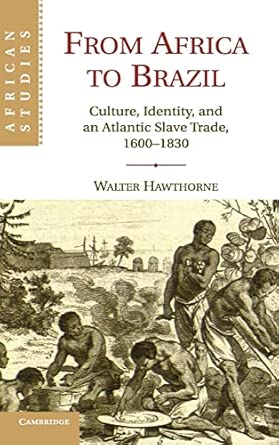
From Africa to Brazil: Culture, Identity, and an Atlantic Slave Trade, 1600–1830: 113
Author(s): Walter Hawthorne (Author)
Publisher: Cambridge University Press
Publication Date: 18 Nov. 2010
Edition: Illustrated
Language: English
Print length: 288 pages
ISBN-10: 0521764092
ISBN-13: 9780521764094
Book Description
From Africa to Brazil traces the flows of enslaved Africans from the broad region of Africa called Upper Guinea to Amazonia, Brazil. These two regions, though separated by an ocean, were made one by a slave route. Walter Hawthorne considers why planters in Amazonia wanted African slaves, why and how those sent to Amazonia were enslaved, and what their Middle Passage experience was like. The book is also concerned with how Africans in diaspora shaped labor regimes, determined the nature of their family lives, and crafted religious beliefs that were similar to those they had known before enslavement. It presents the only book-length examination of African slavery in Amazonia and identifies with precision the locations in Africa from where members of a large diaspora in the Americas hailed. From Africa to Brazil also proposes new directions for scholarship focused on how immigrant groups created new or recreated old cultures.
Editorial Reviews
Review
‘Hawthorne’s richly textured discussion makes a valuable contribution to the existing historiography. This is a story that needs to be told.’ Linda Heywood, Boston University
‘From Africa to Brazil achieves a trans-Atlantic perspective that will serve as a model for those scholars of slavery who are interested in the origins and destinations of enslaved Africans. In connecting the rice-producing regions of the upper Guinea coast with the development of rice cultivation in northeastern Brazil, Hawthorne’s majestic study demonstrates the transfer of African technology and culture to one specific region in the Americas in the eighteenth century.’ Paul Lovejoy, York University
‘Building on his extensive knowledge of Upper Guinea, Hawthorne shows that the majority of slaves arriving into eighteenth-century Amazonia came from a very small area along the coast. As a result, Balanta, Bijago, Papel, and Mandinka were able to recreate a variety of ‘Upper Guinean’ core beliefs and practices in their new Brazilian homes. Hawthorne convincingly demonstrates the tenacity of Upper Guinean culture in Amazonia; yet his contributions extend well beyond a simple examination of Upper Guineans in the region. Indeed, From Africa to Brazil establishes Hawthorne as an expert on the early history of Maranhão and Pará, regions that are vastly understudied. Particularly impressive in this regard is his treatment of indigenous people and the transition from Indian to African labor. Overall, a deeply researched, important contribution to the study of African diaspora history.’ James Sweet, University of Wisconsin, Madison
‘Hawthorne’s data could take him much further than his core narrative of African re-creation, into describing the formation of a complex colonial culture in the periphery of the colonial world; a radically new culture, not just a survival or a hybrid. In fact, what I liked best about this book is that it provides a lot of information that does not exactly fit its proposed argument, but shows instead the excellent quality of the research.’ Journal of Africa
Book Description
This book traces the flows of enslaved Africans from the broad region of Africa called Upper Guinea to Amazonia, Brazil.
About the Author
Walter Hawthorne is Associate Professor of African History at Michigan State University. He is the author of Planting Rice and Harvesting Slaves: Transformations along the Guinea-Bissau Coast, 1400–1900 (2003) and has published in scholarly journals such as the Journal of African History, the Luso-Brazilian Review, Slavery and Abolition, Africa, the Journal of Global History, and the American Historical Review. Before joining the History Department at Michigan State University, he was a visiting Assistant Professor at the University of Vermont and Assistant and Associate Professor at Ohio University.
 Wow! eBook