 Wow! eBook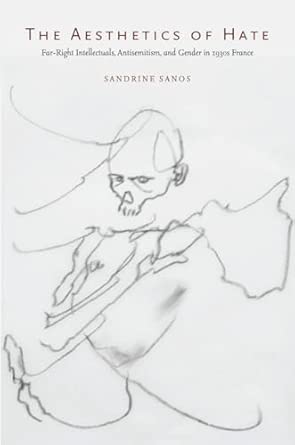
The Aesthetics of Hate: Far-Right Intellectuals, Antisemitism, and Gender in 1930s France
Author(s): Sandrine Sanos (Author)
- Publisher: Stanford University Press
- Publication Date: 24 Oct. 2012
- Edition: 1st
- Language: English
- Print length: 384 pages
- ISBN-10: 0804774579
- ISBN-13: 9780804774574
Book Description
The Aesthetics of Hate examines the writings of a motley collection of interwar far-right intellectuals, showing that they defined Frenchness in racial, gendered, and sexual terms. A broad, ambitious cultural and intellectual history, the book offers a provocative reinterpretation of a topic that has long been the subject of controversy.
In works infused with rhetorics of abjection, disgust, and dissolution, such writers as Maulnier, Brasillach, Céline, and Blanchot imagined the nation through figures deemed illegitimate or inferior―Jews, colonial subjects, homosexuals, women. Sanos argues that these intellectuals offered an “aesthetics of hate,” reinventing a language of far-right nationalism by appealing to the realm of beauty and the sublime for political solutions.
By acknowledging the constitutive relationship of antisemitism and colonial racism at the heart of these canonical writers’ nationalism, this book makes us rethink how aesthetics and politics function, how race is imagined and defined, how gender structured far-right thought, and how we conceive of French intellectualism and fascism.
Editorial Reviews
Review
“Among the strengths of the author in this study is her refusal to judge her subjects―essayist Thierry Maulnier, novelists Robert Brazillach and Louis-Ferdinand Céline, and literary critic Maurice Blanchot, among others―under the retroactive ‘specter of Auschwitz’. Instead, Sandrine Sanos grounds her Far Right intellectuals firmly in the historical and discursive world of France in the 1930s that shaped them . . . Sanos’s argument is strong, meticulously well-supported, and original. She is right that historians have generally remained ‘oblivious’ to the discourse of gender and sexuality that fairly saturates the texts of the Far Right.”―Paul Cohen,
The Historian“In short, this is in many regards an impressive book. Sanos’s primary research is exemplary, and her analyses are grounded firmly in the evidence.”―Geoff Read,
Contemporary French Civilization“Sanos has provided a vital resource for the intellectual history of interwar France . . . Highly recommended.”―D. A. Harvey,
CHOICE“[A]n ambitious and intriguing reappraisal of an important literary movement.”―Samuel Kalman,
Canadian Journal of History“This book is an impressive piece of intellectual and cultural history. In an important intervention, the author illuminates how a range of extreme-right figures in 1930s France shared a racialized conception of the French nation. By historicizing these authors’ thought, placing their writings in their wider political and journalistic context, Sanos moves beyond the narrow frame adopted by many literary scholars. The book’s demonstration of the mutual constitution of antisemitism and colonial racism is one of its chief assets and achievements.”―Judith Surkis, Institute for Advanced Study
“This ambitious and conceptually sophisticated book moves beyond debates about whether the French far-right during the 1930s was ‘really’ fascist. In contrast to most historians, Sanos argues that the French far-right, while not ‘worse’ than other fascisms, was just different: it sought to provide the basis for a ‘reasonable’ racist anti-Semitism that would justify excluding Jews legally and symbolically from France rather than appealing, as they felt Hitler did, to myths.”―Carolyn Dean, Brown University
“Sanos adds to an already large literature on the
Jeune Droite by maintaining that it redefined far right and fascist politics by insisting that aesthetics (particularly art and literature) were the highest form of political expression….The originality of Sanos’s argument lies in her assertion that the Jeune Droite used a new language, that of abjection… to express their vision of the nation.”―Caroline Campbell, Contemporary European HistoryFrom the Author
Sandrine Sanos is Assistant Professor of Modern European History at Texas A & M University―Corpus Christi.
About the Author
Excerpt. © Reprinted by permission. All rights reserved.
THE AESTHETICS OF HATE
Far-Right Intellectuals, Antisemitism, and Gender in 1930s FranceBy SANDRINE SANOS
Stanford University Press
Copyright © 2013 Board of Trustees of the Leland Stanford Junior University
All right reserved.
ISBN: 978-0-8047-7457-4
Contents
Acknowledgments……………………………………………………………………………………………..ixIntroduction………………………………………………………………………………………………..11 “The Crisis Is in Man”: The Nation, the Self, and Cultural Politics in the 1930s………………………………….152 A Genealogy of the Far Right………………………………………………………………………………..433 “Will We Get Out of French Abjection?” The Politics and Aesthetic Insurgency of the Young New Right…………………754 The Absent Author: Maurice Blanchot and the Subjection of Politics………………………………………………1185 “Negroid Jews Against White Men”: Louis-Ferdinand Céline and the Politics of Literature……………………….1586 The Race of Fascism: Je Suis Partout, Race, and Culture………………………………………………………..194Conclusion………………………………………………………………………………………………….245Notes………………………………………………………………………………………………………261Bibliography………………………………………………………………………………………………..333Index………………………………………………………………………………………………………355
Chapter One
“THE CRISIS IS IN MAN”
The Nation, the Self, and Cultural Politics in the 1930s
Those were years exemplary of paradox and surprise. —Jean-Pierre Maxence, Histoire de dix ans, 1939
We were eighteen; our minds were somewhat confused, we felt rather disgusted with the modern world—and had a certain innate bent to anarchy. —Robert Brasillach, Notre avant-guerre, 1941
Cultures of the Anxious Modern
In 1937, far-right essayist and intellectual Thierry Maulnier boldly declared: “We must win back our universe!” Maulnier was, in the mid-1930s, a well-respected literary and political critic. A graduate of the prestigious École normale supérieure, he had begun his journalistic career—as many on the far right did—in the pages of Charles Maurras’s monarchist and ultra-nationalist L’Action Française. By the time he penned this heartfelt call, Maulnier was regarded by many as the natural heir to Maurras: he was a young man whose wide-ranging literary culture matched his reactionary political commitment. His articles appeared in a far-right magazine he had helped create the previous year and coedited with Catholic conservative Jean de Fabrègues, who shared his revulsion at the decadence the postwar era had unleashed. The magazine’s name, Combat (Struggle), proclaimed its editors’ intent. By 1937, when the Spanish Civil War dominated the news and the Popular Front had come to power, Maulnier had already published several collection of essays that took literature and politics as their central topic. Their titles hinted at the radical discontent he experienced: his essays claimed “The Crisis Is in Man,” pondered “Socialist Myths,” and announced “France, Tomorrow.” Maulnier devoted much of his energy in the 1930s to offering a critique of the chaos and decadence he claimed to have observed around him. Such critique infused his insistent call for a revolution of a particular nature, an aesthetic as well as cultural and political revolution that would come from a new generation of far-right intellectuals.
Thierry Maulnier was not alone in this endeavor. His words formed the rallying cry for a group of young men who, in the years 1930 to 1935, expressed themselves in more or less short-lived journals and magazines of high intellectual caliber but little readership, with rather austere names that hardly hinted at their content. They were trained in the ideas of far-right and conservative nationalism and aspired to cultural and political prominence. Ranging from ultra-Catholic journalists Jean de Fabrègues and René Vincent to novelists Robert Brasillach and Georges Blond, music and film critic Lucien Rebatet, energetic polemicist Jean-Pierre Maxence, and the lesser-known but no less dedicated Pierre-Antoine Cousteau and Pierre Monnier, they were a motley collection united in their disgust with the postwar world in which they had come of age. They sharpened their words in little-read newspapers and magazines: Les Cahiers (the Notebooks), Réaction pour l’Ordre (Reaction for Order), La Revue Française (the French Journal), La Revue du Siècle (the Journal of the Century). These young men achieved intellectual and political recognition in the late 1930s with the polemical newspapers they created: from the intellectual magazine Combat (Struggle) to the controversial L’Insurgé (the Insurgent), and the refashioning of weekly newspaper Je Suis Partout (I Am Everywhere). They explained that, in this decade, the 1930s, it was necessary—urgent even—to find a solution to the “confused search” that had pervaded the postwar years and had consumed their youthful undertakings.
It was the memory of a youth influenced and troubled by the political disorders and cultural effervescence of the 1920s that fueled this young intellectual generation’s search for a dissident politics that they conceived as an irrepressible desire for truth. As one of its leading figures, Catholic writer Jean de Fabrègues, observed, “When faced with the poverty of what the modern world has to offer us, we find ourselves gripped by a tragic sense of uneasiness.” With similar language, fellow journalist René Vincent explained in 1935 that their desire for a radical (far-right) politics had emerged out of the disconcerting and confused postwar years:
The uneasiness of 1920 was born under the sign of the post-war disorder; it was, in a certain way, the product of this disorder; it nonetheless expressed a loud dissatisfaction with this very disorder, [and] a categorical refusal of this unfair state of affairs[; it was] a confused search whose troublesome nature some were dangerously inclined to, but in any case, a true search, an unconscious and sometimes blind undertaking, but an undertaking [geared] toward higher values [that were] truer than the ones celebrated by this century.
In the face of the “tragic sense of uneasiness” brought about by the modern world, these young intellectuals claimed action must be urgently undertaken. The modern (namely, the “crazy 20s”), as they experienced it, had produced a pervasive anxiety.
Why did they experience the modern—postwar culture and aesthetics—with such anxiety? (For the words “anxiety” and “disquiet” reappeared obsessively in their writings on the topic of the “après-guerre.”) The war had been a momentous event that had decimated the generations of fathers and older brothers they paid homage to and yet were haunted by. They had not experienced the Great War, as most had been born at the beginning of the century. But its long-lasting cultural, social, and political effects convinced them that a “new order” was necessary. Their elders spoke about it as an event that marked a radical rupture: nothing would ever be the same. The war, though, had not just brought about death, mutilation, and violence. The years of conflict had also brought about seemingly unstoppable social, technological, and cultural change. This young generation met these changes with an “uneasy” anxiety tinged with excitement. They did not simply reject the modern, but felt a profound ambivalence toward it.
As they said repeatedly in the pages of the numerous magazines and newspapers they wrote for, the anxiety lay in the dangers of losing oneself and succumbing to the temptation of the disorder of decadence. They explained their “categorical refusal” as an instinctive reaction to such disorder, an almost “unconscious” undertaking, rather than as the rational and reasoned programmatic reaction of oppositional far-right politics. The “unconscious and sometimes blind” endeavor that drove their political engagement had infused their own politics: it had done so because, they argued, it had allowed them to experience the “tragic” urgency of their undertaking. They had begun their political reflection “from their own very concrete and immediate anxieties.” They wrote and acted out of intimate knowledge rather than distant observation. In short, the foundations of their sense of self were at stake in this changing world.
Historians have usually explained the “anxiety” and “refusal” that this generation of far-right intellectuals evoked as the expression of their political analysis: those terms were simply the affective responses of writers and journalists who were steeped in a long-standing far-right politics and who, like their elders, railed against socialism, capitalism, democracy, and parliamentarism. In doing so, they denounced a “bourgeois age” that was corrupt and decadent and that had given the nation a “sordid face” and a “motionless and fixed mask.” Yet, as has also been noted, the denunciation of bourgeois “capitalist lies” was not confined to this far-right generation but permeated the atmosphere of interwar France. The very terms of these writers’ arguments and analyses must therefore be taken seriously, for the sentiments they articulated were rooted in the cultural and political discourse of the 1930s. We do not fully grasp the significance of their expressions of disgust and refusal unless we situate these intellectuals not just within a political genealogy of far-right ideas but also within the larger context of 1930s French cultural and aesthetic debates. This chapter provides an overview of how categories of civilization, race, gender, and sexuality infused contemporaries’ debates and discussions and how these young intellectuals engaged and responded to them. From the beginning, they conceived of this moment as unstable, uncertain, and “in crisis.” In turn, that rhetoric of “crisis”—admittedly a recurring feature of French political debates—was infused with a different emphasis and legitimated their literature and political endeavors, allowing them to craft a place in conversation with their political forefathers and, more strikingly, against and with their contemporaries.
The Interwar Period: The Fate and Future of French Civilization
The young far right experienced the novelty of the postwar years paradoxically. While modernity seemed to embody, for them, the uncanny experience of dislocation and displacement, at the same time some of them eagerly partook of its most seductive symptoms. In short, they were engaged with what the modern offered in those years, even as many felt ambivalent or condemned its most egregious manifestations. Many loved the cinema and were passionate consumers of its weekly showing, as Brasillach nostalgically recounted in his 1941 memoir, Notre avant-guerre. One of Je Suis Partout’s most dedicated journalists, Lucien Rebatet began his journalistic career as a film and music critic, an occupation he continued under the pseudonym of François Vinneuil in the pages of Je Suis Partout. He reviewed American films, from Charlie Chaplin to westerns, René Clair, and Abel Gance, but also Leni Riefenstahl and most of the Russian cinematic production of those years. Brasillach, who has been characterized by historians as the quintessential “Romantic Fascist,” penned the first encyclopedia of cinema with his brother-in-law Maurice Bardèche, which was translated and distributed by the Museum of Modern Art in 1938. Their fellow polemicist and editor Jean-Pierre Maxence, who often lamented how, in these postwar years, “people drank cocktails just for the sake of it and practiced nudism out of snobbishness rather than hygiene [while] celebrating that new God, America,” also fondly recalled in 1939 how “cinema had widened horizons.” For this far-right critic enamored with both literature and politics, cinema “changed the art of story-telling by giving it speed and immediate punctuation.” Soon, though, he berated this craze for the cinema as a misguided desire for “scandal,” where everyone in Paris “ran to watch every surrealist film.” As another explained, cinema was truly the expression of “the age of the contingent.”
Even when they did not necessarily celebrate those symptoms of modernity, they still participated in the cultural conversations occurring around the seemingly endless proliferation of new cultural forms and activities. They listened to the TSF radio, while participating in Action française’s demonstrations in the Latin Quarter. They eagerly commented on the cultural events of their day. Journalist Lucien Farnoux-Reynaud, one of the 1937 far-right Insurgé‘s regular contributors of a column titled “The New World,” had written ten years earlier about the new musical form called “jazz” that had swept through Paris. For him, “the epoch of the jazz band” meant, as historian Jeffrey Jackson has noted, a “broader cultural shift,” which he found disturbing. Jazz was the kind of novelty, according to Farnoux-Reynaud, that signaled the worrisome dominance of “knee-length skirts, neck-length hair, women with men’s coats and cigarettes.” In short, a “confusion of the sexes, an anguish of living, and a feverishness in everyday pleasure.” While men like Farnoux-Reynaud felt ambivalent about jazz (as did quite a few critics in those years), many others of these young political journalists were music critics, such as Lucien Rebatet and René Vincent (under the pseudonym Hughes Favart). Hardly the traditionalists that the older ultra-nationalist far-right generation were when it came to art and culture, these young men were indeed of their time and enthusiastic critics of the cultural politics they saw unfolding before them.
In the early 1920s, celebrating modernity seemed all the rage. It offered a welcome distraction and challenge to the war years, which had shaken the foundations of Western civilization. Strikingly, attention to modernity was marked by an enthusiastic interest in “black culture.” The exoticizing fascination with “blackness”—dubbed in France “negrophilia”—found its way into the work of avant-garde artists as well as into the dance halls, clubs, and bars of nighttime Paris. Artists like Pablo Picasso, Francis Picabia, and Constantin Brancusi turned to African art as a means to authentically access life (they were following in the footsteps of poet and collector Guillaume Apollinaire). Paris salons seemed enthralled by “l’art nègre,” displaying it on their walls and in their furniture. French artists turned to “blackness” as the quintessential embodiment of difference in order to reinvent an exhausted Western civilization, while others returned from colonies with tales and impressions and Parisians met those “members of the African diaspora” who “flourish[ed]” there. And far-right writers like Maxence bemoaned the fact that, indeed, in the 1920s, “differences were being excessively cherished and nursed.” New cultural forms were yearned for, and “negrophilia” fulfilled that need, especially for bohemians, artists, and youth eager to experience something different and radically new. Nowhere was this more apparent than in Paris, which since the late nineteenth century had been the refuge of artists, writers, and political exiles. Paris—that “fundamentally imperial city”—offered a vibrant cultural scene: jazz clubs were all the rage. As Michel Leiris described in his 1939 autobiographical narrative, L’âge d’homme,
In the midst of this era of incredible licentiousness that followed the conflict, jazz acted as a rallying cry, an orgiastic banner…. [Jazz] acted magically and its influence can be likened to that of possession. It was the best way to provide parties with their true meaning, a kind of religion with communion through dancing, latent or manifest eroticism, and alcohol, the most effective way to level the gap that separates individuals in whatever gathering.
For men like Leiris, jazz embodied the promise of new, unmediated experiences. For young conservatives like Jean de Fabrègues, the same jazz clubs were spaces where Parisians sought “jazz and cocktails to drown their despair.” The music played in these clubs was, from the beginning, associated with something different, and most of all with blackness. This cultural scene was one where blackness came to signify the exotic and the primitive, with little curiosity about its historical and cultural specificities. This is best epitomized by the enduring public fascination with Josephine Baker, who first found fame with her performance in the Revue Nègre music-hall show. In the 1934 film Zouzou, Baker gave a rare performance that epitomized the ways in which race, blackness, and difference fascinated French audiences: cinemagoers could revel in her barely covered body as she sang—dressed in a birdlike outfit and standing in a life-size cage—a melancholic song of her long-lost homeland, Haiti. Baker’s African Americanness was conveniently erased so as to present her as the enticing and eroticized figure of the mulatto woman, now lost in metropolitan France. She yearned for Haiti, whose association with slavery and colonial violence was silenced so as to offer the vicarious consumption of exotic sexualized racial difference. Baker, who was made queen of the 1931 Colonial Exposition, was “transformed” into a “colonial woman.” Audiences flocked to her shows. The fascination with foreignness and (racial) difference that permeated these Parisian years spoke to a certain obsession with the foundations of civilization, since it posed the questions of what it meant to be French and what infused French culture. Excitement pervaded many of the responses to these queries and even young far-right authors recognized that a certain “fever” and new “appetites” had consumed the 1920s.
For young critics equally interested in politics, culture, and literature, what was happening beyond the borders of the nation was also significant and, for some, both troubling and exciting. The nation’s boundaries appeared to have been abolished by the century’s most brutal war and its technological advances. In the 1930s, this permeability was no longer the trauma of boundaries erased by the tanks and planes of European armies while men were battling in the muddy trenches of northern France. Borders had been made porous by the development of capitalism, industrialization, and modernity. Ethnography was enthusiastically embraced as French officials found it necessary to manage their colonial territories with greater interest and under the rubric of a reinvigorated “colonial humanism.” Travels outside of France meant that artifacts and commodities were brought back to the metropole. While “colonial soldiers, workers, professors, and students [who] were not simple immigrants” but embodied French imperial rule came in greater numbers to the metropole, they were not as welcome as the many foreigners who came to settle in Paris. Especially for right-wing nationalists, the issue of borders became a matter of anxiety as immigration came to figure more prominently in policy debates and political discussions. Immigrant workers and German and Central European refugees were the backdrop to this craze for travel and border crossing.
(Continues…)
Excerpted from THE AESTHETICS OF HATEby SANDRINE SANOS Copyright © 2013 by Board of Trustees of the Leland Stanford Junior University. Excerpted by permission of Stanford University Press. All rights reserved. No part of this excerpt may be reproduced or reprinted without permission in writing from the publisher.
Excerpts are provided by Dial-A-Book Inc. solely for the personal use of visitors to this web site.


