Wow! eBook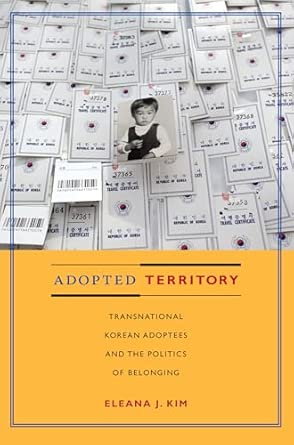
Adopted Territory: Transnational Korean Adoptees and the Politics of Belonging
Author(s): Eleana J. Kim (Author)
- Publisher: Duke University Press
- Publication Date: 30 Nov. 2010
- Language: English
- Print length: 344 pages
- ISBN-10: 0822346834
- ISBN-13: 9780822346838
Book Description
Editorial Reviews
Review
“
Adopted Territory is truly a groundbreaking publication. It not only contributes to the new fields of Korean adoption studies, adoption cultural studies and critical adoption studies that have emerged lately, but also to the unfortunately still too territorialized fields of Asian studies and Korean studies, which still need to become transnationalized and not just include diasporic Asians and Koreans on the research agenda, but also embrace such previously discarded, forgotten and ‘non-authentic’ subjects as adoptees living in Western countries.”–Tobias Hübinette “Pacific Affairs”“
Adopted Territory, Eleana Kim’s powerful and innovative book about Korean transnational adoption, brings both intellectual rigor and a fresh approach to the study of adoptive kinship.”–Barbara Yngvesson “American Ethnologist”“By examining the dynamic history and relations among the concerned state actors, international and domestic adoption agencies, adoptee advocacy groups, and individual adoptees and their self-governance groups, Kim expands existing scholarship within Korean studies on the geopolitics of intimacy . . . and neoliberal and developmentalist modernity. . . .
Adopted Territory may be of particular interest to scholars in the fields of Korean studies, Asian and Asian American studies, and anthropology.”–EuyRyung Jun “Journal of Asian Studies”“Students and scholars of social and cultural anthropology, transnational identity and Korean and Asian American Studies will find Dr. Kim’s ethnography particularly informative. . . .
Adopted Territory cogently argues the transformative potential of adoptee discourses on the inaccurate representations of adoptees as orphans and children, and the ideal family as a nuclear unit, and on challenging the state in social welfare provision. At the very least, for readers, it will re-shape conceptualizations of Korean identity and belonging.”–Ann H. Kim “Ethnic and Racial Studies”“The many strengths of
Adopted Territory are solidified by Kim’s lucid and stylishly crafted prose. One is propelled through the book by a beautiful balance of detailed empirical accounts and judicious use of cultural theory. . . . Kim’s work is an altogether new treatment of a number of themes known to transnational adoption scholars, defamiliarizing territory we thought we knew. At the same time, it will familiarize scholars from a number of other fields with the importance of adoptees’ stories and histories to transnational counterpublics.”–Sara Dorow “Contemporary Sociology”“
Adopted Territory is the best and most thorough treatment of transnational adoption that I have seen. Eleana J. Kim provides sophisticated analyses of Korean overseas adoption to the United States, and South Korean history and state politics, within the contexts of cold war geopolitics and the rise of the American empire, while also attending to issues of nation, race, citizenship, gender, social class, and culture. The breadth, depth, and scope of Kim’s analyses contribute importantly to our understanding of the people and the phenomenon. Her well-contextualized and sensitive discussions of adoptee subjectivities are of particular interest.”–Elaine H. Kim, University of California, Berkeley“This truly remarkable ethnography chronicles the birth and first generation of the global Korean adoptee movement.
Adopted Territory brilliantly asserts that the movement is born of a powerful historical conjuncture among: the U.S.’s millennial culture of multiculturalism; South Korea’s aggressive globalization regimes and emergent democratic civil society; and adoptees coming of age. Adopted Territory offers also a sophisticated study of family, kinship, and nation through the challenging lens of adoption which Eleana J. Kim declares a veritable ‘catalyst for social transformation.’ A beautifully crafted multi-sited ethnography, Adopted Territory will no doubt enjoy a vibrant intellectual life.”–Nancy Abelmann, author of The Intimate University: Korean American Students and the Problems of SegregationFrom the Back Cover
About the Author
Eleana J. Kim is Assistant Professor of Anthropology at the University of Rochester.
Excerpt. © Reprinted by permission. All rights reserved.
ADOPTED TERRITORY
Transnational Korean Adoptees and the Politics of BelongingBy Eleana J. Kim
Duke University Press
Copyright © 2010 Duke University Press
All right reserved.
ISBN: 978-0-8223-4683-8
Contents
Acknowledgments………………………………………………………………………………………….ixNotes on Transliteration, Terminology, and Pseudonyms………………………………………………………..xiiiAbbreviations……………………………………………………………………………………………xviiIntroduction: Understanding Transnational Korean Adoption…………………………………………………….11. “Waifs” and “Orphans”: The Origins of Korean Adoption……………………………………………………..432. Adoptee Kinship……………………………………………………………………………………….833. Adoptee Cultural Citizenship……………………………………………………………………………1014. Public Intimacies and Private Politics…………………………………………………………………..1335. Our Adoptee, Our Alien: Adoptees as Specters of Family and Foreignness in Global Korea………………………..1716. Made in Korea: Adopted Koreans and Native Koreans in the Motherland…………………………………………2117. Beyond Good and Evil: The Moral Economies of Children and Their Best Interests in a Global Age…………………249Notes…………………………………………………………………………………………………..269Works Cited……………………………………………………………………………………………..291Index…………………………………………………………………………………………………..311
Chapter One
“Waifs” and “Orphans”
The Origins of Korean Adoption
Bertha Holt’s The Seed from the East (1956), an account of her husband Harry’s pivotal role in the history of international Korean adoption, offers this vivid summary on the back cover: “Korea … 1954 … Thousands of children suffered in crowded, understaffed and poorly supplied orphanages?children, it seemed, that no one wanted. But God gave one couple a heart to love these children. This most ordinary family?a lumberman with a heart condition, a farming wife and six children?changed the world when they adopted eight Korean-Amerasian children. The story of the Harry Holt family testifies to God’s ability to use ordinary people to bring about extraordinary change. Intercountry adoption flourishes today, largely because God used the faith and determination of the Holts to adopt homeless children into families of their own.” This is, in fact, the story that is conventionally told about the origins of Korean overseas adoption. Not only a narrative of Christian charity and divine selection, it is also one of the “extraordinary” capabilities (even if God given) of “ordinary” individuals. The key characters in this story are thousands of needy children, a quintessential American frontier figure, and a Christian God. Bertha Holt, Harry’s “farming wife,” penned The Seed from the East (1956) and also Bring My Sons from Afar (1986), both of which borrow their titles from verses in the Book of Isaiah. These are the primary texts that compose the legendary story of Harry’s efforts to bring Korean children to families in the West.
It is undeniable that Harry Holt played an instrumental role in helping intercountry adoption to flourish, and for many in Korea the Holt name is virtually synonymous with overseas adoption and child welfare. Yet, fifty years later, the mythic stature of Holt as represented in Bertha’s books and by Holt Adoption Agency (now Holt International Children’s Services) is being challenged by many who are critical of how international adoption developed into a quick fix for the problems of child welfare in the global South and a solution to childlessness in the North (see Sarri, Baik, and Bombyk 1998).
The construction of adoption as an expression of humanistic altruism is perhaps most easily defended by those who benefit from the discrepancies in economic, social, political, and gendered power between Western parents and those elsewhere. Yet some of those beneficiaries, the adoptees themselves, have developed penetrating critiques of contemporary adoption. Dismayed to know that Korea continues to send an average of five or six babies abroad every day, they consider Holt’s humanitarian mission to be an example of another quintessentially American figure?the missionary as cultural imperialist (Bruining 1989; H|inette 2004; Nopper 2004; Trenka, Oparah, and Shin 2006).
These negative views of Holt, while informed by contemporary cultural politics, are not, however, entirely new. Holt was, from the beginning of his child-rescue crusade, a controversial figure in the media and the object of vigorous opposition by professional social workers and child welfare specialists in the United States who found his “unorthodox” placement methods to be dangerous for the children he transplanted and for the families that received them. In addition, although Korean children dominated worldwide international adoption placements well into the early 1990s, this phenomenon can only be properly understood in the context of the international adoptions from Europe and Japan that evolved directly out of the Second World War and American geopolitical ascendance in the early years of the cold war. The patriotic pronatalism of 1950s America ?which linked American cultural citizenship and national security with parenthood and the nuclear family (May 1988)?combined with a middlebrow internationalist ethos (Klein 2003) that encouraged everyday Americans to imagine themselves as participants in world events are also important to my analysis of how international adoption came to be a rationalized and institutionalized practice around those first Korean placements. The concerns that social workers, anthropologists, psychologists, and others voiced in the initial years of international and transracial adoption resonate in the debates that continue to be waged over the benefits and costs of adoption today.
I begin this chapter with a discussion of how Korean children figured in the American social imaginary by examining the images and articles from American print media in the 1950s in which the “Korean waif,” as the object of sentimental attachment and rescue for American GIS, frequently appeared. These “waifs of war” and military “mascots” were among the first to be adopted, oftentimes by American soldiers or their extended families. Although it was the appearance of “mixed-blood” children as a social welfare problem that spurred the Korean government to pursue international adoption as an emergency measure, the first adoptee-mascots were by and large full-Korean boys.
The American press was especially influential in provoking sentimental reactions among Americans, many of whom responded to media images of orphans and “mixed-race” children by contacting the Korean government to donate money, clothing, and toys to orphanages or to inquire about how to adopt these children into their families. I place this phenomenon within the context of American adoption policy and practice of the time, wherein a rationalized social work institution (Herman 2002; Berebitsky 2000) along with a shortage of available white babies led to stringent requirements for infertile American couples who wanted to participate in the postwar baby boom. The adoption of mixed-race Korean American children thus became another alternative for so-called childless couples, especially those motivated by Christian values.
The collapse of egocentric motives into altruistic discourses, combined with an American sense of entitlement and cultural superiority, can be clearly gleaned from the letters written by hopeful couples in America to representatives of the Korean government in the 1950s. I examine the documentation of two cases from South Korean state archives that clarify how Americans articulated their desires for Korean children and how the South Korean state helped to facilitate adoptions in the early years. For it was not simply the desire of Americans that made these adoptions possible but also the accommodating role of the first South Korean administration. The Korean government was concerned about establishing legal procedures for the efficient removal of children from Korea and was perhaps equally invested in fortifying its international reputation. As I show, the South Korean government under President Syngman Rhee capitalized on the sentimental power of Korean orphans to further its diplomatic and foreign relations interests, especially with the United States. Finally, I describe how the establishment of adoption agencies and technological infrastructures by the 1960s made possible, and even necessary, the replacement of dwindling numbers of mixed-race children with full-Korean children. These economic and social orphans are the children who constitute the great majority of Korean adoptees today.
TRANSPLANTING CHILDREN
Prior to the large influx of children from Korea, evacuees or refugees from European countries affected by the Second World War constituted the largest number of foreign children brought to the United States. Some of these transplanted children stayed permanently in American families, whereas others were repatriated after the war. In total, the United States Committee for the Care of European Children facilitated the entry of 4,177 children from Europe into American families between 1940 and 1952 (Close 1953).
Meanwhile, in postwar Japan, the occupation of United States military forces during reconstruction resulted in thousands of Amerasian children born out of the often temporary liaisons between American servicemen and Japanese women. Between 1952 and 1975, more than two thousand children from Japan were adopted by servicemen or foreigners in Japan and overseas (Goodman 2000: 148), but these first transracial intercountry adoptions did not become the object of media attention that the Korean mascots or war orphans would soon become?perhaps due to Japan’s ambivalent status as a former adversary as well as discomfort about American boys “sleeping with the enemy.” The Japanese-American Joint Committee for Help to Mixed-Blood Children was established to offer aid to the estimated six thousand such children and their mothers (Asbury 1954), and Pearl Buck’s Welcome House, the first transracial adoption agency, brought Amerasian children to America as part of a liberal, antiracist, anticommunist project. For Buck, these “children without a country” were the responsibility of Americans who had the moral duty to nurture them as well as the patriotic duty to save them from the scourge of communism.
Predictably, the United States military occupation of South Korea led to sexual relations between American soldiers and local women. The South Korean government estimated that there were one thousand mixed-blood children in the immediate aftermath of the Korean War. At that time, the majority of children in the orphanages and hospitals were full Korean, with mixed-blood children primarily concentrated around the 38th parallel, close to the American military units. American media reports featured images of these children from 1954 onward and thereby incited sudden and unexpected interest among American couples and individuals who wrote to Korean consulates, the Korean government, the un ambassador, and even directly to the president of South Korea to request information about how to adopt a Korean orphan. In the face of postwar chaos and the humanitarian crisis of thousands of orphaned and abandoned children, both full Korean and mixed, the Korean government moved hastily to establish an adoption law and to pursue overseas adoption as a solution to its immediate social welfare needs.
KOREAN WAIFS AND THE MASCOT PROBLEM: AMERICAN SOLDIERS FATHER KOREAN CHILDREN
The surrender of Japan in 1945 seemed to promise liberation and a long-awaited opportunity for self-determination for Korea, which had suffered thirty-five years of brutal colonization under the Japanese. Following the war, however, the cold war superpowers quickly negotiated the distribution of Japan’s former colonies, and Korea, given its strategic geopolitical location, was divided into two occupation zones. The half north of the 38th parallel was under the immediate influence of the Soviet Union, and the southern half was under the protection of the United States. The arbitrary division at the 38th parallel, scrawled hastily on a map in 1945, led to the establishment of two opposing states by 1948. As such Korea was turned into a political hot zone, and the stage was set for the first military conflict of the cold war, with North Korea supported economically and militarily by the Soviets and China, and South Korea by the un and the United States.
The three-year war that ravaged the tiny peninsula resulted in ten million separated families and left half a million widows and tens of thousands of orphaned or needy children in South Korea alone. An estimated thirty-six thousand American troops died, and as many as three million Koreans on both sides had perished by 1953 when the military stalemate restored the boundary at the 38th parallel and set the two nations on a course of cold war hostilities and competing nationalisms for decades to come.
Without the devastation wrought by the war and the subsequent United States military occupation, Korean adoption would probably not exist today. In 1954, Susan Pettiss, assistant director of the International Social Service?American Branch, alerted her fellow social workers, “Let’s face it, international adoptions are here to stay.” And a year later, a study on adoption published by the United States Children’s Bureau in 1955, under the subheading “Intercountry Adoption,” made explicit the connection between United States postwar interventionist policies and its international welfare responsibilities: “As long as it is necessary to maintain approximately a million and a half men in the military overseas what happens to the children of these men becomes a social and a political problem” (Children’s Bureau 1955: 38).
Children left homeless or orphaned during the war were constructed in the American media as objects of humanitarian concern and became major beneficiaries of overseas charity following the war. Moreover, their welfare was key to an American postwar communist containment policy that sought to use humanitarian aid as a means of building good will among the Korean people. The thousands of mixed-race children who were born to Korean women and fathered by members of the armed forces quickly became a highly visible social welfare and publicity problem for both the new South Korean government under President Syngman Rhee and for the newly hegemonic United States, which was concerned about maintaining a reputation as the embodiment of democratic ideals in the “free world.”
For the United States, these “GI babies” or “un babies” presented a possible weapon that the communists could seize upon in the ideological battle to discredit the United States and its cold war expansionism. Bob Pierce, the founder of World Vision International, an evangelical Christian aid organization that first began its international humanitarian projects in Korea, explicitly used the adoption of mixed Korean children as part of an anticommunist, Christian propaganda program. Ironically, however, it was the solution of overseas adoption that led eventually to North Korea’s scathing criticism of South Korean “traitors” who sold children to American “slave traders … divided among capitalists and plantation owners” (Washington Post 1959).
South Korea was the largest development project in the world after the end of the war, with the United States being the primary orchestrator of the nation-building project?a principal objective of which was to create a viable anticommunist state in Asia (Ekbladh 2004: 19). In addition to $200 million donated annually by the United States, as well as costs for maintaining its military bases and troops, American money flooded in from voluntary aid groups, sectarian organizations, and individual donors. Many of the initial fundraising and donation drives were devised by American soldiers and chaplains who wrote home to families, churches, and local newspapers asking for food, clothing, or other supplies for orphanages that they had helped to set up. According to a 1954 report by the Christian Children’s Fund, Armed Forces Aid to Korea (AFAK) had by that time built fifty orphanages as part of an anticommunist goodwill project, and the Korea Civil Assistance Command (KCAC), staffed by the United States army, took care of 65 percent of the material needs of orphanages (Asbury 1954).
Americans at home joined the effort by engaging in a number of aid “operations” for Korean children that were widely publicized. The most famous was Operation Kiddy Car, the evacuation in 1950 of one thousand children from Seoul to Cheju Island at the beginning of the war. Colonel Dean Hess, a Catholic priest turned fighter pilot, was credited with saving these children, and he wrote a memoir that became the Hollywood feature film Battle Hymn in 1956. Other examples include Operation Santa Claus, an army-initiated Christmas clothing drive for orphanages, and Operation Winter and Operation GI, which converted American women’s knitting work into interventionist relief projects. Operation Giftlift brought Christmas presents in 1952 to the children in the Cheju Island orphanage from members of the air force stationed in Japan. The transportation en masse of Korean children out of Korea also borrowed from the militarized connotations of the word “operation”: World Vision’s Operation Stork and Harry Holt’s Operation Baby brought planeloads of children to the United States in late 1956.
In addition, Korean waifs and orphans often appeared in reports recounting the charitable deeds of American soldiers. A Christian Science Monitor article, “GIS Clothe South Korean Waifs,” from October 1953 contains a photo showing a small Korean toddler with an American soldier holding a sweater up to her shoulders (figure 1). The first paragraph reads: “American soldiers?who once called all Koreans ‘gooks’?now are engaged in a number of projects which indicate that affection and respect have largely replaced their earlier skepticism. Many GIS who find Korean customs confusing and Korean politics unsavory are putting their efforts into the most promising of many unofficial relief activities: aid for South Korea’s ragged, appealing children. For these soldiers, the tattered waifs with the beguiling faces are the most understandable feature of the Korean scene.” As this article suggests, American soldiers were able to overcome latent or blatant racism and cultural skepticism by focusing on humanitarian efforts for beguiling children. The waifs of war were often represented as orphans and Korean relatives were rarely, if ever, mentioned in these press accounts. Rather, as shown in the article’s photo the benevolent American soldier stood in as a parental figure, thereby crossing racial and cultural moats of confusion by taking on a paternal role to provide for and clothe the needy third world child.
(Continues…)
Excerpted from ADOPTED TERRITORYby Eleana J. Kim Copyright © 2010 by Duke University Press. Excerpted by permission of Duke University Press. All rights reserved. No part of this excerpt may be reproduced or reprinted without permission in writing from the publisher.
Excerpts are provided by Dial-A-Book Inc. solely for the personal use of visitors to this web site.