 Wow! eBook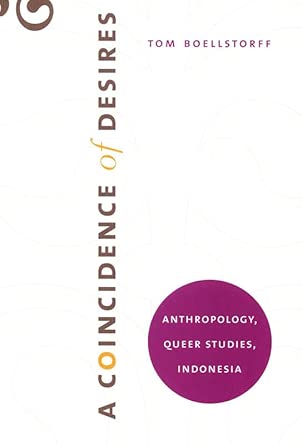
A Coincidence of Desires: Anthropology, Queer Studies, Indonesia
Author(s): Tom Boellstorff (Author)
- Publisher: Duke University Press
- Publication Date: 25 April 2007
- Language: English
- Print length: 312 pages
- ISBN-10: 0822339749
- ISBN-13: 9780822339748
Book Description
The case studies contained in A Coincidence of Desires speak to questions about the relation of sexualities to nationalism, religion, and globalization. They include an examination of zines published by gay Indonesians; an analysis of bahasa gay-a slang spoken by gay Indonesians that is increasingly appropriated in Indonesian popular culture; and an exploration of the place of warias (roughly, “male-to-female transvestites”) within Indonesian society. Boellstorff also considers the tension between Islam and sexuality in gay Indonesians’ lives and a series of incidents in which groups of men, identified with Islamic fundamentalism, violently attacked gatherings of gay men. Collectively, these studies insist on the primacy of empirical investigation to any queer studies project that wishes to speak to the specificities of lived experience.
Editorial Reviews
Review
“
A Coincidence of Desires responds to the imperative in queer studies to resituate the field’s epistemology by asking new questions about the relations between language, religion, sexuality, knowledge, and time. Drawing on a host of ‘coincidences’ between queer studies and anthropology, and using his extensive ethnographic experience in Indonesia, Tom Boellstorff casts his case studies as theoretical meditations in compelling and unexpected ways.”–Robyn Wiegman, Duke University“By exploring different formulations of time in canonical anthropological texts, in queer theory, and in his own ethnography on Indonesia, Tom Boellstorff challenges and reconfigures conventional anthropological and queer understandings of temporality. By focusing on’coincidence’–the temporal simultaneity of two events–Boellstorff destabilizes more traditional notions of linear, hierarchical time that structure a range of hegemonic dualities, including male/female and modern/traditional. Boellstorff’s nuanced treatment of ‘coincidence’ ultimately demonstrates the productive potential for a new interdisciplinarity that brings anthropology and queer theory into dialog around questions of gender, sexuality, modernity, and temporality.”–Megan Sinnott, author of
Toms and Dees: Transgender Identity and Female Same-Sex Relationships in ThailandFrom the Back Cover
About the Author
Tom Boellstorff is Associate Professor of Anthropology at the University of California, Irvine. He is the author of The Gay Archipelago: Sexuality and Nation in Indonesia and a coeditor of Speaking in Queer Tongues: Globalization and Gay Language, as well as the editor of American Anthropologist. To learn more about Tom Boellstorff’s work, visit his website.
Excerpt. © Reprinted by permission. All rights reserved.
A COINCIDENCE of DESIRES
ANTHROPOLOGY, QUEER STUDIES, INDONESIABy TOM BOELLSTORFF
Duke University Press
Copyright © 2007 Duke University Press
All right reserved.
ISBN: 978-0-8223-3974-8
Contents
Acknowledgments…………………………………………..ixA Note on Indonesian Terms and Italicization…………………xiiiINTRODUCTION QUEERING DISCIPLINES IN TIME…………………..1ONE ZINES AND ZONES OF DESIRE……………………………..35TWO WARIAS, NATIONAL TRANSVESTITES…………………………78THREE GAY LANGUAGE, REGISTERING BELONGING…………………..114FOUR BETWEEN RELIGION AND DESIRE…………………………..139FIVE THE EMERGENCE OF POLITICAL HOMOPHOBIA………………….161SIX COMPARATIVELY QUEER IN SOUTHEAST ASIA…………………..181Notes……………………………………………………219References……………………………………………….235Index……………………………………………………269
Chapter One
ZINES AND ZONES OF DESIRE
Desire might seem the most personal of emotions; something that originates in the deepest recesses of the soul and then reaches out in search of connection. However, work in queer studies and anthropology, among other disciplines, has long established how desire is not sui generis. Desire may feel like a product of the individual self, but it is shaped by the fields of culture, history, and power that Foucault referred to as discourses. This state of affairs can be hard to accept when discussing “nonnormative” sexualities-for instance, homosexuality-because often there does not appear to be any discourse corresponding to them. In most contemporary societies, great labor is expended on maintaining heterosexuality-for example, in areas such as norms of dating, gender roles, marriage laws, even architecture. Just as we can identify a dominant medical discourse that has shaped modern Western understandings of health and disease (Foucault 1973), we can identify discourses that have shaped modern notions of heterosexuality. But nowhere in the world has there existed a “homosexual lobby” with the power to shape notions of homosexuality in such a broad and sustained manner.
Theorists since Freud have offered two primary answers to this problem of homosexual desire. The first is that homosexual desire is a kind of “reverse discourse”-in other words, a discourse that reverses the polarity of an oppressive discourse without transcending it altogether: “The appearance in [the] nineteenth century … of a whole series of discourses on the species and subspecies of homosexuality … also made possible the formation of a ‘reverse’ discourse: homosexuality began to speak on its own behalf, to demand that its legitimacy or ‘naturality’ be acknowledged, often in the same vocabulary, using the same categories by which it was medically disqualified” (1978:101). This recalls notions of queer time that frame it in terms of a temporal reversal or slowing down yet still work within straight time.
The second answer involves questioning the idea that there is a one-to-one relationship between discourses and fields of social relations: “People think and act at the intersections of discourses” (Yanagisako and Delaney 1995:18). This is a vision of culture as coincidental, foreshadowed by many visions of interdisciplinarity. It is central, for instance, to queer-of-color critique and women of color feminisms, which typically understand sexuality “as a constitutive component of racial and class formations” (Ferguson 2005:85). It raises the possibility that, for instance, forms of homosexual desire can arise even when they are neither positively called into being through a discourse of “gay rights” nor negatively called into being though a “reverse discourse.” It raises the possibility of coincidental mergings of discourses, wherein homosexual desire may appear as an unexpected effect-one that may have great staying power while bearing the traces of the particular historical conjuncture through which it came into being.
This chapter and the four that follow are concerned with specific cases of this process. They trace how national discourse shapes the subject positions gay, lesbi, and waria (male transvestite) in Indonesia. This coincidence of discourses of nation and sexuality has consequences for understandings of belonging, modernity, and a range of other issues. By “subject position” I mean basically what is meant by the everyday term “identity”: a socially recognized category of selfhood; one with a particular history and typically inhabitable in multiple ways. Subject positions include roles like “woman,” “doctor,” “youth,” and “heterosexual.” “Subjectivities” are the senses of selfhood persons have as they inhabit a subject position (and we all take up many such subject positions throughout our lives), but in ways that always exceed and transform the subject position’s logic even while being powerfully shaped by that logic. The term “identity” is in many cases an acceptable substitute for “subject position,” but given its connotations of self-aware identification, and also its inability to distinguish between categories of selfhood versus senses of selfhood, I find the heuristic binarism of subject position and subjectivity to be helpful in my work.
In this chapter I focus on what I term “zines”-namely, informal magazines that gay Indonesians have been producing since 1982. By following the introduction with a study of these texts-a relatively unknown genre of Indonesian print media-I hope to demonstrate that anthropology and queer studies can build interdisciplinary connections through shared methodologies as well as shared topics of investigation and theoretical frameworks. I aim to demonstrate coincidences between the systems of meaning deployed by the producers and consumers of these zines, on the one hand, and Indonesian national discourse on the other. As privately circulated, small-scale publications, gay zines challenge definitions of “mass” media by providing unique insights into the relationship among print technologies, sexual subjectivities, and narratives of belonging. In particular, the producers and readers of gay zines do not see them as countercultural or as a “reverse discourse.” Instead, they see the zines as part and parcel of the national character of gay sexuality, embodying and demonstrating the worthiness of gay Indonesians for social inclusion.
My goal is to show how zines could hold such meaning. These zines are permeated with two zones, or discourses, of desire-homosexual desire and a desire for national belonging. Zines relate these two zones in the idea that love [cinta] can be the ultimate prestasi (a word meaning both “good deed” and “performance”), indicating to society that gay people are worthy of national inclusion. In these zines, gay Indonesians assume that prestasi must be visible to society to have these effects of inclusion. Since speaking positively of same-gender love in Indonesia is difficult, love fails as a prestasi. Belonging is deferred, and tropes of separation permeate gay zines as a result. Thus, although same-gender desire is clearly sexual, I argue that the second zone of desire-national belonging-is sexualized in a manner not exclusive to gay Indonesians. My ultimate goal in this chapter, therefore, is to show how gay zines reveal a wide-ranging logic of heteronormative citizenship at the heart of the very real “national culture” of postcolonial Indonesia. In the final paragraph of this chapter, I attempt to simulate this regime of affect-the imaginable but unattainable, indeed incommensurable moment when love, for so long linked to the idea of national belonging (Laffan 2003:157), takes on a homosexual cast.
LESBI ZINES
In this chapter I base my conclusions on an analysis of over seven thousand pages of gay zine text, informed by my fieldwork among gay men. Lesbi women have also published zines; however, I face a certain quandary in addressing these texts. Only a few have been published (the total corpus numbers around two hundred pages); this imbalance appears to be due not to any lack of desire to publish but instead to the difficulty that lesbi women face in securing the time, space, and resources to produce the zines. In the two cases in which lesbi women have published outside the capital of Jakarta, their zines have appeared as inserts within gay zines; as such, it is a situation of gay men sharing with lesbi women their relatively greater (but still meager) resources. Given this imbalance, along with the fact that my ethnographic work with lesbi women is less extensive than with gay men, I focus on gay zines in this chapter. I wish to keep in mind the feminist insight that “male” and “female” are not homologous (even in Southeast Asia, where conceptions of gender complementarity are widely distributed [Errington 1990; Hoskins 1998]), without erasing what data I do have on lesbi zines.
My heuristic compromise in this chapter is to focus my discussion on how gay zines illuminate masculine conceptions of national belonging but bring in lesbi material in a comparative vein where such data exist. In this way, I underscore some of the differences between lesbi and gay zines. For instance, lesbi zines are more likely to view Indonesia as a better place to live compared to countries in Euro-America; they are more likely to debate the implications of visibility; and they are more likely to express frustration with the difficulty of meeting other women given the limitations on women’s mobility and privacy in most parts of the archipelago. Additionally, Indonesian women are affected by the state’s family principle [azas kekeluargaan] that sets forth the unattainable goal of simultaneous domesticity and career within a heterosexual couple (see, for example, C. Jones 2004; Sen 1998; Suryakusuma 1996). Although men are affected by this state discourse, it is easier for them to fulfill the requirement of proper sexual citizenship and still sustain a gay life. In addition to identifying differences between gay and lesbi zines, I also note some parallels between them in regard to the relationship between homosexual desire and national belonging.
PRODUCTION AND CONSUMPTION
In the United States, zines originated with sci-fi fanzines in the 1930s and 1940s, reappeared in the 1980s with punk counterculture, and then became a full-fledged genre in the 1990s (Duncombe 1997:6-8; Friedman 1997:9-13). One writer’s definition of zines describes them as “noncommercial, nonprofessional, small-circulation magazines which their creators produce, publish, and distribute by themselves” (Duncombe 1997:6). In many respects this is an apt characterization of the print media created by gay Indonesians, and for this reason I use “zine” as the best English equivalent for these texts.
My primary data source is a textual analysis of the complete run of nine separate zines, for a total of 7,385 pages of text. This represents, to my knowledge and the knowledge of these zines’ producers, 100 percent of all gay and lesbi zines ever produced from the appearance of the first such zine in 1982 up to November 2001. These zines were published in Surabaya, Yogyakarta, Jakarta, Makassar, and Semarang, with reader contributions literally from across the nation. Three of the texts are lesbi zines and the rest are gay zines, some of which have occasional lesbi content (see table 1). I hone in on two elements of these zines: the communication between producers and readers (editorials, letters to the zine, and personal ads), and the short stories [cerita pendek or cerpen] sent in by readers. In this category I also include the genre of true-experience narratives [pengalaman sejati], also sent in by readers, which do not differ greatly from the short stories. I present images included in gay and lesbi zines to reinforce my analysis of the textual materials. A secondary source of data stems from my fieldwork, which includes interacting with gay and lesbi Indonesians as they create, read, discuss, and exchange zines. With the exceptions of K-79 and New Jaka-Jaka (NJJ), I am personally acquainted with the producer of each gay and lesbi zine published up to November 2001.
One should not be surprised to find some general distinctions in this wide spectrum of zines, based on the differing political and cultural sympathies of their editors. For instance, the zines published in Yogyakarta, a center of intellectual life and student activism, have tended to address issues of politics more directly than other zines, particularly following a change of editorship in 1999. The editors of K-79 (published in Semarang) treated homosexuality as a disease in need of curing more than the editors of any other zine. Such distinctions, however, are quite minor and are further mitigated by the relatively high amount of content sent in by readers.
The fairly even tenor among zines extends chronologically as well as geographically. Indeed, the continuity in zine thematics is notable, given that the time period under discussion, 1982 to the early 2000s, was a time of great change in Indonesia. I can offer several hypotheses to explain this continuity. First, the sixteen-year period between 1982 and 1998 was actually a time of remarkable stability-enforced by an authoritarian government-compared with sixteen-year periods before it, for instance, 1965-81, 1948-64, or 1931-47. Second, 1982-98 was the period during which the gay subjectivity came into its own as a conceivable way of life, if one largely hidden from Indonesian society and rarely claimed as an identity. The gay subject position appears to have emerged in the 1970s, becoming in the 1980s and 1990s a socially self-conscious national network of primarily (but not solely) urban friendship networks and occasionally organizations. It originated through transforming conceptions of homosexuality from outside of Indonesia, with little input from “traditional” homosexualities and transgenderisms.
A distinct question of continuity arises in regard to the post-Soeharto period-that is, since 1998. Given the hypothesis I develop in this chapter concerning the relationship between nationalism and sexuality, one might reason that this major shift in the nation-state form would affect gay zines (and gay sexuality in general). A few of the examples of post-1998 zine materials cited in this chapter could be construed as indicating this kind of shift; however, for two reasons-one methodological, one theoretical-I want to caution against an interpretation based on the view that everything has changed. Methodologically, a confounding variable exists in that all lesbi zines and every gay zine except GAYa Nusantara ceased publication by 2003. From my conversations with zine producers and others during my visits to Indonesia since 1998, there seems to be a variety of reasons for this, including a fear of militant Islam in Yogyakarta, funding problems in Makassar and elsewhere, and group infighting or lack of subscribers (even during the 1982-1998 period, most zines were published for only a few years). Given that GAYa Nusantara continues to publish, and new gay and lesbi zines have come into existence since 2002, some novel linkages and delinkages between nationalism and sexuality may yet appear. For instance, one could hypothesize that current movements toward regional autonomy [otonomi daerah] could lead to efforts to reinterpret gay subjectivity in terms of locality and tradition. This seems unlikely, however, since these movements have tended to cast themselves in terms of revitalizing tradition, while the gay and lesbi subject positions are, if nothing else, clearly understood by those who inhabit them as novel (not originating in local tradition) and linked to national and transnational conceptions of sexuality.
(Continues…)
Excerpted from A COINCIDENCE of DESIRESby TOM BOELLSTORFF Copyright © 2007 by Duke University Press. Excerpted by permission.
All rights reserved. No part of this excerpt may be reproduced or reprinted without permission in writing from the publisher.
Excerpts are provided by Dial-A-Book Inc. solely for the personal use of visitors to this web site.


