Wow! eBook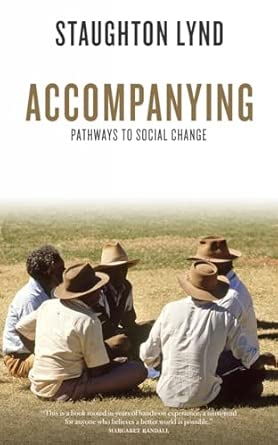
Accompanying : Pathways to Social Change
Author(s): Staughton Lynd (Author)
- Publisher: PM PRESS
- Publication Date: 10 Jan. 2013
- Edition: Reprint
- Language: English
- Print length: 170 pages
- ISBN-10: 1604866667
- ISBN-13: 9781604866667
Book Description
Editorial Reviews
Review
“Since our dreams for a more just world came crashing down around us in the late 1980s and early 1990s, those of us involved in social activism have spent much of the time since trying to assess what went wrong and what we might learn from our mistakes. In this highly readable book, Lynd explores the difference between organizing and accompanying. This book is a must-read for anyone who believes a better world is possible.”
–Margaret Randall
“Everything that Staughton Lynd writes is original and provocative. This little book is no exception. Among his greatest contributions on display here is the transformation of the ‘organizer’ and ‘organized’ into a collaboration of different people with different skills, each making a decisive contribution.”
–Paul Buhle, author of Robin Hood: People’s Outlaw and Forest Hero
“Accompanying is arguably the most thoughtful examination of Archbishop Oscar Romero’s concept of accompaniment insofar as it helps us to understand how liberation theology matured from taking a ‘preferential option for the poor’ to companionship with the poor as they organize themselves… This legacy flows into the Occupy Movement today when it reclaims foreclosed homes, and occupies banks and spaces collectively and spontaneously. This book would be important at any moment in history, but is indispensable today as we accompany one another in the quest to free ourselves from the shackles of the world the 1 percent has inflicted on us.”
–Carl Mirra, Associate Professor of Education, Adelphi University, and author of The Admirable Radical: Staughton Lynd and Cold War Dissent, 1945-1970
“I like this book very much. The fact that it is based on Alice and Staughton’s own experiences of accompanying makes it a very valuable tool for understanding and promoting the notion.”
–Father Joe Mulligan, SJ
About the Author
Staughton Lynd taught American history at Spelman College and Yale University. He was director of Freedom Schools in the 1964 Mississippi Freedom Summer. An early leader of the movement against the Vietnam War, he was blacklisted and unable to continue as an academic. He then became a lawyer, and in this capacity has assisted rank-and-file workers and prisoners for the past thirty years. He has written, edited, or co-edited with his wife Alice Lynd more than a dozen books.
Excerpt. © Reprinted by permission. All rights reserved.
Accompanying
Pathways to Social Change
By Staughton Lynd
PM Press
Copyright © 2012 Staughton Lynd
All rights reserved.
ISBN: 978-1-60486-666-7
Contents
Introduction,
I. Organizing,
The Labor Movement,
The Civil Rights Movement,
II. Accompaniment,
Againts the War,
Oscar Romero: An Unlikely Saint,
Accompanying Prisoners,
Occupying the Future,
Conclusion,
Index,
CHAPTER 1
The Labor Movement
As a historian and as a lawyer specializing in employment law, I had continuing contact with rank-and-file workers and union organizing in Chicago, Youngstown, and Pittsburgh for more than thirty years, beginning in 1967. It was a profound experience of accompanying. I learned that what a middle-class professional like me can offer is needed and important, but even more significant is the way that workers like Vicky Starr, John Sargent, and Ed Mann accompany each other.
The concept of “organizing” in the United States derives from the trade union movement. Viewers of the movie Norma Rae will recall the essentials. The full-time “organizer,” whose salary is paid by a national union, is sent into town and registers at a motel. The organizer seeks to win recognition from a local employer at a designated workplace as the exclusive bargaining representative of the workers.
The time this process is expected to take depends on whether the workplace has been characterized by the union as “hot” or “cold.” The organizer proceeds as quickly as possible. He or she — usually he — gets to know activists at the plant to whom other workers look for informal leadership. A committee of such activists is formed, and potential union support in different parts of the workplace is carefully evaluated. After a few weeks or months, the organizing effort “goes public.” Supporters are encouraged to wear union buttons to work. Cards indicating a desire to join the union, or to hold an election, are circulated. When the number of signatures is well over half of eligible workers at the targeted shop or office, the employer is approached with the demand for a “card check” assessment of union support by a neutral party (often in exchange for a weak collective bargaining agreement). Alternatively, the National Labor Relations Board may be asked to conduct an election, as in Norma Rae.
The aftermath of this process was not shown in the movie. Typically, the day after the election, win or lose, the organizer checks out of the motel and leaves town. If the union has been unable to obtain employer recognition, workers who made known their pro-union sentiments by wearing buttons or circulating cards are left exposed to retaliation. If the union has won the election, other representatives of the national union often show up with a predetermined collective bargaining agreement. Contract proposals appropriate to the local situation may be ignored.
This (of course with many variations) has been the story of union organizing in the United States since the 1930s.
Community organizer Saul Alinsky did his initial work “Back of the Yards” in southwest Chicago. He modeled his organizing on that of the CIO packinghouse workers’ union, which was in process of formation there. I became one of the first four staff members of Mr. Alinsky’s Industrial Areas Foundation Training Institute in 1968. I believe I have a basis for the conclusion that union organizing and community organizing a la Alinsky are cut from the same cloth. There is the same tendency to personalize conflict by singling out a principal spokesperson for the “enemy” by name. There is the same conviction that support can be mobilized only by appealing to the narrow, self-interested motives of individual workers. There is the same expectation that once the fledgling union or community organization has been recognized as a negotiating partner, all concerned will put their feet on the table and break out the liquor and cigars. An exaggerated atmosphere of hostility is followed by an artificial atmosphere of good feeling.
As I will explain, members of the Students for a Democratic Society (SDS) who in the 1960s took up residence in city neighborhoods in an effort to create an “interracial movement of the poor” pursued a similar game plan. It was never the intention of these would-be organizers to stay in a neighborhood for what Dr. Farmer would consider more than “a little while.” Instead, after a few months or, for the most persistent, a few years, SDS organizers like trade union organizers departed the scene and moved on.
The organizing model sketched in the preceding paragraphs is presently in crisis. Trade union membership, about one-third of the work force just after World War II, is now approximately 10 percent. Since the 1970s corporations have moved manufacturing out of the United States on a massive scale to take advantage of lower wage rates elsewhere. No longer insistent on equal pay for equal work, unions have agreed to collective bargaining contracts that provide two or more wage scales for the same job. The vision of dramatic social change in the direction of a more democratic workplace has given way to a situation in which, when the company announces the impending shutdown of a plant, American trade unions stand by helplessly.
The question presents itself: can the labor movement still hope to lead the whole society toward what Youngstown steelworker Ed Mann called “a better way.” This question can be broken down into two more specific questions, one looking backward and the other forward.
1. Why Did the Congress of Industrial Organizations So Rapidly Abandon the Shopfloor Self-Activity and Political Radicalism That Characterized Its Beginnings?
When my wife Alice and I moved to Chicago in 1967, the student movement was turning toward a strategy of imagined working-class revolution. Working-class young men were being drafted to fight in Vietnam and beginning to resist the orders of their officers. As in the 1930s, many middle-class young people were leaving the campus to become steelworkers or workers in automobile assembly plants.
Hoping to evaluate the prospects of working-class radicalism, Alice and I sought to explore the world of working-class experience, first in Chicago from 1967 to 1976, and then in Youngstown and Pittsburgh, from 1976 to the late 1990s. (We are still in Ohio but, Youngstown having substituted prisons for steel mills, we have become advocates for prisoners.) “Go see so-and-so,” we would be told, and led in this way from one person to the next we put together a collection of oral histories entitled Rank and File. We created occasions when veterans of the labor movement of the 1930s could share what they had learned with the new generation of would-be radicals. We helped to organize a Writers’ Workshop in Gary where a variety of people told their stories.
What we found was fundamentally at odds with the conception of working-class consciousness as inherently retrospective, defensive, and pragmatic. For example, Vicky Starr was a child of Eastern European immigrants who grew up on a farm in Michigan. Vicky’s father had been a coal miner and had “bought a few books about Lenin and Gorky.” She recalled that when Sacco and Vanzetti were executed “the foreign-born people were in mourning for a week.” The family practiced what Vicky’s father described as a socialist idea: “No work, no eat.” Vicky went on to help to organize the Packinghouse Workers of America in South Chicago and, after World War II, secretaries at the University of Chicago. She described herself as a socialist throughout her adult life.
Vicky introduced us to two friends and fellow spirits, Sylvia Woods and Katherine Hyndman, and the three became the protagonists of the documentary movie Union Maids. Sylvia, an African American, came from New Orleans, where her father was a skilled roofer and a member of Marcus Garvey’s Back to Africa movement. After moving to Chicago, Sylvia helped to organize a United Automobile Workers (UAW) local union at Bendix during World War II. Memorably, she stated in her interview in Rank and File, “We never had [dues] check-off. We didn’t want it. We said if you have a closed shop and check-off, everybody sits on their butts and they don’t have to worry about organizing and they don’t care what happens. We never wanted it.”
Sylvia became a radical when she met white workers who fought for equal rights for black workers. They turned out to be Communists.
The third union maid, Katherine Hyndman, appeared in Rank and File under the name Christine Ellis. Kate stated at the end of Union Maids, “I still believe in socialism, but I don’t know if there is any single European country that has the kind of socialism that I would want. To me, socialism should mean that the greatest say-so is the people themselves. Let the people decide.”
To be sure, the union maids were not typical, any more than Tom Paine was typical of artisans at the time of the American Revolution. What they prove, however, is that working-class radicalism remains a possibility. In time of crisis, such a possibility can spread like a spark from one person to the next and turn into a wildfire.
So what happened to the socialist radicalism espoused by workers like Vicky Starr, Sylvia Woods and Kate Hyndman in Chicago and northern Indiana, or (as will appear) by Ed Mann and John Barbero in Youngstown? Why did the CIO become a movement that caused Gary, Indiana, steelworker Jesse Reese to cry out, “Your dog don’t bark no more”? How did the new trade union movement become a top-down, bureaucratic affair that caused me to describe rank-and-file labor activists in Youngstown as “broken-hearted lovers”?
Many answers to these questions have been offered. The labor movement’s current distress has been ascribed to the National Labor Relations Act (the NLRA, or Wagner Act) of 1935; to the Supreme Court’s restrictive interpretation of the NLRA in the years immediately following the law’s enactment; to passage of the Taft-Hartley Act in 1947; to the expulsion of Communist-led unions from the Congress of Industrial Organizations; to the lackluster leadership of the labor movement following the merger of the CIO and AF of L; and to the influence of business ideology on the courts and National Labor Relations Board (NLRB) in recent decades.
I have come to feel that these were secondary causes or symptoms. The heart of the matter, I gradually concluded, lay elsewhere. Let me explain.
Growing up in the 1930s and 1940s with liberal, Left-leaning parents, I had absorbed a view of the labor movement still affirmed by most labor historians, labor lawyers, and labor organizers. It was taken for granted that the creation of the Congress of Industrial Organizations was a Good Thing. There were books on the shelves of our family’s apartment with titles like Labor on the March. The objective of all non-unionized workers was assumed to be employer recognition of a single union as exclusive bargaining agent, with periodic negotiation of comprehensive collective bargaining contracts.
Hope was expressed that a labor party might soon come into being, as in Great Britain.
My father voted for the American Labor Party in several New York state elections. In January 1949, he gave a speech at the Fourth Annual International Educational Conference of the UAW-CIO in Milwaukee. The union printed the talk as a pamphlet after (according to a prefatory note by Victor Reuther) “reports of it … circulated through the union with the result that there has been an insistent demand for its publication.” My dad closed his speech by saying that this was a period like the shift from feudalism to capitalism five hundred years ago. He thought that “liberal democracy” was a compromise between democracy and capitalism that was “finished,” and that we were going to have either a great deal more democracy or a great deal less. He ended by affirming that “labor looks to me like the only force in contemporary society big enough and strong enough to save democracy for us Americans.”
I had never seen such happiness in my father’s face as when he came through the front door of our apartment after giving that talk.
However, two events in my childhood raised some question about organized labor’s presumed democratic mission.
The first was reading a book called The Managerial Revolution by an ex-Trotskyist named James Burnham. Burnham said that in the transition from feudalism to capitalism, the middle class, before it took state power, had created a network of new institutions within the shell or womb of feudal society: free cities, guilds, Protestant congregations, corporations, ultimately parliaments. Nothing like this was possible within the more tightly woven fabric of capitalism, Burnham argued. Marx, he noted, had expected trade unions to become the counterparts of medieval communes. But the reality was that while trade unions may soften some of capitalism’s hardships, they did not prefigure a new society but were part of the existing scheme of things.
A second discordant note was sounded in a book by C. Wright Mills called The New Men of Power about the full-time officers and staff of CIO unions. As I glanced through the book, I saw that it began with a quotation about a 1916 incident involving members of the Industrial Workers of the World (IWW). They had rented a barge called the Verona to take them to a free speech fight in the West Coast city of Everett, Washington. As the barge approached the dock the sheriff called out, “Who are your leaders?” From the ship came the response, “We are all leaders.” The sheriff thereupon ordered those under his command to open fire. “We are all leaders” was an alternative image of what a union could be like.
It was not until Alice and I moved to Chicago that I began to experience enlightenment with regard to the question: what happened to the radicalism of the early CIO? It came about through dramatic encounters with a steelworker, John Sargent, and an automobile worker, Marty Glaberman.
John Sargent
At about the same time Alice and I were getting to know the “union maids,” I had the opportunity to meet steelworker John Sargent. Soon after our first meeting, John invited Alice, me, and our three-year-old daughter Martha for dinner. Almost the first thing he did when we arrived was to take our daughter by the hand to show her the goldfish in a little pond in his back yard. It was the same quality of empathy described to me by a steelworker who told how, at a gathering of rank and filers, John put his arm around one of the many Mexican immigrants who worked at the mill and spoke glowingly of the man’s contributions to the cause. “That man seemed to grow a foot taller as Sargent spoke,” I was told.
John Sargent was the first president of the eighteen-thousand-member local union at Inland Steel in East Chicago, Indiana, in the late 1930s. He was reelected in 1943, 1944, 1946, and, despite vicious Red-baiting, 1964. When we met him, he was again working as an electrician in the mill.
In her oral history, Vicky Starr had described working-class selfactivity in Chicago packinghouses in the late 1930s. John Sargent, in a presentation to a community forum on “Labor History from the Standpoint of the Rank and File,” narrated very similar events during those same years at Inland Steel. In neither setting was there a written collective bargaining agreement, but in both situations workers took direct action in response to an unjust discharge or a unilateral change in conditions, and achieved results. When the war came, Vicky left her work in packing but John remained a steelworker for another thirty years. Accordingly, John had an opportunity to contrast conditions before and after union recognition while Vicky did not.
John Sargent reported that the Little Steel strike of 1937, which most labor historians consider a defeat, was, from his point of view, a “victory of great proportions.” The steelworkers did not win a contract. What they did get was an agreement through the governor’s office that the company would recognize and bargain with “the Steelworkers Union and the company union and any other organization that wanted to represent the people in the steel industry.”
Without a contract, without any agreement with the company, without any regulations concerning hours of work, conditions of work, or wages, a tremendous surge took place. We talk of a rank-and-file movement: the beginning of union organization was the best kind of rank-and-file movement you could think of. John L. Lewis sent in a few organizers, but there were no organizers at Inland Steel. … The union organizers were essentially workers in the mill who were so disgusted with their conditions and so ready for a change that they took the union into their own hands.
Without a contract, John continued,
we secured for ourselves agreements on working conditions and wages that we do not have today [1970]. For example, as a result of the enthusiasm of the people in the mill you had a series of strikes, wildcats, shut-downs, slow-downs, anything working people could think of to secure for themselves what they decided they had to have. If their wages were low there was no contract to prohibit them from striking, and they struck for better wages. If their conditions were bad, if they didn’t like what was going on, if they were being abused, the people in the mill themselves — without a contract or any agreement with the company involved — would shut down a department or even a group of departments to secure for themselves the things they found necessary.
(Continues…)Excerpted from Accompanying by Staughton Lynd. Copyright © 2012 Staughton Lynd. Excerpted by permission of PM Press.
All rights reserved. No part of this excerpt may be reproduced or reprinted without permission in writing from the publisher.
Excerpts are provided by Dial-A-Book Inc. solely for the personal use of visitors to this web site.