Wow! eBook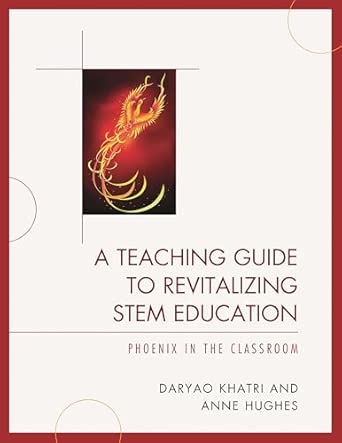
A Teaching Guide to Revitalizing Stem Education: Phoenix in the Classroom
Author(s): Daryao Khatri (Author)
- Publisher: R&L Education
- Publication Date: 13 Nov. 2012
- Language: English
- Print length: 128 pages
- ISBN-10: 9781610484480
- ISBN-13: 1610484487
Book Description
By reading and using A Teaching Guide to Revitalizing STEM Education, educators will rediscover how to streamline the subject matter— math, physics, statistics, and organic chemistry—by eliminating unnecessary difficulties and distractions from course textbooks. A useful guide for both high school teachers and postsecondary faculty, this book explains how to organize, arrange, and streamline STEM content so that it is approachable, understandable, and applicable for students. Likewise, this guide discusses important classroom management skills and pedagogical techniques that will help students master these critical subjects. Providing and explaining over a dozen lesson plans, A Teaching Guide to Revitalizing STEM Education will encourage educators to effectively optimize the recent emphases on science, technology, engineering, and math education.
Editorial Reviews
Review
Organic chemistry has always been a bear with students, who drop out and fail at alarming rates. About four years ago, I had a serious discussion with Dr. Khatri, one of the co-authors of this book, about possible reasons for these rates. We have been working on this problem for over three years, and we have actually found a solution to it.
After transposing the course, designing it in parallel, and using the student-friendly inductive approach to teaching, we have completely reversed the failing rate of students. We have achieved a retention and success rate of nearly 85% in organic chemistry I. This is a change from a 35-40% retention and success rate over a period of decades. I do highly recommend this book to everyone teaching chemistry in general–and organic chemistry, in particular–to review this book and use the examples provided as a guide to design their own courses. The use of exit questions and priming homework originated through our work in transposing the organic chemistry course. They are very powerful strategies for achieving high student retention and success rates.
This latest book by Khatri and Hughes utilizes their student-friendly inductive pedagogical techniques in its design. Their recent innovation of presenting problems in parallel is revolutionary, in my opinion. In terms of achieving high retention and successes for students in STEM disciplines, this book can change the teaching landscape forever….I highly recommend this book for everyone teaching a STEM discipline at the high school and college levels. The book contains examples of instructional material for a number of STEM disciplines designed in parallel using the inductive and student-friendly pedagogical techniques. Using these approaches, I have been able to complete entire math courses in less than the prescribed time-frames–and still have all my students with me, and succeeding.
About the Author
Daryao Khatri, PhD, holds a doctorate in physics with emphases on mathematics and computer science from the Catholic University of America, as well as a bachelor’s and Master’s in physics from the University of Delhi, India, from 1966 and 1968 respectively. During 1968-70, Khatri taught at Jamia Millia Islamia, Department of Physics, India. Since 1973, he has taught diverse populations in all classes at the University of District of Columbia in the departments of physics and computer science.
Anne O. Hughes, PhD, began her professional career in an inner-city school on the docks of Baltimore in a split-level class, armed with three courses taken at the local teachers college that proved unusable with virtual non-readers (fourth grade) and accelerated students (third grade). This teaching-learning experience changed her life, encouraging her to earn a Master’s in educational psychology and reading from the University of South Carolina and a doctorate in educational psychology and reading from the University of Chicago. More significantly, it was because of this experience that she has devoted her career to working with poor, minority, and increasingly diverse student populations, whether at the University of Texas, the University of Arizona, the U.S. Department of Education, or most recently at the University of the District of Columbia.