 Wow! eBook
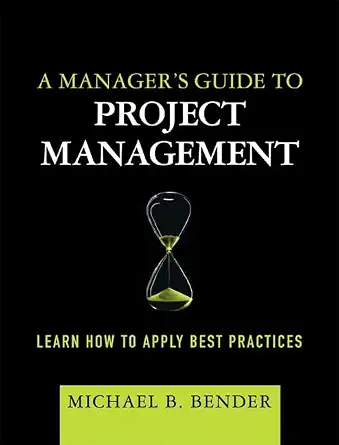
A Manager's Guide to Project Management: Learn How to Apply Best Practices
Author(s): Michael B. Bender (Author)
- Publisher: Ft Pr
- Publication Date: January 1, 2009
- Edition: 1st
- Language: English
- Print length: 289 pages
- ISBN-10: 0137136900
- ISBN-13: 9780137136902
Book Description
There are plenty of books about project management, but this is the first one written for the people who have the most at stake: the senior executives who will ultimately be held accountable for the successes of the projects they approve and supervise. Top enterprise project management expert Michael Bender explains project management from the perspective that matters most to executives: adding value. Most books view project management from the inside, focusing primarily on lower-level issues, such as the creation of Work Breakdown Structures. A Manager's Guide to Project Management views it from above, explaining how project managers can best achieve the strategic goals of the business; the executive's role in successful project management; and the tools available to executives who want to gain greater value from project management. Drawing on his extensive experience, Bender shows how to: make sure project and enterprise goals align; structure organizations to support more effective project communication and decision making; integrate project processes with other organizational processes; oversee projects more effectively. This book contains a full section on understanding and managing projects as capital investments, including detailed coverage of building balanced project portfolios. Bender concludes with a sophisticated discussion of managing projects in global environments and optimizing resources where multiple projects must be managed.
Editorial Reviews
About the Author
MICHAEL B. BENDER, PMP, is founder and CEO of Ally Business Developers, a consortium of world-class business, organizational, and professional development experts. Benders project/program management experience spans 30 years and several continents. He has applied his technical, leadership, and managerial skills to projects including the Hubble Space Telescope; NEXRAD (Next Generation Weather Radar); and air traffic control systems for the United States, UK, and Taiwan. Bender is a speaker for the American Management Association (AMA) and Global Knowledge, and a guest speaker at DePaul University and the Project Management Institute. He has authored many AMA project management seminars and recently completed a study of best practices in multiproject management.
Excerpt. © Reprinted by permission. All rights reserved.
A Manager’s Guide to Project Management: Learn How to Apply Best Practices
Preface
Project Management Is a Value Strategy
Value. That term has taken on new importance in the last few months. As I sit here writing this preface, the Dow Jones Industrial Average has been down for the previous eight days, down some 2,000 points since the United States Congress passed the $700 billion economic recovery bill, and some 35 percent from its peak only about a year ago.
This “economic event” was caused partly by derivatives, instruments that derive their value from some other instrument that has value. Derivatives appear to serve two purposes: 1) to offer alternative methods for exchanging an instrument with intrinsic value (futures and options, for example) and 2) to disguise the true value of the instrument, to sell it for more than it’s worth (in this case, mortgage securities). According to reports, companies have hired mathematicians and physicists to develop derivatives of such instruments. Now the United States Treasury is considering buying these instruments (called “toxic mortgage securities” by some newspeople) because no one knows what they’re worth. The Federal Reserve Bank (the “Fed”) is planning to take equity interest on some banks, to help finance banks holding such instruments.
Value. Perhaps it’s coincidental—or perhaps it’s fate—that this book was published shortly after these events. The reason: the core theme for this book is that projects and project management add value to an organization.
Adding value to an organization is the only reason to engage in a project or in project management.
My quest in this book is not just to present project management—enough books cover that. My quest involves the next steps in project management evolution: to offer you, the executive, ideas, tools, and concepts to improve project management to increase the value of your organization.
The Project Manager’s Secret Society
Project management is an extremely well-defined discipline. Inside the discipline is a suite of tools designed to conquer any challenge. Enough books have been written about project management to fill a small library. Sadly, however, the pundits have failed in one very important area—to communicate our wisdom and needs to the rest of the world. To outsiders, project management is still a secret. These pundits have focused only on the discipline itself, finding yet another way to describe the ubiquitous work breakdown structure (WBS) or embellish even more on scope definition or risk management. We have enough books that teach project managers how to run projects.
As we browse the library of project management books, we find a small and dreary section: the section that looks outward from project management to embrace those not directly involved in the discipline—what project managers call stakeholders. This book’s theme is based on the value of projects and project management. This theme is certainly not new—the book’s target audience, however, is.
This book is designed for executive managers, the group that has the most influence on and control over projects and project managers. This group defines which projects should be done, which should be cancelled, and how project management should be implemented. Yet for all its influence, this group has been neglected in literature for too long.
This book is designed for you, the executive manager. I tear down the walls that hide the secret society. You will see how project managers put plans together to achieve your goals. I present your role in projects and project management, and I give you tools to handle those roles. I help you to successfully implement project management in your organization, whether you’re a for-profit or not-for-profit organization.
Because the only purpose for a project is to add value, I also show you how to add real value to your organization.
How to Use This Book
This book is designed both as a straight read-through and as a reference book. It builds on concepts continuously throughout the text. If you’re reading Chapter 4, I assume that you’re familiar with the material in Chapters 1–3. I attempt to cite where you can find previously presented material, where reasonable.
The book is a high-level “how-to” book. It presents concepts and tools, and then suggests how to implement such concepts and tools. It is not a detailed “how-to” book; it does not contain all the details you need for implementation. For that, I would need several volumes. Besides, you have subject matter experts that work for you. If they have been well trained, if you give them clear direction, and if you work with them, you cannot fail.
Consider this book a consultant, an advisor. As a consultant or advisor, I can offer only ideas, tools, and concepts.
I can lead a horse to a watering trough. I can show the horse the water. I can point the horse’s head toward the desert we’re both about to enter, but I can’t make that horse drink that water.
You, the executive, must decide what to do with these ideas and tools. You can take a glib approach (not recommended) and half-apply the ideas, with little understanding. Just don’t blame me or project management when it fails. You can take this book at face value (also not recommended), implement it exactly as written, and then later discover that different people do things differently. You can challenge every concept in this book (highly recommended), knowing that the additional thought processes will foster your understanding and enable you to implement the concepts and tools your way. Or you can delegate this book to someone else within your organization. (Okay, as long as you delegate it to the right person—and, of course, that you buy another copy.) The choice is yours.
Read this book. Study it. Bounce its ideas off your own experience, your own management style, your own perspective, and your subject experts. If you do that, whatever your decisions are, your organization will be better—and we will have done our job.
The Book’s Layout and Roadmap
This book is divided into parts, each containing two or more chapters. Each part has a core theme, with the underlying chapters providing supporting details. We provide the outline here.
Part I: “Understanding Projects and Project Management”
This part provides a foundation on project and project management that’s necessary to develop advanced concepts.
Theme: Project management, when supported, already defines sufficient tools and techniques to achieve project success.
This part includes three chapters:
?Chapter 1: "The Goals of Project Management"
Chapter 2: “Project Management Framework and Structure”
Chapter 3: “Project Definition and Planning”
Part II: “Aligning Project Management with the Organization”
Part II examines the role of project management in the organization and presents tools and concepts to successfully integrate it with other organizational activities. Integration is achieved through alignment, thus gaining buy-in and improving organizational efficiency.
Theme: Projects are not ancillary activities to our real jobs; they are an integral part of all organizations.
This section includes four chapters. The first two focus on strategic alignment, making sure that your project’s goals align with the organization’s goals. The third takes an organizational focus: defining organizational structures designed to align communication and decision making. The fourth focuses on project activities themselves, concentrating on integrating and aligning project processes with other organizational processes.
Chapter 4: “Strategic Alignment”
Chapter 5: “A Framework for Strategic Alignment”
Chapter 6: “Organizational Alignment”
Chapter 7: “Process Alignment”
Part III: “Project Management Oversight”
Part III develops concepts and tools to help you make sure your projects are running correctly.
Theme: As with all organizational disciplines, project management must be managed.
This part contains three chapters, each building on the previous to develop a complete system for oversight.
Chapter 8: “Project Cost Management”
Chapter 9: “Project Oversight”
Chapter 10: “Project Management Oversight”
Part IV: “Projects as Capital Investments”
Part IV expands on the concept that projects add value and are capital investments.
Theme: Projects are capital investments.
This part contains three chapters. The first focuses on financial benefits and presents the basic building blocks for a balanced portfolio. The second chapter builds on these concepts, recognizing that not all benefits are financial and develops a balanced portfolio. The third chapter demonstrates how you might apply the different techniques in different situations.
Chapter 11: “Projects as Capital Investments”
Chapter 12: “Developing a Balanced Portfolio”
Chapter 13: “Balanced Portfolio Techniques in Action”
Part V: “Globalization and Resource Optimization”
Part V builds on the concepts in all earlier sections to develop advanced concepts for dealing with globalization, strategic outsourcing, and multiproject resource optimization.
Theme: Globalization and advanced techniques enable us to optimize resources.
This part contains two chapters:
Chapter 14: “Globalization and Strategic Outsourcing”
Chapter 15: “Optimizing Resources in a Multiproject Environment”
© Copyright Pearson Education. All rights reserved.


