Wow! eBook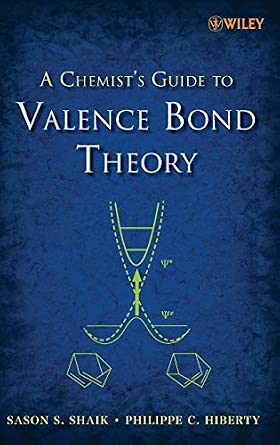
A Chemist's Guide to Valence Bond Theory
Author(s): Sason S. Shaik (Author), Philippe C. Hiberty (Author)
- Publisher: Wiley-Interscience
- Publication Date: 21 Dec. 2007
- Edition: 1st
- Language: English
- Print length: 336 pages
- ISBN-10: 9780470037355
- ISBN-13: 0470037350
Book Description
Editorial Reviews
Review
From the Inside Flap
Modern valence bond theory and state-of-the-art methodologies
Since the 1980s, valence bond (VB) theory has enjoyed a renaissance characterized both in the qualitative application of the theory and in the development of new methods for its computer implementation. Written by leading authorities, this is the premier reference on current VB theory and applications in a pedagogical context, perhaps the first such attempt since Pauling’s The Nature of the Chemical Bond. After an introduction, A Chemist’s Guide to Valence Bond Theory pre-sents a practical system that can be applied to a variety of chemical problems in a uniform manner. Concise yet comprehensive, it includes:
-
A tour of some VB outputs and terminology
-
An explanation of basic VB theory
-
A discussion of various applications of the VB method to chemical problems, encompassing bonding problems, aromaticity and antiaromaticity, the dioxygen molecule, polyradicals, excited states, organic reactions, inorganic/organometallic reactions, photochemical reactions, and catalytic reactions
-
Samples of inputs/outputs and instructions for interpreting results
-
A short programmable outline for converting molecular orbital wave functions to VB structures
-
A guide for performing VB calculations
Complete with exercises and answers at the end of chapters, numerous solved problems, and a glossary of terms and symbols, this is the authoritative guide for computational chemists, chemical physicists, and research chemists in organic and organometallic/inorganic chemistry concerned with reactivity and molecular structure. It is also an excellent text for advanced undergraduate and graduate students.
From the Back Cover
Modern valence bond theory and state-of-the-art methodologies
Since the 1980s, valence bond (VB) theory has enjoyed a renaissance characterized both in the qualitative application of the theory and in the development of new methods for its computer implementation. Written by leading authorities, this is the premier reference on current VB theory and applications in a pedagogical context, perhaps the first such attempt since Pauling’s The Nature of the Chemical Bond. After an introduction, A Chemist’s Guide to Valence Bond Theory pre-sents a practical system that can be applied to a variety of chemical problems in a uniform manner. Concise yet comprehensive, it includes:
-
A tour of some VB outputs and terminology
-
An explanation of basic VB theory
-
A discussion of various applications of the VB method to chemical problems, encompassing bonding problems, aromaticity and antiaromaticity, the dioxygen molecule, polyradicals, excited states, organic reactions, inorganic/organometallic reactions, photochemical reactions, and catalytic reactions
-
Samples of inputs/outputs and instructions for interpreting results
-
A short programmable outline for converting molecular orbital wave functions to VB structures
-
A guide for performing VB calculations
Complete with exercises and answers at the end of chapters, numerous solved problems, and a glossary of terms and symbols, this is the authoritative guide for computational chemists, chemical physicists, and research chemists in organic and organometallic/inorganic chemistry concerned with reactivity and molecular structure. It is also an excellent text for advanced undergraduate and graduate students.
About the Author
Philippe C. Hiberty is Director of Research at the Centre National de la Recherche Scientifique (CNRS) and a member of the Theoretical Chemistry Group in the Laboratoire de Chimie Physique at the?University of Paris-Sud. He taught quantum chemistry for years at the Ecole Polytechique in Palaiseau. He received the Grand Prix Philippe A. Guye from the French Academy of Sciences in 2002. Under the supervision of Professor Lionel Salem, he devoted his PhD to building a bridge between MO and VB theories by devising a method for mapping MO wave functions to VB ones. In collaboration with Professor Sason Shaik, he applied VB theory to fundamental concepts of organic chemistry such as aromaticity, hypervalence, odd-electron bonds, prediction of reaction barriers from properties of reactants and products, and so on. He is the originator of the Breathing-Orbital Valence Bond method, which is aimed at combining the lucidity of compact VB wave functions with a good accuracy of the energetics.