Wow! eBook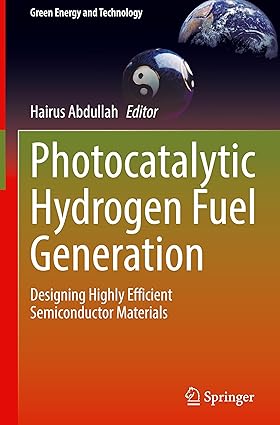
Photocatalytic Hydrogen Fuel Generation: Designing Highly Efficient Semiconductor Materials (Green Energy and Technology)
by: Hairus Abdullah (Editor)
Publisher: Springer
Publication Date: 2025-03-09
Language: English
Print Length: 324 pages
ISBN-10: 9819619203
ISBN-13: 9789819619207
Book Description
This book highlights crucial parameters and strategies in photocatalytic water splitting. The process utilizes light energy to drive the separation of water into hydrogen and oxygen with the help of a photocatalyst. The efficiency and performance of catalytic activities are determined by various parameters supported by material characterizations. Commonly, the catalytic performances in visible-light photocatalytic water splitting are governed by bandgap energy, surface area, crystal structure, charge carrier dynamics, catalyst loading, cocatalyst, pH of solution, and reaction temperatures. However, covering all the requirements to obtain a highly efficient catalytic activity is an impossible task. Some recent strategies with promising results have been explored to improve and optimize the catalytic properties. In addition, various techniques for catalytic material characterizations, such as XRD, SEM, TEM, XPS, XANES, EXALFS, TRPL, TPC, EIS, and CV analysis, are also discussed. Finally, some related perspectives and outlook are discussed for future development.
Editorial Reviews
This book highlights crucial parameters and strategies in photocatalytic water splitting. The process utilizes light energy to drive the separation of water into hydrogen and oxygen with the help of a photocatalyst. The efficiency and performance of catalytic activities are determined by various parameters supported by material characterizations. Commonly, the catalytic performances in visible-light photocatalytic water splitting are governed by bandgap energy, surface area, crystal structure, charge carrier dynamics, catalyst loading, cocatalyst, pH of solution, and reaction temperatures. However, covering all the requirements to obtain a highly efficient catalytic activity is an impossible task. Some recent strategies with promising results have been explored to improve and optimize the catalytic properties. In addition, various techniques for catalytic material characterizations, such as XRD, SEM, TEM, XPS, XANES, EXALFS, TRPL, TPC, EIS, and CV analysis, are also discussed. Finally, some related perspectives and outlook are discussed for future development.