 Wow! eBook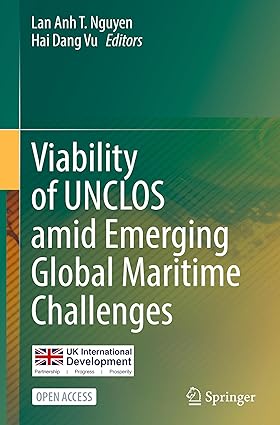
Viability of UNCLOS amid Emerging Global Maritime Challenges
by: Lan Anh T. Nguyen (Editor), Hai Dang Vu (Editor)
Publisher: Springer
Edition: 2025th
Publication Date: 2024-11-24
Language: English
Print Length: 217 pages
ISBN-10: 9819758378
ISBN-13: 9789819758371
Book Description
This open access book assesses UNCLOS’ resilience and vitality as a legal framework for addressing emerging global maritime challenges. Against the backdrop of a number of emerging global maritime challenges, including the rise of sea levels and the maintenance of maritime safety and connectivity, the preservation of marine biodiversity of areas beyond national jurisdiction, and the promotion of marine scientific research, a contention has been made that UNCLOS does not provide sufficient or efficient regulation, and therefore, that countries should negotiate new legal provisions to complement or replace UNCLOS. Within this context, in the first part of the book, UNCLOS as a general well-established legal framework is reviewed. In the part that follows, an analysis of the positive points, limitations, and shortcomings of UNCLOS provisions in specific areas such as navigation rights, sea level rise, marine scientific research, and BBNJ is provided. The book goes on to a more individualized analysis and offers suggestions regarding the application of legal frameworks in UNCLOS to promote cooperation and manage maritime challenges in the South China Sea, an area where UNCLOS is often interpreted and applied with considerable variation. The book serves as a distinctive resource for practitioners, researchers, lecturers, and students in international and maritime law. It is also a valuable reference for policymakers and government advisors who want to get a thorough understanding of the developments of UNCLOS.
Editorial Reviews
This open access book assesses UNCLOS’ resilience and vitality as a legal framework for addressing emerging global maritime challenges. Against the backdrop of a number of emerging global maritime challenges, including the rise of sea levels and the maintenance of maritime safety and connectivity, the preservation of marine biodiversity of areas beyond national jurisdiction, and the promotion of marine scientific research, a contention has been made that UNCLOS does not provide sufficient or efficient regulation, and therefore, that countries should negotiate new legal provisions to complement or replace UNCLOS. Within this context, in the first part of the book, UNCLOS as a general well-established legal framework is reviewed. In the part that follows, an analysis of the positive points, limitations, and shortcomings of UNCLOS provisions in specific areas such as navigation rights, sea level rise, marine scientific research, and BBNJ is provided. The book goes on to a more individualized analysis and offers suggestions regarding the application of legal frameworks in UNCLOS to promote cooperation and manage maritime challenges in the South China Sea, an area where UNCLOS is often interpreted and applied with considerable variation. The book serves as a distinctive resource for practitioners, researchers, lecturers, and students in international and maritime law. It is also a valuable reference for policymakers and government advisors who want to get a thorough understanding of the developments of UNCLOS.


