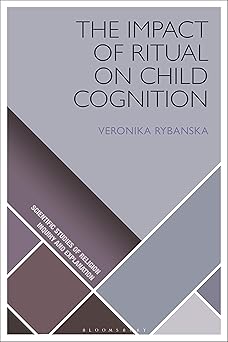
The Impact of Ritual on Child Cognition (Scientific Studies of Religion: Inquiry and Explanation)
by: Veronika Rybanska (Author),D. Jason Slone(Series Editor),Donald Wiebe(Series Editor),Luther H. Martin(Series Editor),Radek Kundt(Series Editor),William W. McCorkle Jr.(Series Editor)&5more
Publisher: Bloomsbury Academic
Publication Date: 2020/1/9
Language: English
Print Length: 216 pages
ISBN-10: 135010891X
ISBN-13: 9781350108912
Book Description
In this book, Veronika Rybanska explores how ritual participation affects the cognitive abilities of children. Rybanska argues that, far from being a simple matter of mindless copying, ritual participation in childhood requires rigorous computation by cognitive mechanisms. In tu, this computation can improve a child’s ‘executive functioning’: a set of cognitive skills that are essential for successful cognitive, social and psychological development. After providing a critique of existing literature on religion and ritual, Rybanska presents a new interdisciplinary approach that draws from anthropology, psychology and cognitive neuroscience. Using cross-cultural examples, including a comparison between Melanesian culture and Weste culture, Rybanska shows that some of the most socially important effects of rituals seem to be universal. The implications of this research suggest that we should rethink multiple aspects of child-rearing and educational policy, and shows that the presence of some form of ritual during childhood could have positive evolutionary benefits.
About the Author
In this book, Veronika Rybanska explores how ritual participation affects the cognitive abilities of children. Rybanska argues that, far from being a simple matter of mindless copying, ritual participation in childhood requires rigorous computation by cognitive mechanisms. In tu, this computation can improve a child’s ‘executive functioning’: a set of cognitive skills that are essential for successful cognitive, social and psychological development. After providing a critique of existing literature on religion and ritual, Rybanska presents a new interdisciplinary approach that draws from anthropology, psychology and cognitive neuroscience. Using cross-cultural examples, including a comparison between Melanesian culture and Weste culture, Rybanska shows that some of the most socially important effects of rituals seem to be universal. The implications of this research suggest that we should rethink multiple aspects of child-rearing and educational policy, and shows that the presence of some form of ritual during childhood could have positive evolutionary benefits.