 Wow! eBook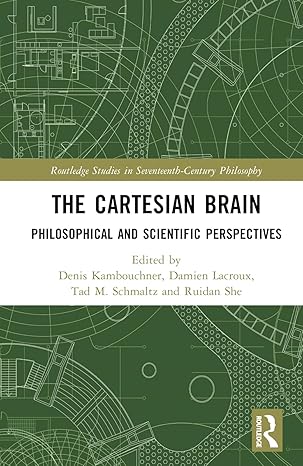
The Cartesian Brain (Routledge Studies in Seventeenth-Century Philosophy)
by: Denis Kambouchner (Editor),Damien Lacroux (Editor),Tad M. Schmaltz (Editor),Ruidan She (Editor)&1more
Publisher:
Edition: 1st
Publication Date: 2024/9/23
Language: English
Print Length: 292 pages
ISBN-10: 1032545658
ISBN-13: 9781032545653
Book Description
This volume presents new research on Cartesian psychophysiology that combines historical and textual analysis with a consideration of recent advances in contemporary neuroscience research. It seeks to explain why the Cartesian theory of the brain and its communication with the mind still offer a remarkable model for cognitive studies.New research in the philosophy of mind and cognitive science has reignited interest in the role and the structure of the “Cartesian brain” among scholars of Descartes. This volume rethinks Cartesian psychology from the perspective of physiology, with the aim of redetermining the contributions of the brain and central nervous system to mental phenomena. The first part of the volume conces the details of Descartes’s own physiological account of the brain. The discussion covers his treatment not only of the anatomy of the brain but also of the mode of interaction between mind and body, in which the pineal gland plays a central role, and of the relation between the brain and the rest of the body. The second part considers the reception and legacy of the Cartesian brain. The focus here is on understanding how Cartesian psychophysiology was received by Descartes’s early mode contemporaries and immediate successors, as well as on the relevance of the Cartesian brain for contemporary neurophysiology and cognitive science.The Cartesian Brain is an essential resource for scholars and advanced students interested in Descartes, history of philosophy, history of science, philosophy of mind, and cognitive science.
About the Author
This volume presents new research on Cartesian psychophysiology that combines historical and textual analysis with a consideration of recent advances in contemporary neuroscience research. It seeks to explain why the Cartesian theory of the brain and its communication with the mind still offer a remarkable model for cognitive studies.New research in the philosophy of mind and cognitive science has reignited interest in the role and the structure of the “Cartesian brain” among scholars of Descartes. This volume rethinks Cartesian psychology from the perspective of physiology, with the aim of redetermining the contributions of the brain and central nervous system to mental phenomena. The first part of the volume conces the details of Descartes’s own physiological account of the brain. The discussion covers his treatment not only of the anatomy of the brain but also of the mode of interaction between mind and body, in which the pineal gland plays a central role, and of the relation between the brain and the rest of the body. The second part considers the reception and legacy of the Cartesian brain. The focus here is on understanding how Cartesian psychophysiology was received by Descartes’s early mode contemporaries and immediate successors, as well as on the relevance of the Cartesian brain for contemporary neurophysiology and cognitive science.The Cartesian Brain is an essential resource for scholars and advanced students interested in Descartes, history of philosophy, history of science, philosophy of mind, and cognitive science.


