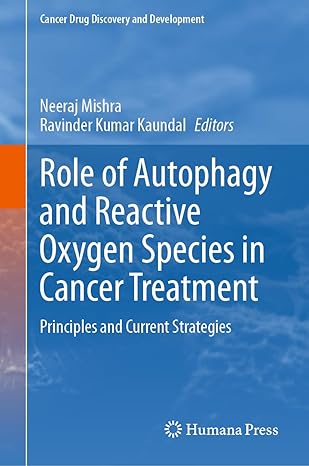
Role of Autophagy and Reactive Oxygen Species in Cancer Treatment: Principles and Current Strategies (Cancer Drug Discovery and Development)
by: Neeraj Mishra (Editor),Ravinder Kumar Kaundal (Editor)
Publisher: Humana
Edition: 2024th
Publication Date: 2024/9/2
Language: English
Print Length: 380 pages
ISBN-10: 3031664205
ISBN-13: 9783031664205
Book Description
Autophagy is a catabolic process that eliminates damaged and faulty cellular components via lysosomes. It responds to adverse circumstances like nutritional deficiency, hypoxia, and oxidative damage. Reactive oxygen species (ROS) cause oxidative stress, which is a multidimensional chemical that drives various pathophysiological diseases, including cancer. In addition, the autophagy process has a double role, first preventing tumour formation, but later fostering tumour progression. A growing body of research suggests that autophagy and ROS have a complex interplay in which they can either prevent cancer growth or enhance disease genesis. While a combination of autophagy inhibitor and cytotoxic medicines is now being used in cancer treatment, investigating the potential of autophagy inhibitors for overcoming resistance to different anticancer medications and how this relates to the control of cancer micro environmental stressors raises several questions. Autophagy’s dual functions as a safeguarding and cytotoxic process have drawn attention to its significance in the development of cancer.
About the Author
Autophagy is a catabolic process that eliminates damaged and faulty cellular components via lysosomes. It responds to adverse circumstances like nutritional deficiency, hypoxia, and oxidative damage. Reactive oxygen species (ROS) cause oxidative stress, which is a multidimensional chemical that drives various pathophysiological diseases, including cancer. In addition, the autophagy process has a double role, first preventing tumour formation, but later fostering tumour progression. A growing body of research suggests that autophagy and ROS have a complex interplay in which they can either prevent cancer growth or enhance disease genesis. While a combination of autophagy inhibitor and cytotoxic medicines is now being used in cancer treatment, investigating the potential of autophagy inhibitors for overcoming resistance to different anticancer medications and how this relates to the control of cancer micro environmental stressors raises several questions. Autophagy’s dual functions as a safeguarding and cytotoxic process have drawn attention to its significance in the development of cancer.