Wow! eBook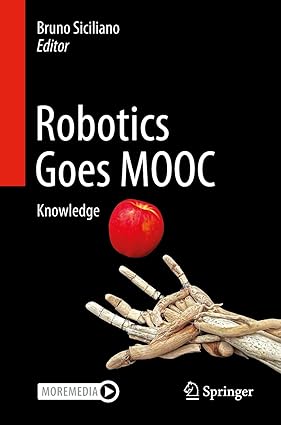
Robotics Goes MOOC: Knowledge
by: Bruno Siciliano (Editor)
Publisher: Springer
Edition: 2024th
Publication Date: 2025-06-14
Language: English
Print Length: 307 pages
ISBN-10: 3319740946
ISBN-13: 9783319740942
Book Description
The robot “concept” was clearly established by those many creative historical realizations, such as those recalled above. Nonetheless, the emergence of the “physical” robot had to await the advent of its underlying technologies of mechanics, controls, computers, electronics and sensors ―in one word, mechatronics― during the course of the twentieth century. As always, new designs motivate new research and discoveries which, in turn, lead to enhanced solutions and thus to novel concepts. This virtuous circle over time produced that knowledge and understanding which gave birth to the field of Robotics, properly referred to as the science and technology of robots.To make robots and intelligent machines useful to humans it is necessary to have a broad and tight intersection between Robotics and AI. Sophisticated mathematical models are needed that enable the robot from a physical point of view, as well as intelligent algorithms capable of correlating all the information coming from the use of technologically advanced sensors with the data available from experience. It is expected that the synergy of model-based techniques with data-driven approaches will contribute to increasing the level of autonomy of robots and intelligent machines in the near future.The first book of the Robotics Goes MOOC project starts with the journey of robotics in the introductory chapter by Khatib, who has pioneered our field of robotics and has ferried it to the third millennium. Sensing is crucial for the development of intelligent and autonomous robots, as covered in Chapter 2 by Nüchter et al. Model-based control is dealt with in Chapter 3 by Kröeger et al along with motion planning, as well as in Chapter 4 by Villani and Chapter 5 by Chaumette to handle force and visual feedback, respectively, when interacting with the environment. Resorting to AI techniques is the focus of the last part of the book, namely, Chapter 6 by Peters et al on Learning, Chapter 7 byBeetz et al on knowledge representation and reasoning, and Chapter 8 by Burgard et al on graph-based SLAM.
Editorial Reviews
The robot “concept” was clearly established by those many creative historical realizations, such as those recalled above. Nonetheless, the emergence of the “physical” robot had to await the advent of its underlying technologies of mechanics, controls, computers, electronics and sensors ―in one word, mechatronics― during the course of the twentieth century. As always, new designs motivate new research and discoveries which, in turn, lead to enhanced solutions and thus to novel concepts. This virtuous circle over time produced that knowledge and understanding which gave birth to the field of Robotics, properly referred to as the science and technology of robots.To make robots and intelligent machines useful to humans it is necessary to have a broad and tight intersection between Robotics and AI. Sophisticated mathematical models are needed that enable the robot from a physical point of view, as well as intelligent algorithms capable of correlating all the information coming from the use of technologically advanced sensors with the data available from experience. It is expected that the synergy of model-based techniques with data-driven approaches will contribute to increasing the level of autonomy of robots and intelligent machines in the near future.The first book of the Robotics Goes MOOC project starts with the journey of robotics in the introductory chapter by Khatib, who has pioneered our field of robotics and has ferried it to the third millennium. Sensing is crucial for the development of intelligent and autonomous robots, as covered in Chapter 2 by Nüchter et al. Model-based control is dealt with in Chapter 3 by Kröeger et al along with motion planning, as well as in Chapter 4 by Villani and Chapter 5 by Chaumette to handle force and visual feedback, respectively, when interacting with the environment. Resorting to AI techniques is the focus of the last part of the book, namely, Chapter 6 by Peters et al on Learning, Chapter 7 byBeetz et al on knowledge representation and reasoning, and Chapter 8 by Burgard et al on graph-based SLAM.