 Wow! eBook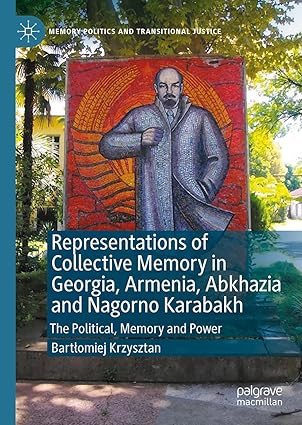
Representations of Collective Memory in Georgia, Armenia, Abkhazia and Nagorno Karabakh: The Political, Memory and Power (Memory Politics and Transitional Justice)
by: Bartłomiej Krzysztan (Author)
Publisher: Palgrave Macmillan
Publication Date: 2024-11-30
Language: English
Print Length: 359 pages
ISBN-10: 303162288X
ISBN-13: 9783031622885
Book Description
The book is a unique proposal for an integral description of memory regimes in the South Caucasus region, covering both the independent states of Armenia and Georgia, but also the separatist entities created as a result of the turbulent changes of the early 1990s – Abkhazia and Nagorno-Karabakh. Being a transdisciplinary proposal, encompassing the perspectives of political science, history and social anthropology, the book may be of interest to researchers from different academic disciplines. At the same time, due to its narrative form, it can also be an interesting proposal for students of eastern studies, allowing for a fuller understanding of the dynamics of political change in the post-Soviet space. The comprehensive and integral approach to the issue of analysing and interpreting collective memory through the prism of its representation, presented in the form of an anthropological story based on case studies, may also be of interest to those not associated with institutional Academia.
Editorial Reviews
The book is a unique proposal for an integral description of memory regimes in the South Caucasus region, covering both the independent states of Armenia and Georgia, but also the separatist entities created as a result of the turbulent changes of the early 1990s – Abkhazia and Nagorno-Karabakh. Being a transdisciplinary proposal, encompassing the perspectives of political science, history and social anthropology, the book may be of interest to researchers from different academic disciplines. At the same time, due to its narrative form, it can also be an interesting proposal for students of eastern studies, allowing for a fuller understanding of the dynamics of political change in the post-Soviet space. The comprehensive and integral approach to the issue of analysing and interpreting collective memory through the prism of its representation, presented in the form of an anthropological story based on case studies, may also be of interest to those not associated with institutional Academia.


