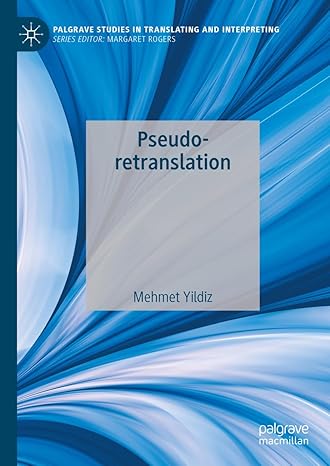
Pseudo-retranslation (Palgrave Studies in Translating and Interpreting)
by: Mehmet Yildiz (Author)
Publisher: Palgrave Macmillan
Edition: 2024th
Publication Date: 2024/8/17
Language: English
Print Length: 163 pages
ISBN-10: 3031645138
ISBN-13: 9783031645136
Book Description
This book presents pseudo-retranslations as a new phenomenon of translational intertextuality, revealing how pseudo-retranslations establish large networks of intertextuality across academic works, how academic authors have recourse to this procedure as they create their academic texts, and how pseudo-retranslations contribute to the dissemination of translation-distorted scholarly knowledge and lead to epistemically polluted academic ecosystems. Pseudo-retranslation can be defined as an academic author’s partial or complete exploitation of another academic author’s translation and presenting it as a retranslation of the source text. This phenomenon, first documented in Yildiz (2021), arises from academic authors’ failure to refer to or translate primary sources – particularly in English. Since there occurs no actual retranslation process, this procedure is called pseudo-retranslation. Using a range of academic texts from the Turkish context as case studies, the author presents the integral constituents of this phenomenon, and the behavioural pattes of its renderers. This book will be of particular interest to academics and postgraduates in the field of translation studies and (corpus) linguistics.
About the Author
This book presents pseudo-retranslations as a new phenomenon of translational intertextuality, revealing how pseudo-retranslations establish large networks of intertextuality across academic works, how academic authors have recourse to this procedure as they create their academic texts, and how pseudo-retranslations contribute to the dissemination of translation-distorted scholarly knowledge and lead to epistemically polluted academic ecosystems. Pseudo-retranslation can be defined as an academic author’s partial or complete exploitation of another academic author’s translation and presenting it as a retranslation of the source text. This phenomenon, first documented in Yildiz (2021), arises from academic authors’ failure to refer to or translate primary sources – particularly in English. Since there occurs no actual retranslation process, this procedure is called pseudo-retranslation. Using a range of academic texts from the Turkish context as case studies, the author presents the integral constituents of this phenomenon, and the behavioural pattes of its renderers. This book will be of particular interest to academics and postgraduates in the field of translation studies and (corpus) linguistics.